Soft Corals — What They Are and What You Need to Know Before Your First Purchase
Soft Corals — What They Are and What You Need to Know Before Your First Purchase
In the reef aquarium, corals are divided into three main groups: soft corals, LPS, and SPS. The division is not arbitrary — it reflects genuine biological differences that directly affect what conditions a coral needs and how it responds to mistakes.
Soft corals are almost always mentioned as the “easiest” group. This is partly true — they tolerate parameter fluctuations better than stony corals, recover quickly from stress, and often grow rapidly. But the label conceals a great deal: the group is biologically heterogeneous, some species can be dangerous to handle, and others demand more than their reputation suggests. This article explains what every hobbyist needs to know before buying their first soft coral.
What Makes a Coral “Soft”
All corals are animals. They consist of polyps — small, cylindrical individuals whose oral opening is surrounded by tentacles. Most reef tank corals live with two simultaneous strategies: their tissue harbours photosynthesising algae, zooxanthellae, which produce energy from light, while the corals also capture plankton with their tentacles.
Soft corals stand apart from other corals in two ways.
No calcified skeleton. Stony corals — LPS and SPS — build a hard limestone skeleton that remains after the animal dies. Soft corals have no such skeleton. Their structure is soft tissue. Most species embed small calcified support structures called sclerites within their tissue, but these do not form a continuous hard mass. This makes soft corals physically flexible: they sway in flow, contract under stress, and recover quickly.
Eight tentacles. Soft corals belong to the class Octocorallia — the octocorals. Every polyp has exactly eight tentacles. Stony corals and anemones have six tentacles or multiples thereof. This is not visible to the naked eye in most species, but it is a fundamental biological distinction.
Practical identification is simple: if the structure is soft, flexible, and contracts under stress without a hard skeleton, it is most likely a soft coral.
Five Main Groups
Soft corals are not a uniform group — they are a collection of very different animals united mainly by soft structure. Five groups are relevant in hobby tanks.
Leather Corals — Sarcophyton, Sinularia, Lobophytum
Leather corals are the most common soft corals in hobby tanks. They are robust, grow quickly, and tolerate parameter fluctuations well.
Sarcophyton is easy to recognise: a thick stalk and a mushroom-cap crown on whose surface polyps open. Colour is typically brownish, cream, or pale green. Typical adult size is 10–30 cm in diameter, larger in some specimens. Sinularia grows finger-like or branch-like lobes. Lobophytum forms plate-like or lobed colonies.
All three genera are chemically active — they release compounds into the water that can interfere with other corals. More on this below.
Sarcophyton has a characteristic behaviour called tissue shedding: the coral closes, its surface turns waxy and yellowish, and the outer layer ultimately detaches. The process lasts from a few days to three weeks. It is not a sign of stress — it is a normal biological process.
Zoanthids and Palythoa — Zoanthus, Palythoa, Protopalythoa
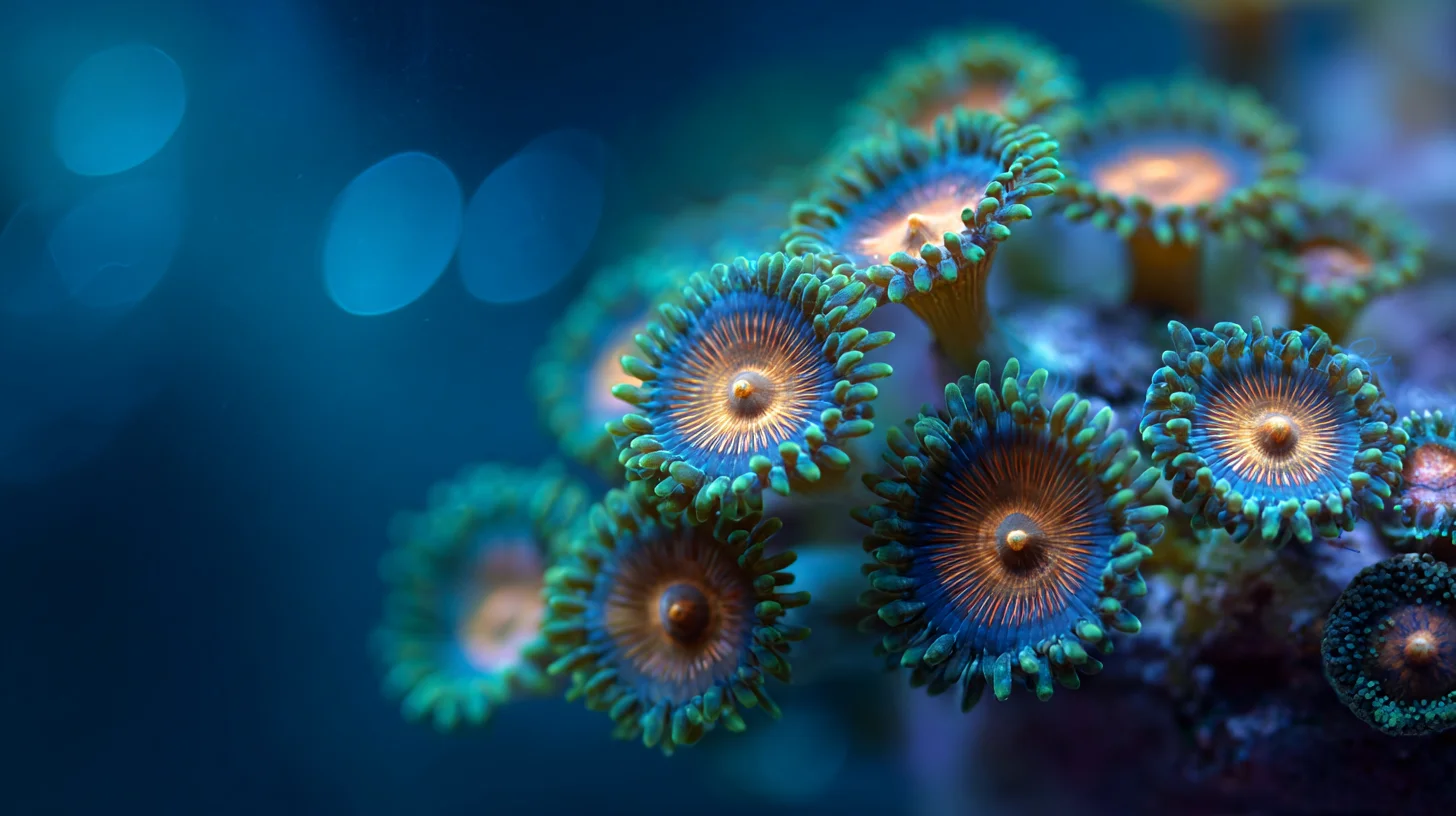
Zoanthids grow as a carpet-like community in which small polyps are connected through shared tissue. The colour range is the broadest of any coral group — almost every colour exists, and rare colour forms can cost hundreds of euros for a single fragment.
Zoanthus species are small-polyped and grow as a dense mat. Palythoa and Protopalythoa are larger-polyped with darker tissue.
The palytoxin warning specifically concerns this group — covered in the next section.
Mushrooms — Discosoma, Rhodactis, Ricordea
Mushrooms are solitary, disc-shaped polyps. They do not form a unified colony as zoanthids do — each individual is separate. Mushrooms reproduce by dividing and can form clusters, but each polyp lives independently.
Discosoma is the most common and most resilient. Flat or slightly undulating in form, wide colour range. Rhodactis is larger and fleshier with more visible tentacles. Ricordea is the most colourful — R. florida from the Caribbean, R. yuma from the Indo-Pacific.
Mushrooms are genuinely low-light animals and suit the lower, shadier sections of the tank.
Pulsing Soft Corals — Xenia, Anthelia
Xenia is unique: its polyps pulse rhythmically, continuously opening and closing their tentacles. No other coral does this spontaneously. Pulsing is also a practical indicator — when the tank’s iodine level is correct, Xenia pulses steadily. When iodine drops, pulsing slows or stops.
Xenia’s biggest problem is invasiveness. It spreads rapidly from surface to surface, covers other corals, and is practically impossible to fully remove once it has spread through the main rockwork. Xenia must be placed on its own isolation rock separate from the main structure — no exceptions.
The same applies to the green star polyp Briareum, which is at the very top of the soft coral invasiveness list.
Gorgonians
Gorgonians grow into a unique fan or bush shape along a flexible axis. They are the most demanding of the soft coral groups.
The most important distinction in hobby tanks is photosynthetic vs. non-photosynthetic. Photosynthetic gorgonians (Eunicea, Plexaura, Pseudopterogorgia) contain zooxanthellae and are reasonably maintainable — they require strong flow and benefit from regular feeding. Non-photosynthetic gorgonians require daily feeding to survive. They belong with more experienced hobbyists.
One absolute rule for all gorgonians: tissue must never be exposed to air. Gorgonian tissue above the waterline dies within minutes.
Palytoxin — A Serious Risk to Know Before Your First Purchase
Many Palythoa and some Zoanthus species contain palytoxin, one of the most toxic naturally occurring compounds known. This is not an exaggeration — palytoxin poisonings have been treated in hospitals around the world, and cases have almost invariably followed handling corals without protective equipment, or heating rocks that carried palythoa.
Mechanism: palytoxin binds to cellular ion pumps and causes ionbalance collapse. Absorbed through skin, it absorbs slowly. Contact with eyes can cause permanent damage. In the respiratory tract — as an aerosol — it is especially dangerous.
Four absolute rules when handling zoanthids or palythoa:
Always use nitrile gloves — a thin disposable glove is not sufficient. Wear eye protection. If water may splash or during propagation, wear an FFP2 mask. Never heat rocks or debris that may carry palythoa — the aerosol is life-threatening.
If you suspect exposure, wash skin thoroughly and seek medical attention. Do not wait for symptoms to appear.
Why “Easiest Group” Is a Misleading Label
Soft corals tolerate more than LPS or SPS — this is true. Parameter fluctuations, temporarily elevated nutrients, inadequate flow — a soft coral survives what a stony coral does not. In that sense they are more forgiving.
But “easy” does not mean “undemanding.” Leather coral Sarcophyton genuinely needs measured light — its light saturation point is higher than most LPS corals. Xenia responds sensitively to iodine fluctuation. Gorgonians require flow and regular feeding. Zoanthids grow so aggressively that they can devastate other tank inhabitants if placement is wrong. And as noted, handling zoanthids requires protective equipment.
Soft corals are a good starting point because mistakes are more forgiving — not because they can be kept without understanding what you are doing.
A second thing worth knowing: soft corals do not belong in every tank. Leather corals release chemical compounds into the water that can interfere with stony corals, particularly SPS. In a tank containing both leather corals and SPS corals, activated carbon use and adequate water changes are essential. Without them, the chemical load from leather corals can gradually weaken stony corals — and the cause may go undetected for weeks.
Summary Table
| Leather corals | Zoanthids | Mushrooms | Xenia | Gorgonians (photo.) | |
|---|---|---|---|---|---|
| Light (PAR) | 150–400 | 80–200 | 50–150 | 100–250 | 50–150 |
| Flow | moderate | moderate | low | moderate | strong |
| Nitrate | 2–15 ppm | 2–15 ppm | 2–15 ppm | 2–15 ppm | 2–15 ppm |
| Phosphate | 0.03–0.10 ppm | 0.03–0.10 ppm | 0.03–0.10 ppm | 0.03–0.10 ppm | 0.03–0.10 ppm |
| Feeding | not needed | benefits | occasionally | not needed | 2–3×/week |
| Special note | tissue shedding, allelopathy | palytoxin, invasiveness | low flow | invasiveness, iodine | flow, no air exposure |
Values are indicative. Species-level variation is considerable — always research individual species requirements before purchase.
Where to Go Next
A deeper article on soft corals covering parameters, allelopathy, nutrition, propagation, and troubleshooting: Soft Corals in the Reef Tank.
Related articles:
- Activated Carbon in the Reef Tank — allelopathy management
- Ozonation in the Reef Tank — organic compound management
- Water Changes in the Reef Tank — the fundamental dilution method
- Laboratory Testing in the Reef Tank — ICP-OES and iodine monitoring
- Lighting in the Reef Tank — PAR measurement in practice
References
1. Peer-Reviewed Studies
- McFadden, C.S., van Ofwegen, L.P. & Quattrini, A.M. (2022). Revisionary systematics of Octocorallia (Cnidaria: Anthozoa) guided by phylogenomics. Bulletin of the Society of Systematic Biologists, 1(3). doi:10.18061/bssb.v1i3.8735
- Kamel, H.N. & Slattery, M. (2005). Terpenoids of Sinularia soft corals: chemistry and bioactivity. Pharmaceutical Biology, 43(3), 253–269.
- Riddle, D. (2006). How Much Light: Analyses of Selected Shallow-Water Invertebrate Light Requirements. Advanced Aquarist. [Sinularia densa light saturation points]
2. Hobbyist Literature and Brand Documentation
- Wood, C. (2024). Reef Chemistry Deep Dive. Captivate Aquaculture / Salem Clemens podcast [transcript, project library]. [Xenia as iodine indicator]
- Optimal Placement of Corals in the Marine Aquarium (2025). Meerwasserforum expert report [project library]. [PAR reference values, allelopathy, placement]
- Reef2Reef Community. Soft coral care guides (2020–2025). reef2reef.com.
- Manta Systems (2025). Balancing Nutrient Levels for Corals. mantasystems.net.
3. Books and Textbooks
- Fabricius, K. & Alderslade, P. (2001). Soft Corals and Sea Fans: A Comprehensive Guide to the Tropical Shallow-Water Genera of the Central-West Pacific, the Indian Ocean and the Red Sea. Australian Institute of Marine Science.
- Borneman, E.H. (2001). Aquarium Corals: Selection, Husbandry, and Natural History. TFH Publications / Microcosm.
- Delbeek, J.C. & Sprung, J. (1994). The Reef Aquarium, Vol. 1. Ricordea Publishing.
- Ruppert, E.E., Fox, R.S. & Barnes, R.D. (2004). Invertebrate Zoology: A Functional Evolutionary Approach, 7th ed. Brooks/Cole.