Coral Cutting and Propagation in Practice — Tools, Techniques, and Recovery
Coral Cutting and Propagation in Practice
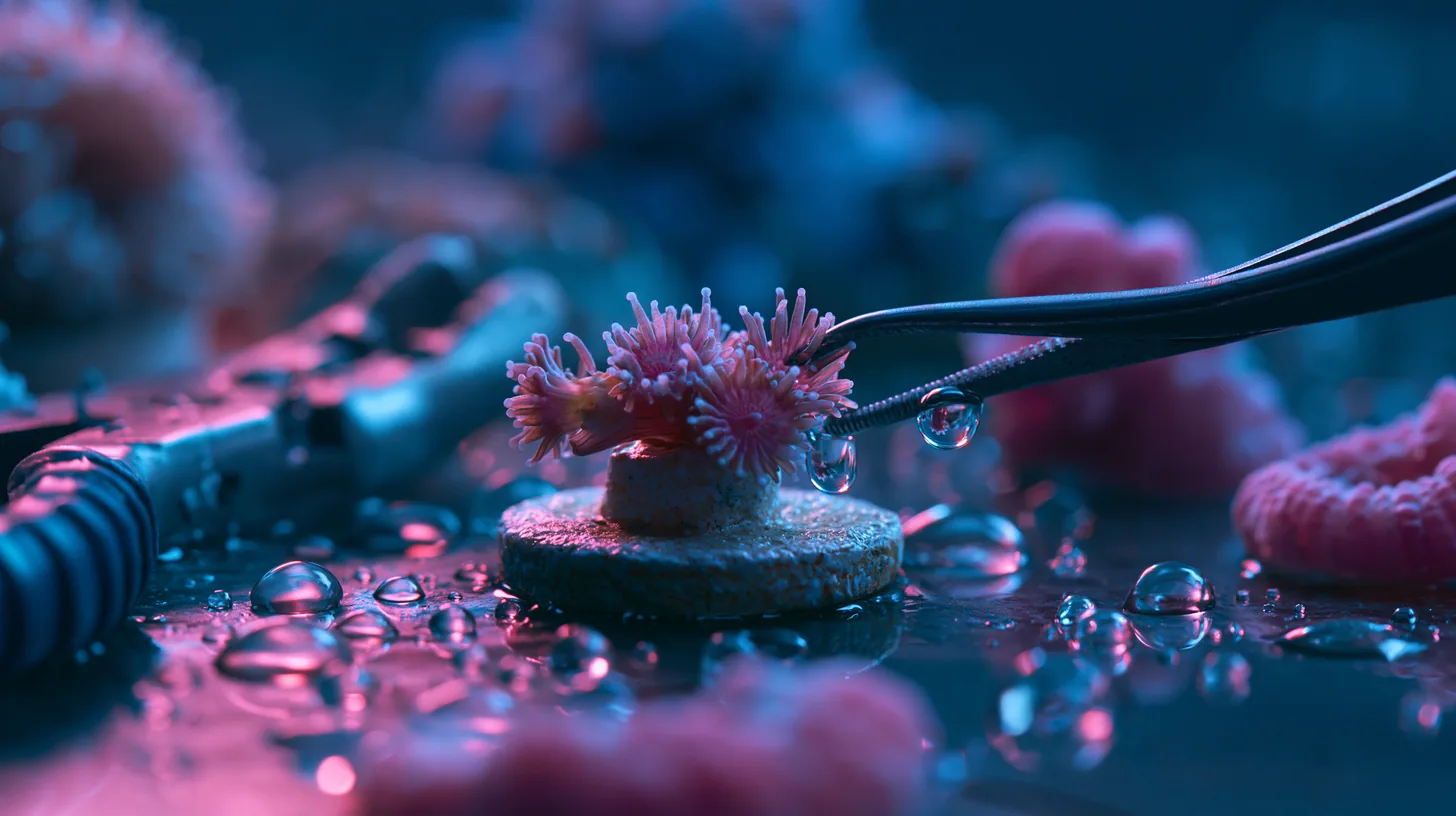
Coral cutting is simply removing a piece from a colony and growing that piece into a new individual. It’s one of the core skills in reef keeping: it lets you control and prune the shape of a colony, trade excess pieces with other hobbyists, and perform rescue operations when part of a coral is damaged.
Cutting isn’t difficult — but it requires the right tools, an understanding of what different corals need, and above all, correct timing. A piece taken from a stressed coral can cause more damage than benefit.
When to Cut — and When Not To
The first rule: the coral must not be stressed before cutting. A recently moved coral, one living in unstable parameters, or a sick specimen is not a good candidate for cutting.
The right moment is when the coral:
- has been actively growing for at least several weeks
- opens fully and normally around the clock
- has been living in stable parameters — alkalinity, calcium, and magnesium consistent
If a coral was recently moved or the tank has gone through a parameter shift, wait at least a few weeks before cutting.
Tools
The right tools make coral cutting a straightforward operation. Poor tools lead to messy cuts, unnecessary stress, and poor adhesion.
Cutters and saws
- Bone cutters — the standard tool for branching SPS corals (acropora, stylophora, seriatopora). Fast and effective. Note: bone cutters produce a shockwave that can knock tissue off the tip of a branch — a dremel is a better choice if cutting out of water.
- Cutting scissors — for soft corals and zoanthids. Sharp, small, easy to handle in wet conditions.
- Dremel with diamond blade — for precise SPS cuts, especially larger colony sections or plating forms (montipora, plating acropora). Cuts through the skeleton cleanly.
- Bandsaw with cooling fluid — for serious LPS cutting. Cooling fluid is tank water with enough iodine added to turn it light amber — the iodine disinfects the cut surface and helps prevent infection.
- Scalpel or razor blade — for soft corals, mushrooms, and zoanthids where precision is needed.
Gluing and attachment
- Cyanoacrylate gel (CA gel) — the only reliable option for underwater attachment. Use the gel form, not liquid — liquid disperses too quickly in water. A quality gel (e.g., BSI IC-GEL) is thicker, doesn’t clog the tip after first use, and cures evenly underwater.
- Accelerator — cures CA gel almost instantly when sprayed on. Especially useful when the gel isn’t bonding well or a piece is awkward to hold in position.
- Plugs — rough, porous surface adheres far better than smooth. Ceramic or concrete-surfaced plugs are clearly superior to smooth plastic plugs — coral encrusts faster and glue bonds better to an irregular surface.
Work area
- A small container filled with tank water — for working and post-cut recovery immediately after cutting
- A bright flashlight or LED lamp — important especially for LPS cuts when observing tissue condition
- Gloves and a mask — essential when handling zoanthids (palytoxin, see below)
Gluing Technique
Gluing is where many hobbyists first run into problems: the piece won’t stay on the plug, the gel cures before the coral is in position, or the piece detaches an hour later.
A reliable technique:
- Fully wet the plug in tank water before applying glue — a dry plug pulls moisture from the gel too quickly
- Apply gel to the plug surface
- Briefly dip the plug in tank water — this forms a thin skin on the gel surface, making the glue easier to work with
- Press the piece against the plug and hold, or place in a small container of tank water for 10 minutes to cure
- If using accelerator: spray onto the plug surface before placing the piece — it cures almost instantly
Turn off pumps in the display tank when gluing pieces directly in — water flow will dislodge a piece before the glue has cured.
Soft Corals
Soft corals are the easiest starting point for coral cutting. They don’t require cutting bone, they recover quickly, and most species respond well to simple cutting technique.
Zoanthids and palythoa — cut directly from the rock or plug surface with a scalpel or razor blade. Polyps don’t need to be removed individually — colony pieces work well. Important: palythoa contains palytoxin, a serious health hazard. Wear gloves, don’t touch your face, and wear a mask especially if water might splash. Aerosol reaching the airways is dangerous.
Toadstool leather (Sarcophyton) — the most efficient method is to cut a ring from around the entire perimeter of the cap. You’re left with a still-round cap, and the ring can be cut into smaller pieces — each piece develops into its own individual. Minimum piece size is around 2–3 cm for reliable recovery.
Other leather corals (Sinularia, Lobophytum) — scissors or scalpel work well. If a piece won’t stay attached to a plug with glue, you can use a rubber band to hold it in place until the coral naturally attaches.
Mushroom corals (Discosoma, Rhodactis) — in many cases the simplest approach is to let the mushroom attach naturally to a rock or plug and separate with the rock, or cut from the base with a scalpel.
LPS Corals
LPS corals are the most challenging group to cut because they have thick soft tissue surrounding the bony skeleton. The cut needs to go through cleanly — tearing or poor cutting damages tissue over a wide area.
Euphyllia (hammer, frogspawn, torch) — cut between heads. Euphyllia colonies usually have natural dividing points that are clearly visible when the polyps are retracted. A bandsaw or dremel with cooling fluid is the best tool — bone cutters can cause more significant tissue damage. The cut surface can be dabbed with iodine solution before mounting on a plug.
Acanthastrea and blastomussa — cut between heads so each piece has at least one complete mouth. Dremel or sharp bandsaw. Tissue will squeeze out at the cut — this is normal.
Brain corals (Platygyra, Favia, Favites) — cut cleanly with a bandsaw using iodine-tinted cooling water. The cut typically passes through the valley ridge structure. Each piece needs its own mouth or several mouths for successful recovery.
LPS piece recovery — place in reduced flow and slightly lower light for a few days. Healing of the cut surface typically takes 1–3 weeks.
SPS Corals
SPS is in many ways the easiest group to cut — at least for branching species. The cut is mechanical and tissue damage is minimal when technique is correct.
Acropora (branching) — the standard tool is bone cutters or a dremel. Important: if cutting out of water, a dremel is better than bone cutters. The shockwave from bone cutters can knock tissue off the branch tip and leave bare skeleton exposed. A dremel cuts more cleanly.
Optimal cutting position: start from the base of a colony and work toward the branch tips. The goal is to give each piece as few open cut surfaces as possible — ideally just one. The colony base continues growing and branches again.
Did you know that cutting the tip off an acropora stimulates growth? The colony often responds with multiple new branches after the cut — this is one reason pruning doesn’t slow SPS growth; it accelerates it.
Montipora (plating, branching) — plating forms are cut with a dremel or bandsaw. Branching montipora with bone cutters. Montipora recovers quickly and is generally easy to cut.
Stylophora, seriatopora, pocillopora — bone cutters or scissors. These often have natural branching points that make ideal cut locations.
SPS piece recovery — a new piece will encrust (grow skeleton over the cut) from the cut surface first. Let the piece fully encrust before considering new cuts or trimming dormant branches — this often takes 4–6 months. Place in reduced light and flow for a few days, then gradually return to normal conditions. Acclimation matters — replicate the source tank’s conditions as closely as possible.
Recovery and Placement
Cutting is a stress event regardless of how clean the cut was. The coral needs time to recover before normal conditions.
Immediately after cutting:
- Place in reduced flow and slightly lower light for 2–5 days
- Watch for tissue closing over the cut surface — this signals normal recovery
- Avoid feeding immediately after cutting
Once tissue has closed:
- Move the piece to normal conditions
- SPS: allow full encrustation before further action (months)
- LPS: polyps typically reopen within a few days
A piece is considered “healed” when tissue has grown over the cut surface and the coral behaves normally — opens fully, feeds if offered food, and is growing.
Amino acids and vitamins for recovery
The intuition here is backed by research: after tissue damage, readily available building blocks speed up healing. Amino acid supplementation after cutting is well-supported, particularly for SPS and LPS corals.
The most relevant amino acids for recovery are glutamine (tissue growth and immune response), serine and threonine (mucus production and wound healing), and proline and hydroxyproline (structural integrity of tissue, prevention of necrosis). Vitamin C supports tissue repair as an antioxidant and is specifically mentioned for post-cut LPS care.
Products like FM Recon, Nyos Amino, Tropic Marin Pro-Coral Amino, or Aquaforest AF Amino Mix are suitable here. Dose in the evening when possible — corals absorb amino acids more efficiently at night when polyps are extended. Stay at or below the manufacturer’s recommended dose: overdosing can trigger cyanobacteria or bacterial slime outbreaks.
Common Mistakes
Cutting in unstable conditions. If parameters have been swinging or the tank has gone through a change, wait. Stress accumulates — cutting an already-stressed coral significantly raises the risk of loss.
Wrong glue or technique. Liquid cyanoacrylate doesn’t work underwater — it disperses before the coral is secured. Always use the gel form.
Immediate placement in normal flow and light. A piece needs a brief acclimation period. High flow tears a freshly glued piece off before it has bonded.
Pieces that are too small. A piece under 2 cm may not survive — it doesn’t have enough tissue mass for recovery. This applies especially to soft corals.
Handling zoanthids without protection. Palytoxin is a real hazard. Gloves and a mask are mandatory, not optional.
Trading Coral Pieces in the Community
Trading coral pieces is also a social part of the hobby. Swapping pieces between hobbyists is common — it’s how rare genetics spread through the community and how hobbyists acquire specimens they couldn’t otherwise access.
When selling or trading pieces, share your source tank’s parameters and lighting setup with the recipient — it helps them acclimate the piece correctly and improves its chances in the new tank.
References
- Reef2Reef Community (2024). Coral fragging tips and methods. https://www.reef2reef.com/threads/fragging-101-i-acropora.388919/
- Tidal Gardens (2024). Acropora coral care. https://tidalgardens.com/articles/coral-care-articles/acropora-coral-care.html
- Humble.fish Community (2021). Fragging and gluing tips — OZ_SPS. https://humble.fish/community/threads/comprehensive-fragging-tutorial.4797/
- Reef2Reef Community (2024). Promoting SPS growth by fragging. https://www.reef2reef.com/threads/promoting-sps-growth-by-fragging.492633/