Soft Corals in the Reef Tank
Soft Corals in the Reef Tank
Soft corals are the most misunderstood group in reef keeping. They are discussed as a uniform category — “beginner corals” — yet the group contains animals that are biologically and practically very different from one another: Sarcophyton with precisely measurable light requirements and a powerful chemical arsenal, Palythoa requiring a complete handling protocol to prevent serious poisoning, Xenia serving as the tank’s best free iodine indicator, and photosynthetic gorgonians for which strong unidirectional flow is vital. The only thing these animals genuinely share is tolerance of parameter fluctuation.
This article covers everything essential — biology, main groups with species-specific detail, real lighting requirements, water chemistry and nutrient ratios, the mechanism and management of allelopathy, nutrition, the specific challenges of the mixed reef, propagation technique, and identification of the most common problems.
Biological Foundation
Eight Tentacles — Recognising Octocorals
Soft corals belong to the class Octocorallia, the octocorals. The defining feature is simple: every polyp has exactly eight tentacles and eight internal mesenteries. This distinguishes them from stony corals and anemones, which belong to Hexacorallia — six tentacles or multiples thereof.
The absence of a calcified skeleton is the second defining characteristic of soft corals, though it is not entirely precise. Most species embed small calcified support structures called sclerites within their tissue, which provide shape and rigidity without forming a continuous skeleton. Sclerite shape and structure are taxonomically important — they are used to distinguish species under microscopy. For the practical hobbyist, the key recognition point is that a dried soft coral shows none of the clear skeletal framework typical of stony corals.
The soft tissue structure allows what a calcified skeleton does not: rapid contraction, shape change under stress, and fast recovery. Sarcophyton can contract to a quarter of its size and re-expand fully within hours — a stony coral cannot do this.
Taxonomy in Transition — What Happened to Alcyonacea
Until 2022, hobbyist literature used the well-established order Alcyonacea as a catch-all for nearly all soft corals. A major genetic reclassification published in 2022 (McFadden, van Ofwegen & Quattrini 2022) overturned this structure entirely. The researchers analysed hundreds of nuclear gene loci combined with mitochondrial genetics across broad taxonomic sampling, producing the first well-supported phylogenetic tree for the entire class. The result was dramatic: 21 new families, a completely reorganised higher taxonomy, and two new orders replacing the previous one.
Malacalcyonacea (“soft octocorals”) contains the majority of what hobbyists call soft corals: leather corals, mushrooms, pulsing soft corals, and most gorgonians with a proteinaceous axis.
Scleralcyonacea (“harder octocorals”) contains sea pens, blue coral (Heliopora), and Calcaxonia gorgonians with a calcified axis — groups rarely seen in hobby tanks.
The old Alcyonacea order is now formally obsolete. Hobbyist literature still uses it widely, referring in practice to the content of Malacalcyonacea. The important insight is not memorising new names but understanding what the taxonomic upheaval reveals: soft corals do not form a genetically coherent group. “Soft coral” is a practical convenience category, not a precise taxonomic unit.
Holobiont Biology — A Different Microbiome to Stony Corals
The holobiont structure in soft corals differs significantly from stony corals. Microbiome data (McCauley et al. 2022) shows that Alcyonacea prokaryote communities are smaller than those of stony corals: Scleractinia average 894 ASVs per sample, Alcyonacea 427. However, inter-species ASV distribution in Alcyonacea is greater than the internal variation within stony corals — suggesting stronger species-level specialisation.
Endozoicomonas bacteria, central components of coral holobionts, occur in soft corals but in different clades than in stony corals. Clade 11 of globally distributed Endozoicomonas is specifically Octocorallia-associated, whereas clade 2 inhabits Acroporidae and clade 13 Pocilloporidae.
In practice, this means soft corals may not benefit to the same degree from probiotic products developed for stony coral microbiome management. Precise data are not yet sufficient for specific recommendations, but the direction is clear: soft corals have their own microbiome profile that cannot be directly compared to stony corals.
Main Groups and Identification
Leather Corals — Sarcophyton, Sinularia, Lobophytum
Leather corals are the most common soft corals in hobby tanks. They belong to the family Alcyoniidae and share a common basic lifestyle: photoautotrophy as the primary energy source, significant allelopathic activity, rapid growth under favourable conditions, and high tolerance of parameter fluctuation.
Sarcophyton is the most recognisable soft coral: a thick stalk and a mushroom-cap crown whose surface is covered with small polyps when open. Size ranges from a few centimetre cutting to adults over 30 cm in diameter. Colour is most often brownish, cream, or pale green; some forms show green or yellow fluorescence under UV. The most common species in hobby tanks are S. glaucum, S. trocheliophorum, and S. ehrenbergi, though species-level identification is practically impossible without sclerite microscopy.
The characteristic behaviour of Sarcophyton is tissue shedding: the coral closes its polyps, contracts, the surface tissue turns pale and waxy, and ultimately the entire outer layer sloughs off. The process takes from a few days to several weeks. Tissue shedding is not a sign of stress — it is normal biology. The allelopathic load released into the tank increases significantly during shedding: the old surface tissue contains concentrated terpenoids that are released into the water as it detaches.
Sinularia grows finger-like, cylindrical, or flat lobes. It is often smaller and less robust-looking than Sarcophyton but chemically equally or more active. Colour ranges from near-white to dark brown, with a green tint in some species. The genus contains hundreds of described species with widely varying ecological requirements — some grow shallow in strong light, others deeper in low light.
Lobophytum forms plate-like, lobed, or brick-like colonies with often very small polyps. It is the rarest of the three in hobby tanks. Identification can be difficult because juvenile or stressed Lobophytum closely resembles Sinularia.
All three genera are among the most allelopathically active soft corals. This is covered in detail in the allelopathy section.
Zoanthids and Palythoa — Zoanthus, Palythoa, Protopalythoa
Zoanthids are colonial polyps in which individual polyps grow as a carpet-like community connected through shared coenenchyme tissue. Unlike leather corals, zoanthids do not form separate individuals — the entire colony is united through shared tissue.
The colour range in hobby tanks is the broadest of any coral group. Zoanthus species are typically small-polyped and grow as a dense mat. Palythoa and Protopalythoa are larger-polyped, often covered with thicker, darker tissue.
Palytoxin is a serious health risk — this is not an exaggeration.
Many Palythoa and some Zoanthus species produce palytoxin, one of the most toxic naturally occurring compounds known. Its mechanism: palytoxin binds to Na⁺/K⁺-ATPase pumps and converts them into permanent non-selective ion channels. The result is complete collapse of cellular ion balance: in muscle cells this causes spasms and rhabdomyolysis, in cardiac muscle arrhythmia, in severe cases respiratory paralysis.
Palytoxin absorbed through skin absorbs slowly — gloves are mandatory. Absorption through mucous membranes is faster. Contact with eyes can cause permanent damage. Aerosol is particularly dangerous: in the respiratory tract, palytoxin causes pulmonary damage rapidly. Hospital-treated palytoxin poisonings have been reported worldwide, and in almost every case the cause was handling zoanthids without protective equipment or heating rocks that contained palythoa.
Mandatory safety measures:
- Always use nitrile gloves when handling zoanthids or palythoa — thin disposable latex gloves are not sufficient
- Wear eye protection
- Wear an FFP2 or FFP3 mask if water may splash or during propagation
- Never heat rocks or debris that may carry palythoa — the aerosol is life-threatening
- If exposure is suspected: wash skin thoroughly with water, seek medical attention immediately — do not wait for symptoms to develop
Mushrooms — Discosoma, Rhodactis, Ricordea
Mushrooms (order Corallimorpharia) are technically their own group outside octocoral classification — they belong to Hexacorallia as close relatives of stony corals. In hobby categorisation they are grouped with soft corals because of shared practical characteristics: no calcified skeleton, no sclerites, solitary polyps or loose colonies, soft tissue.
Discosoma is the most common and most resilient. Flat or slightly undulating disc-shaped polyps in a wide colour range — green, brown, blue, red — with bright fluorescent colours under UV in some hobby forms. In hydrogen peroxide dip tests, Discosoma is among the most resilient soft corals: it contracts dramatically and produces mucus, but recovers excellently by the following day.
Rhodactis is larger and often fleshier, with more visible tentacles at the polyp margin. Some Rhodactis forms — particularly larger individuals — can be aggressive toward neighbours and engulf small fish or shrimp. In hydrogen peroxide tests, Rhodactis is more variable than Discosoma: in some individuals the lowest concentration produced the worst outcome, suggesting species-level sensitivity variation.
Ricordea florida is the Caribbean species: clearly round, covered with bubble-tipped tentacles, often strongly coloured. It differs from Discosoma in tentacle form — Ricordea florida tentacles have spherical tips, Discosoma tentacles are cylindrical. It produces more mucus than any other tested soft coral in hydrogen peroxide dips — appearing dramatically stressed, but recovering excellently.
Ricordea yuma is the Indo-Pacific species, often even more colourful than R. florida. Hobbyist observations suggest R. yuma can ingest mysis shrimp and commercial coral foods produce a visible response. Detailed macroscopic analysis shows, however, that the polyp can close around food without actually digesting it. André Müller’s macro-lens documentation of R. yuma showed the polyp “sliming” powdered food and rejecting it after closing. Hypothesis: the so-called mouth is more of an excretory opening than an active digestive structure, and nutrition occurs primarily osmotically through the tissue as amino acids and small-molecule carbon sources. This does not rule out the benefit of feeding — documented cases of mysis ingestion exist — but the truth is species-specific.
Pulsing Soft Corals — Xenia, Anthelia, Heteroxenia
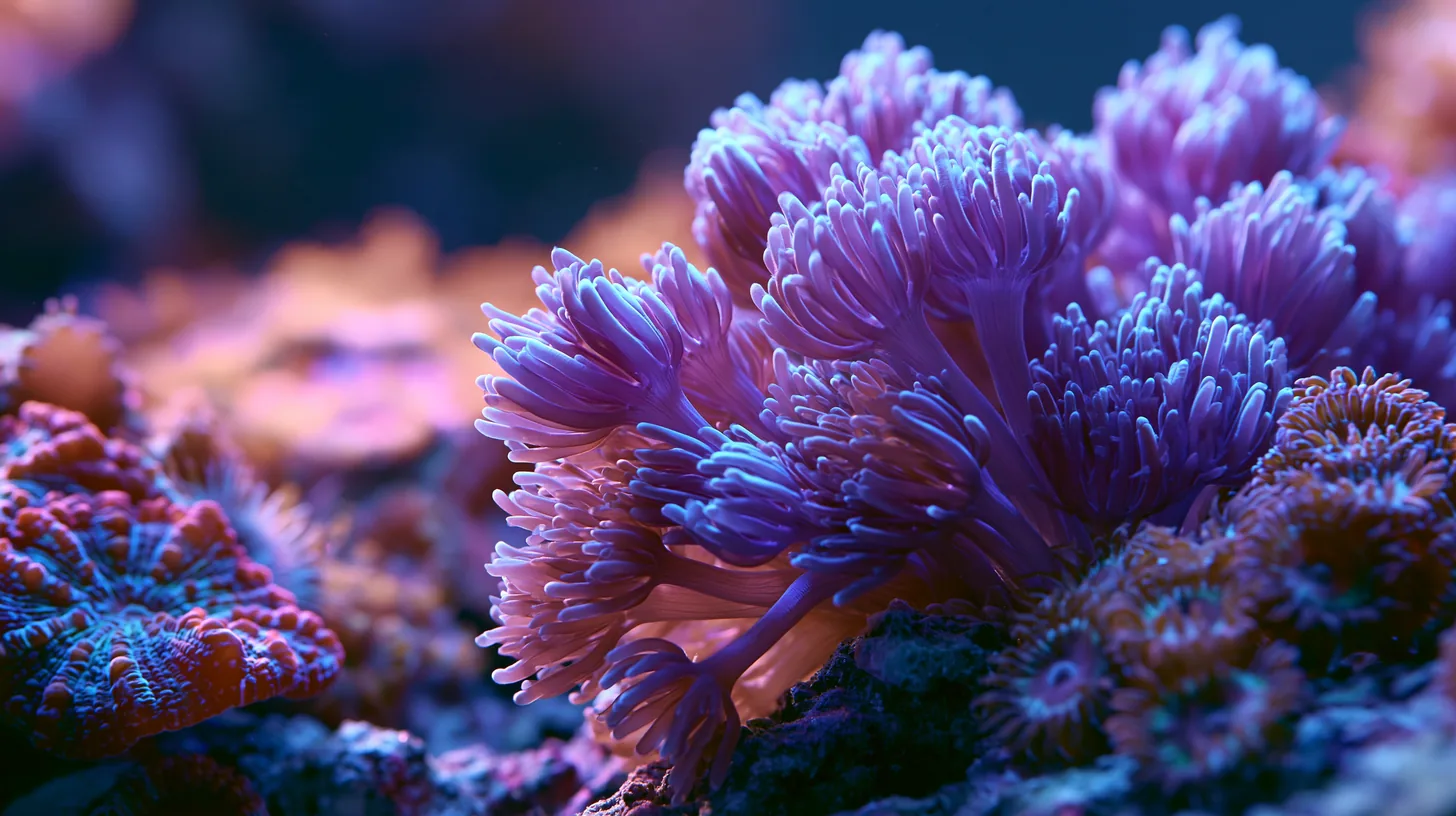
Xenia is unique in the hobby tank: its polyps pulse rhythmically, opening and closing their tentacles continuously. No other coral does this spontaneously and persistently in the same way. The function of pulsing is debated — hypotheses include enhanced gas exchange, capture of food particles through movement, and support of DOC metabolism. No definitive answer exists.
The practical value of pulsing for the hobbyist is however clear: Xenia is a free iodine indicator. When the tank’s iodine level is optimal, Xenia pulses continuously and vigorously. When iodine drops below optimum, pulsing slows or stops entirely. In Chris Wood’s (Captivate Aquaculture) experiment, adding Lugol’s iodine to the tank restarted pulsing within 15–20 minutes of the compound beginning to equilibrate through the water mass. This is direct, visual feedback on iodine status — no test kit needed. Every tank with Xenia gets free diagnostics.
Anthelia grows as a soft, tufted colony. It does not pulse as visibly as Xenia, but shares the same growth habit and nutritional strategy.
Invasiveness is the most significant practical challenge with Xenia and Briareum. These species grow extremely aggressively — spreading from rock to rock through contact, adhering to all surfaces, and capable of overgrowing slower-growing corals. An isolation rock is almost essential: Xenia and Briareum are placed on their own rock, separate from the main reef structure, so growth can be controlled. Never place Xenia or the green star polyp Briareum directly on the main rockwork — removal later is practically impossible without dismantling the entire structure.
Gorgonians — Sea Fans and Sea Whips
Gorgonians form a morphologically unique group: a flexible axis — proteinaceous or sclerite-based — from which a branching fan or bush structure develops. Their growth form is unlike anything else in the soft coral group; no other coral produces comparable three-dimensional fan structures.
The most critical distinction in the hobby tank: photosynthetic vs. non-photosynthetic.
Photosynthetic gorgonians (Eunicea, Plexaura, Pseudopterogorgia, Pterogorgia) contain zooxanthellae and derive part of their energy from photosynthesis. They are practically the only gorgonian group that can be successfully maintained long-term in hobby tanks without special arrangements. Recognition principle: if the polyps show brown colouration or open toward light — likely photosynthetic. Species available in the EU are predominantly Caribbean in origin.
Non-photosynthetic gorgonians are extremely challenging in hobby tanks. Without a daily supply of particulate food they begin to decline rapidly. First a brownish mucus layer spreads across the surface (distress signal: the coral is stressed and hungry), then tissue begins to detach from the axis, and ultimately the entire branch dies. Non-photosynthetic gorgonians belong with more experienced hobbyists who have a clear daily feeding protocol and the commitment to maintain it.
Flow data for gorgonians: A realistic flow target to enable effective polyp feeding is 10–18 cm/s (data collected in the Caribbean in the 1970s–80s, confirmed by Horniman Museum cultivation results with Unicella varicosa). Within this range, polyp extension is optimal for particle capture. Below 10 cm/s particles do not move sufficiently; above 18 cm/s polyps compress closed for protection.
Air exposure is a fatal mistake for gorgonians. Gorgonian tissue at or above the water surface dies very rapidly — in minutes, not hours. This imposes a constraint on tank fill level and transport handling. A gorgonian must never be allowed to grow to the water surface. Prune and limit growth in good time — a branch can be trimmed underwater without harm.
Lighting — Challenging the Myth
Hobbyist literature perpetuates a persistent claim: soft corals survive on low light. This is only partially true — for mushrooms and non-photosynthetic gorgonians yes, but for leather corals the claim is misleading.
The Riddle Data
Dana Riddle’s experimental photomeasurement data for Sinularia densa (Advanced Aquarist, 2006) is one of the few direct measurements on soft corals:
- Photosynthetic saturation point for Sinularia densa: ~207 µmol/m²/s
- Comparison: Montipora capitata stony coral: ~135 µmol/m²/s
- Comparison: Porites lobata (yellow-green form): ~250 µmol/m²/s
Sinularia densa reaches photosynthetic saturation at a higher PAR value than some stony corals. The reason lies in tissue structure: thick, layered coenenchyme tissue causes significant self-shading. Zooxanthellae living in outer layers receive only a fraction of the surface light, so saturating the entire colony requires a higher overall intensity.
Practical consequence: Sarcophyton and Sinularia do not thrive in a dim tank corner. They grow, but slowly, brown, and loosely structured. In the right light — PAR 150–300 µmol/m²/s — the same coral grows compact, dark green or cream-coloured, and fully open.
PAR Reference Values by Group
These are indicative starting points. Species-level variation is considerable, and no number replaces the coral’s own behaviour as a measuring instrument — extension, colour, growth.
| Group | PAR µmol/m²/s | Note |
|---|---|---|
| Sarcophyton | 150–400 | Shedding cycle can be triggered by sudden light change |
| Sinularia, Lobophytum | 100–300 | Saturation point higher than commonly assumed |
| Zoanthus | 80–200 | Strong light intensifies colours |
| Palythoa | 80–200 | Similar to Zoanthus |
| Discosoma, Rhodactis | 50–150 | Genuinely low-light animals |
| Ricordea spp. | 50–150 | Similar to Discosoma |
| Xenia, Anthelia | 100–250 | Pulsing correlated with light quality as well |
| Photosynthetic gorgonians | 50–150 | Do not require intense light |
| Non-photosynthetic gorgonians | 0–50 | Light not relevant |
Photoacclimation Is a Real Process
Soft corals have the ability to adjust zooxanthellae density and pigment profile in response to light level — just as stony corals do. This means that sudden transfer from low to strong light can cause a light-stress response even if the final PAR value is appropriate.
Practical consequence: a new specimen is started in the lower section of the tank or in a shadier position and moved gradually over weeks toward its final placement. Sarcophyton in particular responds to sudden light changes by closing and initiating a shedding cycle — not an emergency, but unnecessary stress that is easily avoided.
Overexposure is also possible. Sarcophyton in very strong light (PAR above 450–500 µmol/m²/s) begins bleaching and contracting. It is not as vulnerable to light as an SPS coral, but the threshold exists.
Flow
Flow requirements vary among soft corals more than in any other major coral group — from near-still conditions for mushrooms to 10–18 cm/s unidirectional flow for gorgonians.
Leather Corals
Moderate, rhythmically variable flow is optimal. Strong direct flow from a pump prevents polyp extension — polyps press flat against the tissue surface and cannot expand normally. Too little flow, conversely, allows detritus to accumulate on the cap surface and prevents the waxy tissue layer from detaching during the shedding cycle. The layer can remain in place and suffocate new tissue beneath.
Practical test: if the surface of Sarcophyton’s cap carries a dust layer or an undetached tissue layer that has not left within a week, flow is too weak or misdirected.
Zoanthids
Moderate, indirect flow. Too little flow deposits detritus in the colonial structure; polyps become covered and the colony deteriorates. Too much direct flow prevents polyp extension. Zoanthids are fairly flexible in their flow requirements — most species are quite adaptable.
Mushrooms
Genuinely low flow is correct here. Strong direct flow causes a mushroom to close permanently and eventually stress. Mushrooms are placed in a quiet section of the tank — somewhere with clearly perceptible movement but no direct pump output. The most common error: a mushroom a few centimetres from a circulation pump nozzle — it will never open properly.
Xenia and Anthelia
Moderate, gentle, preferably indirect flow. Direct, hard pump output tears polyps and prevents pulsing. Too little flow leads to DOC accumulation in the vicinity. Xenia is sensitive to flow changes — if it stops pulsing, flow is one of the first factors to check alongside iodine.
Photosynthetic Gorgonians
The strongest flow of any soft coral group. Optimal flow is 10–18 cm/s. Within this range polyps extend fully and capture particles efficiently. Below 10 cm/s they do not extend sufficiently for feeding; above 18 cm/s they compress closed.
In low-flow conditions cyanobacteria and algae begin growing on the gorgonian surface — the clearest sign of insufficient movement or a declining animal.
Dead Spots
No point in the tank where a soft coral is placed should have complete absence of flow. Detritus accumulates rapidly in still water beneath and around soft corals — particularly under the wide base tissue of leather corals. Accumulated detritus, as it decomposes, causes localised oxygen depletion and base tissue necrosis that can spread upward through the entire stalk.
Water Chemistry and Nutrients
What Soft Corals Do Not Consume — The Difference from Stony Corals
The most important starting point for understanding soft coral maintenance is what they do not require at the same level as stony corals:
Soft corals have no massive calcified skeleton, so calcium (Ca) and alkalinity (KH) consumption is a fraction of that of stony corals. A tank containing only soft corals does not require an active dosing system for calcium and alkalinity maintenance — regular water changes keep values naturally within range. Ca 380–420 ppm and KH 7–9 dKH are achievable with water changes alone.
This changes immediately in a mixed reef once stony corals are introduced — their consumption dominates and parameter monitoring becomes essential.
Magnesium is relevant for soft corals — it is a structural component of sclerites — but not in the same critical sense as in stony coral calcification. Natural seawater levels (1250–1350 ppm) are the appropriate target.
Nutrient Profile — The ULN Tank Is Not Optimal
Soft corals tolerate higher nutrient levels than SPS corals — this is true — but the other side is often forgotten: very low nutrient conditions (ultra low nutrient, ULN) are actively harmful to soft corals.
Meerwasserforum 2025 data on nitrate and phosphate consumption by coral group confirms what experience-based hobbyist knowledge has long indicated: soft corals need some nutrients to grow normally. Below 1 ppm nitrate, leather coral growth slows significantly. Below 0.01 ppm phosphate, mushrooms and zoanthids become stressed.
Riuttareef’s view on the optimal range for soft corals:
- Nitrate: 2–15 ppm
- Phosphate: 0.03–0.10 ppm
- N:P ratio: close to 1:100 (industry laboratory consensus)
These values are clearly higher than SPS optima — and this is precisely what makes the mixed reef a management of compromises. Liebig’s law of the minimum applies to soft corals exactly as it does to stony corals: growth is always limited by the factor in shortest supply.
Iodine and Halogens — A Special Requirement for Soft Corals
Iodine deserves particular mention in the context of soft coral maintenance. Zoanthids, Xenia, and leather corals respond to iodine fluctuation noticeably more sensitively than stony corals.
In natural seawater, iodine concentration is approximately 0.055–0.080 mg/l (ICP-OES reference value). In hobby tanks, iodine is consumed and degraded rapidly: activated carbon adsorbs it, ozonation oxidises it to other iodine compounds, and UV light degrades it. Water changes alone are generally insufficient to maintain iodine levels in a tank with many soft corals.
Xenia pulsing functions as an iodine indicator as described above. In ICP-OES monitoring (frequency 4–6 weeks) iodine is one of the primary parameters to track in a tank with significant soft coral populations. Lugol’s iodine or an iodide-based preparation are the typical supplementation options.
Calcium/Alkalinity/Magnesium Consumption
In a tank containing only soft corals, consumption is so small it is absorbed into water change volumes. In a mixed reef, stony coral consumption dominates completely. Practical consequence: the quantity of soft corals does not significantly affect dosing requirements in a mixed reef — stony coral biomass is the determining factor.
Allelopathy — Chemical Warfare in a Closed System
Allelopathy is the most important and most underestimated maintenance issue for soft corals in the mixed reef. It refers to the release of biologically active chemical compounds into the water to inhibit, stress, or destroy competitors.
The Mechanism
Soft coral allelopathic compounds are primarily terpenoids — specifically diterpenes (cembranoids, furanogermanoids, dolabellanoids) and sesquiterpenes. These have been identified in dozens of Sarcophyton, Sinularia, Lobophytum, Lemnalia, and Litophyton species. The same compounds have attracted interest from medical researchers for their anti-inflammatory, antimicrobial, and anti-tumour properties.
In natural open-reef environments these compounds dilute rapidly. In a closed tank they accumulate — particularly when filtration is insufficient or water changes are infrequent.
Terpenoids are lipophilic: they bind readily to organic surfaces and lipid-rich tissue. Accumulation can continue for weeks before concentration rises to a detectably harmful level. This delay explains why adding a leather coral to a tank may cause no problems in the first month — but after three months SPS coral growth has stopped.
During the tissue shedding cycle, allelopathic load increases significantly: detaching surface tissue contains concentrated terpenoids that are released into the water. This is the tank’s chemically most critical moment in relation to soft corals.
The Strongest Producers — Hierarchy
Not all soft corals are equally allelopathic. Research data and hobbyist experience point to the following hierarchy:
Very strong: Sarcophyton (particularly during shedding), Sinularia (some species continuously very active), Lobophytum, Lemnalia, Litophyton. Gorgonians can also be chemically active.
Moderate: Xenia, Anthelia — allelopathic but less aggressive than leather corals.
Minor: Discosoma, Rhodactis, Ricordea, Zoanthus — the primary “weapon” is rapid growth and physical overgrowing, not chemical warfare.
Signs in the Tank
Allelopathy problems in a closed tank typically manifest in stages:
Weeks 1–4 after adding leather corals: no visible signs.
Months 1–3: stony corals closest to leather corals begin closing polyps earlier, opening later, with reduced polyp extension.
Months 3–6: growth slowdown or arrest in stony corals with no other obvious cause. Some SPS corals — particularly Acropora — begin losing tissue at branch tips (“receding tips”) when allelopathic load is high.
Acute allelopathy symptoms during a leather coral shedding cycle: rapid closure of other corals, sometimes broader contraction throughout the tank.
Organo-MS mass spectrometry (Oceamo laboratory) can identify coral terpenoids in water, but a quantitative standard with reference values has not yet been established — compounds can be identified mass-spectrometrically, but no consensus threshold for “dangerous” exists.
Management
Continuous activated carbon is the most effective single measure. Terpenoids are lipophilic and adsorb efficiently to high-quality activated carbon. Use granular high-grade carbon (ROX 0.8 or equivalent quality). Change regularly — saturated carbon no longer adsorbs and in extreme cases can desorb back into the water. When a shedding cycle begins, it is wise to change activated carbon immediately rather than waiting for the normal replacement schedule. See also: Activated Carbon in the Reef Tank.
Ozonation oxidises organic compounds to polar forms that no longer function allelopathically in the same way. Ozonation combined with a protein skimmer is the most effective combination for DOC load management overall. ORP target 300–350 mV is a safe range. See also: Ozonation in the Reef Tank.
Water changes directly dilute accumulated compounds. Regular, adequately sized water changes are the foundation of allelopathy management — activated carbon and ozonation complement but do not replace them. See also: Water Changes in the Reef Tank.
Physical distance is the simplest but often forgotten measure. Flow direction matters: a soft coral upstream distributes its allelopathic compounds through the entire remaining tank volume before reaching filtration. Position leather corals so that the primary flow direction carries compounds through filtration, not past other corals.
Nutrition
Photoautotrophy — The Primary Energy Source
All zooxanthellae-bearing soft corals — leather corals, zoanthids, Xenia, mushrooms, and photosynthetic gorgonians — derive the majority of their energy from photosynthesis. Among Symbiodiniaceae in soft corals, C-clade zooxanthellae predominate, though precise data are more limited than for stony corals. C-clade zooxanthellae are known for broader tolerance of varying conditions compared to A-clade, which partially explains the greater stress tolerance of soft corals.
Xenia is a special case: it is nearly entirely photoautotrophic. Feeding is unnecessary and generally unhelpful.
Heterotrophic Supplementation by Group
Leather corals can capture nanoplankton-sized particles and microbes, but feeding is not the primary maintenance concern. Phytoplankton and small zooplankton particles (rotifers, copepod nauplii) can support growth. Leather corals should not be fed aggressively — excess food raises nutrient levels more than the coral benefits from.
Zoanthids are more active feeders than often assumed. Polyps extend visibly for particle feeding and tentacles carry nematocysts for prey capture. Small-particle zooplankton — copepod nauplii, rotifers — or commercial coral foods work well. Small-polyped forms (Zoanthus spp.) respond best to very finely particulate nutrition.
Mushrooms are nutritionally a contentious group. Discosoma and Rhodactis respond visibly to particle feeding — the polyp closes around food. Larger Rhodactis individuals can capture and digest small crustaceans. With Ricordea species, the closure response is documented, but whether true digestion occurs or food is rejected via mucus depends on species and individual. Practical recommendation: offer small amounts of fine-particle food 1–2 times per week — do not overfeed; allow the water to clear before the next feeding.
Photosynthetic gorgonians benefit from regular targeted feeding 2–3 times per week. Small zooplankton particles, phytoplankton, or commercial coral foods. Reduce flow during feeding for 15–30 minutes so particles are not swept past before polyps can capture them.
Non-photosynthetic gorgonians require daily feeding — this is an absolute requirement, not a recommendation. Without daily particulate food supply, a non-photosynthetic gorgonian begins to decline within weeks.
Mixed Reef — Managing the Compromises
A mixed reef — a tank containing soft corals, LPS corals, and SPS corals in the same water — is an aesthetically attractive goal, but it is biologically the most demanding tank format. Three fundamental tensions make it a challenge:
The Nutrient Conflict
Soft corals may need nitrate at 5–15 ppm and phosphate at 0.05–0.10 ppm — a range in which they grow well. SPS corals, particularly Acropora, lose colouration at even mildly elevated nitrate and ideally grow with nitrate below 5 ppm and phosphate below 0.05 ppm.
These ranges do not fully exclude each other, but the compromise zone is narrow. Nitrate 3–8 ppm, phosphate 0.03–0.07 ppm is the range in which both groups can coexist — but neither at optimum. If the goal is a spectacular, fast-growing SPS-dominant tank, soft corals limit what is achievable.
The Allelopathic Pressure
Leather corals continuously produce terpenoids whose concentration builds in a closed tank. SPS corals — particularly Acropora — are sensitive to these compounds. Good allelopathy management (activated carbon + ozonation + water changes) does not eliminate the problem entirely but keeps it at manageable levels.
Placement Conflicts
SPS corals to the top in strong light and strong flow. Mushrooms to the bottom in weak flow and shade. Leather corals in the middle at moderate conditions. Gorgonians in their own area in strong flow, separated from others. These do not fit comfortably together in a small tank.
Practical Placement Recommendations
Position leather corals and other strong allelopathy producers downstream relative to SPS corals. Flow direction should carry allelopathic compounds toward filtration, not past other corals.
Zoanthids on isolation rocks — their growth rate is such that without their own rock they will cover neighbouring corals within a few months.
Mushrooms to the lower section, in the shadiest position with the weakest flow.
Gorgonians in their own area in the strong-flow zone. They must not be in physical contact with other corals.
Xenia and Briareum on isolation rocks well away from the main structure.
Propagation
Zoanthids and Palythoa
Cut the colony directly from the rock or plug surface with a scalpel or razor blade. Colony fragments work well — there is no need to isolate individual polyps. Palytoxin: see safety guidelines in the earlier section. Nitrile gloves, eye protection, mask when needed. Fragment is attached to plug with cyanoacrylate gel. Dry the plug first — then dip in tank water so the gel does not cure too quickly against a dry surface, apply gel, press fragment in place, hold for 30–60 seconds or place in a small container of water to cure.
Sarcophyton
The most effective method is a ring cut: slice around the rim of the cap to separate a thin ring. The main cap body remains intact, and the ring can be divided into segments — each develops into its own individual. Minimum cutting size for a fragment is 2–3 cm for fast recovery. Attach to plug with rubber band until the coral attaches on its own — cyanoacrylate gel can work but adhesion through Sarcophyton’s mucus is unreliable. Allelopathic load increases after cutting — replace or increase activated carbon.
Sinularia and Lobophytum
Scissors or scalpel, always underwater. Minimum fragment size approximately 3–5 cm — smaller pieces recover slowly. Attach with rubber band or gel. Sinularia may produce white mucus after cutting — normal stress response. Allelopathic compounds increase during cutting stress — activated carbon.
Mushrooms
The simplest approach is to allow the coral to attach naturally to a rock or plug and then detach it with the substrate. Cutting with a scalpel from the base tissue also works — a fast, clean cut. Discosoma divides spontaneously under favourable conditions. Mushrooms are resilient to cutting.
Gorgonians
Cut a branch with sharp scissors underwater — never in air. Minimum fragment length 5–8 cm. Attach with underwater epoxy or wire directly onto rock surface. Do not use cyanoacrylate gel as the primary adhesive for a gorgonian axis on a hard surface — adhesion is unreliable. Ensure the fragment stays fully submerged throughout the entire process.
Common Problems and Troubleshooting
Leather Coral Not Opening
Tissue shedding or stress? Tissue shedding is a normal process: the coral contracts, the surface turns cloudy and waxy, polyps do not open, the process lasts from a few days to three weeks. During a shedding cycle the coral is not in danger. Recognition: a visible yellowish or greyish waxy layer forms on the surface and ultimately detaches in pieces or as a single layer.
A stress response looks similar, but in a stress situation other corals in the tank typically also show symptoms, there is a water chemistry deviation, or some external factor has changed suddenly. If the coral has been closed for over 4 weeks with no shedding layer visible, check: flow (is it sufficient to dislodge the surface?), nutrient levels (ULN can arrest recovery), iodine, and allelopathic load.
Xenia Stops Pulsing
Diagnostic protocol in order: first iodine (ICP or Lugol test — add a small dose of Lugol’s iodine; if pulsing restarts within 15–20 minutes, iodine deficiency is the cause), then KH (too high or too low KH affects pulsing), nitrate (too low in ULN conditions can arrest pulsing), DOC load (sudden organic spike e.g. from a dead fish).
Zoanthids Closed
Multiple possible causes — work through them systematically. Flow: too strong or too weak, try repositioning. Allelopathic compound: has a leather coral been added or the activated carbon cycle changed? Pest: Tegastes zoanthicola copepods are a common cause of zoanthid closure — with a small loupe you can see small shadow movements on the polyp surface. Parameter change: sudden KH or temperature shift.
Mushroom Darkening or Permanently Contracted
Most often the cause is too much light or direct flow pressure. A mushroom must not be placed near a circulation pump nozzle or in the highest PAR zone. Check the PAR value at the placement site. Another possible cause is an allelopathic compound — if a leather coral has been added to the tank, the mushroom may be sensitive to the compounds released.
Cyanobacteria or Algae Growing on Gorgonian
First check: flow. Insufficient flow is by far the most common cause. If flow is adequate, check whether tissue is alive — press gently with a finger (underwater, gloved): living tissue feels springy and flexible, dead tissue slides off the axis. If tissue has been lost, the gorgonian is losing viability. Immediate response: remove dead sections, improve flow, temporarily increase feeding frequency.
References
1. Peer-Reviewed Studies
- McFadden, C.S., van Ofwegen, L.P. & Quattrini, A.M. (2022). Revisionary systematics of Octocorallia (Cnidaria: Anthozoa) guided by phylogenomics. Bulletin of the Society of Systematic Biologists, 1(3). doi:10.18061/bssb.v1i3.8735
- McCauley, M. et al. (2022). Microbiome diversity, host specificity and thermal sensitivity in cnidarians. ISME Journal. [Alcyonacea vs. Scleractinia prokaryote data, Endozoicomonas clade distribution]
- Pollock, F.J. et al. (2018). Coral-associated bacteria demonstrate phylosymbiosis and cophylogeny. Nature Communications, 9, 4921. [Endozoicomonas clade 11 Octocorallia specificity]
- Kamel, H.N. & Slattery, M. (2005). Terpenoids of Sinularia soft corals: chemistry and bioactivity. Pharmaceutical Biology, 43(3), 253–269.
- Anjaneyulu, A.S.R. & Murthy, M.V.R.K. (2010). Bioactive terpenoids from soft corals of the genera Lemnalia, Sinularia, and Lobophytum. Natural Product Research, 24(1), 1–20.
- Bohlmann, J. & Keeling, C.I. (2008). Terpenoid biomaterials. Plant Journal, 54(4), 656–669.
- Riddle, D. (2006). How Much Light: Analyses of Selected Shallow-Water Invertebrate Light Requirements. Advanced Aquarist. [Sinularia densa saturation point PAR ~207 µmol/m²/s]
2. Hobbyist Literature and Brand Documentation
- Wood, C. (2024). Reef Chemistry Deep Dive. Captivate Aquaculture / Salem Clemens podcast [transcript, project library]. [Xenia as iodine indicator, Lugol test 15–20 min response time]
- Aslett, C.G. (2025). Holosystemics Part III: The Prokaryotes of the Coral Holobiont. Reef Ranch Publishing [project library]. [Alcyonacea microbiome data, ASV comparison]
- Optimal Placement of Corals in the Marine Aquarium (2025). Meerwasserforum expert report [project library]. [PAR tables, allelopathic genera, mixed reef, placement zones]
- Coral Nutrition (2024). Salem Clemens / Reef Builders / Indofish podcast [transcript, project library]. [Ricordea yuma feeding observations, mushroom nutrition]
- Hydrogen Peroxide Coral Dip Test Results (2024) [project library]. [Discosoma, Rhodactis, Ricordea, Sinularia tolerance data at three concentrations]
- Real Reef Talk — Coral Spawning (2025). Reef Ranch [project library]. [Unicella varicosa gorgonian flow data 10–18 cm/s, Horniman Museum]
- Aslett, C.G. (2024). SPS Academy Part IV. Reef Ranch Publishing [project library]. [photoautotrophy vs. heterotrophy, zooxanthellae ecology]
- Manta Systems (2025). Balancing Nutrient Levels for Corals. mantasystems.net.
- Meerwasserforum (2025). Nitrat und Phosphatverbrauch Weich- vs. LPS- vs. SPS-Korallen. meerwasserforum.info.
3. Books and Textbooks
- Fabricius, K. & Alderslade, P. (2001). Soft Corals and Sea Fans: A Comprehensive Guide to the Tropical Shallow-Water Genera of the Central-West Pacific, the Indian Ocean and the Red Sea. Australian Institute of Marine Science.
- Borneman, E.H. (2001). Aquarium Corals: Selection, Husbandry, and Natural History. TFH Publications / Microcosm.
- Delbeek, J.C. & Sprung, J. (1994). The Reef Aquarium, Vol. 1. Ricordea Publishing.
- Delbeek, J.C. & Sprung, J. (2005). The Reef Aquarium: Science, Art, and Technology, Vol. 3. Ricordea Publishing.
- Ruppert, E.E., Fox, R.S. & Barnes, R.D. (2004). Invertebrate Zoology: A Functional Evolutionary Approach, 7th ed. Brooks/Cole.