
Activated carbon — principles, selection and use
Activated carbon — principles, selection and use
Activated carbon is one of the most widely used and most misunderstood filtration media in the hobby. It does not remove nitrate, phosphate or inorganic compounds — but it is the most effective single tool for managing refractory dissolved organic matter. Understanding this distinction is important before deciding when, how and how much to use.
What activated carbon is
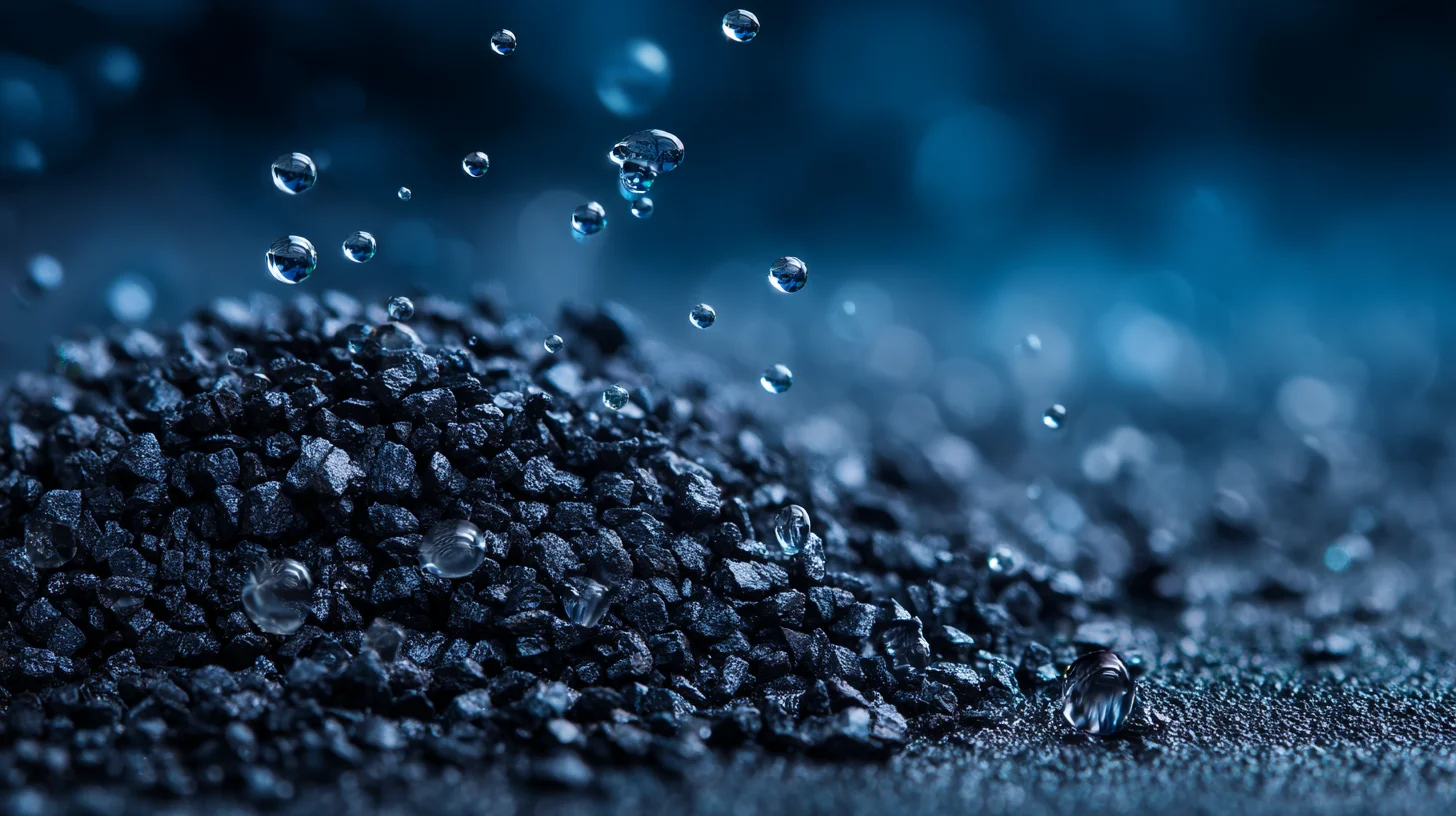
Activated carbon (granular activated carbon, GAC) is a highly porous carbon-based material with an exceptionally large internal surface area — typically 500–1,500 m²/g depending on raw material and activation method. This means that one gram of material contains more surface than three tennis courts.
The mechanism is adsorption — not absorption. In adsorption, molecules attach to the material’s surface via van der Waals forces and hydrophobic interactions; in absorption, they are drawn into the material itself like water into a sponge. This distinction matters practically: adsorption is capacity-limited — once all surfaces are occupied, the activated carbon is exhausted and adsorption no longer occurs.
The raw material is carbon — bituminous coal, lignite or coconut shell. Activation takes place by heating the material to approximately 1,000 °C in the presence of steam or carbon dioxide, which creates an extensive internal pore network.
What activated carbon removes
Activated carbon is particularly effective against:
- Refractory DOC — especially aromatic compounds, humic structures, phenolic compounds and pigments causing water yellowing (CDOM). These are precisely the compounds that SAC 254 measurement detects.
- Allelopathic toxins — many coral species release chemical compounds into the water that hinder neighbouring species. Activated carbon removes these effectively — particularly important when competing species share a tank.
- Medications and chemicals — after an antibiotic course, activated carbon removes drug residues effectively before corals are returned to the tank.
- Saxitoxin and other biological toxins — a rarer but important application in crisis situations.
- Dyes and odour compounds — water clarification and removal of unpleasant odours.
What activated carbon does not remove
Activated carbon does not remove inorganic compounds: nitrate, phosphate, alkalinity, calcium, magnesium or sodium. It also does not remove ammonia or nitrite to any significant degree. These require biological filtration or water changes.
The situation with trace elements is more complex: activated carbon binds copper — but often because copper is bound to organic matter, and the whole organo-complex adsorbs together. In high-DOC tanks, trace elements may be more chelated, making them more susceptible to removal along with activated carbon. However, activated carbon is not as aggressive a trace element remover as a GFO reactor.
Carbon types and quality differences
Not all activated carbon is the same. Three main types:
Bituminous (coal-based)
The most common in aquarium use. Hard structure, less dust, smaller average pore size. Works well for basic organic matter removal. A larger dose is needed to achieve the same effect as with higher-quality types.
Lignite
Softer, more dust, wider pore size distribution. More effective for adsorbing larger molecules, but more difficult to handle due to the dust problem.
Coconut shell
Common in marketing — but a poor choice for a reef aquarium. The most microporous of the three, optimised for gas-phase adsorption. Suitable for air filtration, not water. High-quality activated carbons for water filtration are coal-based.
Quality varies significantly
The spread of ICP testing has revealed an uncomfortable truth to hobbyists: there are activated carbon products on the market that release harmful impurities into the water.
Phosphate leaching is the best-documented problem. Some activated carbon is activated in an industrial process using phosphoric acid (H₃PO₄), which efficiently increases surface area — but leaves phosphorus compounds in the material’s structure. These leach into the water during use, often slowly and with a delay. The result can be an unexplained phosphate rise in the tank — just when the user expects the water to improve. Some manufacturers sell phosphate-free activated carbon but package it in bags that themselves leach phosphate. The problem is therefore multi-layered.
Heavy metals are a rarer but more serious risk. In cheap production, impurities in the raw material or activation process can leave heavy metals in the material that dissolve into saltwater. Lead, mercury and other heavy metals are toxic to corals and fish even at very low concentrations — and are only revealed by ICP analysis.
Practical measure: always test a new batch of activated carbon before use by soaking it in RO water and measuring the soak water’s phosphate with a Salifert test or equivalent. High-quality activated carbon produces no measurable phosphate. If the measurement shows phosphate — discard the batch. Activated carbon intended for aquarium use, manufactured to water filtration standards, is the only safe choice.
Carbon dust and HLLE
Activated carbon is frangible — it breaks easily into dust under mechanical stress. Carbon dust has been identified as a possible risk factor in the development of head and lateral line erosion (HLLE), particularly in tangs (Acanthurus spp.) and other surgeonfish relatives.
The link between HLLE and carbon dust is based on a single study in which large amounts of unwashed activated carbon were used over an extended period. The link is not absolute — with proper use the risk is minimised:
- Rinse activated carbon in RO water before use until the rinse water runs clear
- Do not scrape or grind the carbon during rinsing — turn it gently
- Never let carbon tumble — never in a rotating reactor
Methods of use
Mesh bag
The simplest and cheapest method. The bag is placed in a high-flow section of the sump or beneath the overflow chamber.
Note: water always takes the path of least resistance — in a tightly packed bag, water may route around the outer edges without contacting most of the media. This is called channelling. Channelling can be reduced by positioning the bag so that flow is forced through it, not around it.
A mesh bag is not a poor choice — it is simple and easy to replace. A reactor is more effective, but a bag suffices for a basic situation.
Upflow reactor
A reactor pumps water upward through the media bed. All tank water passes through a forced route — no channelling, maximum contact time.
Critical detail for activated carbon: activated carbon must not tumble in the reactor. Tumbling grinds carbon granules against each other and produces dust that enters the tank. Install a sponge or foam disc on top of the activated carbon in the reactor — it keeps the media stationary without tumbling. Flow rate should be low enough that the carbon barely moves — it must not tumble.
A reactor is particularly suited to situations where optimal performance is needed or larger media quantities are used.
HOB filter (hang-on-back)
Useful in sumples and compact tanks. A bag of activated carbon added to the media basket of a HOB filter is a functional solution — water is forced through the media by the filter’s construction. Easy to maintain.
Intermittent use in a reactor
Instead of continuous use, the reactor can be run periodically — for example in runs of a few days every 4–6 weeks. This is justified in tanks where continuous trace element removal is to be avoided or where DOC levels are otherwise under control. A single run cleans the water quickly and effectively.
Saturation and replacement interval
Activated carbon’s effectiveness is greatest in the first few hours. It saturates faster in saltwater than fresh water, because all minerals and ions compete with organic molecules for adsorption sites.
Practical replacement interval: 2–4 weeks in normal use. Longer use is not dangerous — saturated activated carbon does not typically release adsorbed compounds back into the water to any significant degree — but it no longer adsorbs new compounds. The benefit stops even though the device remains in place.
Water colour is a simple indicator: if the water begins to yellow, the activated carbon is exhausted or undersized.
Activated carbon and protein skimmer — the logic of the combination
A skimmer and activated carbon remove different DOC fractions:
- The skimmer is effective against surface-active macromolecules — proteins, lipids and glycoproteins that migrate to the air-water interface.
- Activated carbon is effective against refractory aromatic compounds — phenols, humic structures and other smaller organic molecules that do not adsorb onto bubbles.
These two are not overlapping but complementary. The combination covers the DOC spectrum more broadly than either alone. This is why an effectively operating system includes both — not a choice between them but a mutually supporting combination.
Practical checklist
- Always rinse in RO water before use
- Test each new batch with a phosphate meter before adding to the tank
- Do not let carbon tumble — add a foam disc above it in the reactor
- Replace every 2–4 weeks
- Use aquarium-grade carbon manufactured to water filtration standards — not carbon intended for air filtration
- Use intermittently if DOC is under control, continuously if DOC is elevated or allelopathy is suspected
- Always remove before a medication course — and add fresh carbon afterwards to remove residues
References
1. Peer-reviewed research
- Graber, E.A. (2010). Head and lateral line erosion in marine fish: review of current understanding. Journal of Fish Diseases.
- Ho, B.H. (2011). Activated carbon and HLLE: a critical review of the evidence. Aquarium Sciences and Conservation.
2. Hobbyist literature and brand documentation
- Aslett, C.G. (2024). Teach a Person to Fish — SPS Academy Part II. reefranch.co.uk. (Phosphate leaching, carbon quality, HLLE mechanism.)
- Clemens, S. & Dank, K. (2025). Dissolved Organic Carbon in Reef Aquariums — Podcast Transcript. Beyond the Reef Podcast. (GAC as a DOC management tool, trace element binding.)
- DrTim’s Aquatics (2020). Activated Carbon. drtimsaquatics.com. (Phosphate leaching from different carbon types.)
- Delbeek, J.C. & Sprung, J. (1994). The Reef Aquarium, Volume 1. Ricordea Publishing.
3. Books and textbooks
- Borneman, E.H. (2001). Aquarium Corals: Selection, Husbandry, and Natural History. Microcosm / TFH Publications.
- Fenner, B. (2002). Activated Carbon and Its Use in the Marine Aquarium. WetWebMedia.com.