
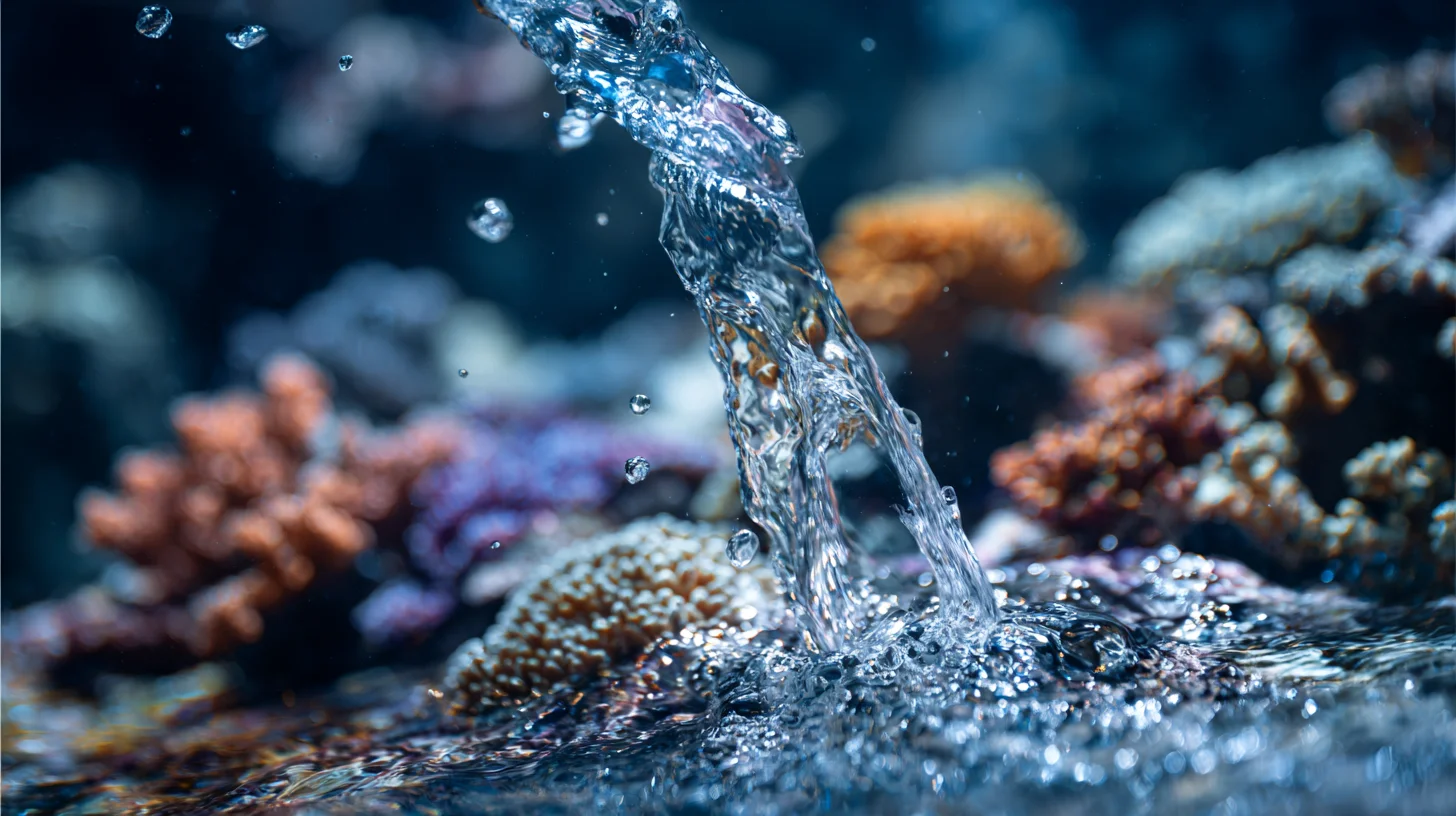
Water Changes — Why You Change Water
A reef aquarium is a closed system. On a natural reef, the ocean ensures that water composition remains stable — tides, currents, and an enormous water volume constantly dilute and replenish everything. At home, this mechanism doesn’t exist. The tank is cut off from the ocean, and its water volume changes continuously through the metabolism of its inhabitants, feeding, and chemical processes.
Water changes are the simplest way to correct this fundamental problem. The operating principle is as simple as it is effective: remove a portion of old water and replace it with clean, properly prepared saltwater.
What Accumulates in Your Tank
In a closed system, certain substances inevitably accumulate over time.
Nitrate and phosphate are the end products of biological decomposition. Food, fish waste, and dead organic matter are broken down by bacteria — the byproducts end up in the water column. A protein skimmer, refugium, and carbon dosing all help, but none eliminate everything. Without water changes, nitrate and phosphate rise slowly but surely.
Dissolved organic carbon (DOC) accumulates as complex molecules that bacteria and protein skimmers don’t efficiently break down. These so-called refractory compounds turn water yellow and reduce light penetration. Fresh saltwater is essentially DOC-free — water changes are the most effective single tool for diluting these compounds.
Heavy metals and other contaminants can accumulate through food, additives, and even RO/DI water. Copper is a classic example: in Holmes-Farley’s measurements, it was at higher levels in aquarium water than in the salt mix used — accumulation happens slowly but consistently.
Chloride and sulfate are major ions whose balance can gradually be distorted by dosing. Adding calcium, alkalinity, and magnesium always brings along counter-ions that accumulate in the water. Water changes are the only practical way to correct this ionic drift.
What Depletes from Your Tank
In contrast to accumulation, certain substances continuously decrease.
Calcium, alkalinity, and magnesium are consumed in stony coral calcification faster than any other process can replenish them. Water changes alone cannot maintain the level of these elements in an SPS-dominated tank — it would require daily changes of 30–50%. A dedicated dosing strategy is required. Water changes supplement but cannot replace the need for dosing.
Trace elements — some consumed in coral biochemistry, others removed by protein skimmers or activated carbon — are partially replenished through water changes. Fresh saltwater contains trace elements in the correct ratios, so regular water changes restore balance. However, this isn’t sufficient for rapidly depleted elements or those removed by aggressive filtration — those require ICP monitoring and targeted supplementation.
What Water Changes Cannot Do
It’s important to understand what water changes do not accomplish.
Calcium and alkalinity supplementation requires its own dosing strategy — Balling, two-part, or kalkwasser. Water changes are too small to replenish the consumption of an actively calcifying tank.
Nitrate and phosphate management requires primarily optimizing feeding and secondary export mechanisms. Water changes dilute nutrients but don’t remove their source.
Serious acute problems — sudden chemical exposure, toxins in the tank — require rapid and large water changes that deviate from the normal maintenance schedule.
Why Consistency Matters
Water changes work best when done regularly and proactively — not as a rescue measure when something has already gone wrong.
A small weekly change is more effective than a large infrequent one. The reason is mathematical: the same total volume split across more frequent changes keeps concentration drift smaller at all times. Small, regular water changes also disturb the microbiome less than large single changes, which have been shown to cause rapid taxonomic turnover in bacterial communities.
Natural reefs with direct access to seawater pumping — such as many public aquariums — change water continuously. This is the extreme application of the water change principle: no parameter correction, just constant convergence toward natural seawater composition.
Summary
Water changes are the simplest and most reliable tool in reef aquarium keeping. They require RO/DI equipment to produce clean source water, but they don’t rely on complex biochemistry and don’t depend on any single technology functioning correctly. They work when other methods fail, and they make the work of all other methods easier.
A single water change doesn’t change much. A regular, consistent water change routine changes everything.
Sources
1. Peer-Reviewed Research
- Kellogg, C.T.E., Goldsmith, D.B., & Carlson, C.A. (2018). Microbiome Dynamics in a Large Artificial Seawater Aquarium. mSystems, 3(2), e00017-18. DOI: 10.1128/mSystems.00017-18 (A 90% water change caused microbiome stability loss and rapid taxonomic turnover — supports small regular changes over large single ones)
2. Hobbyist Literature and Brand Documentation
- Holmes-Farley, R. (2005). Water Changes in Reef Aquaria. Reefkeeping Magazine, October 2005. reefkeeping.com (Comprehensive mathematical analysis of the effects of different water change volumes and frequencies on various substance concentrations; a classic)
- Bulk Reef Supply (2021). Why Water Changes Matter — Beginner’s Guide Ep. 25. bulkreefsupply.com
- Aquaforest (2025). Water change in a reef aquarium — how to do it safely? aquaforest.eu
3. Books and Textbooks
- Borneman, E.H. (2001). Aquarium Corals: Selection, Husbandry, and Natural History. Microcosm / TFH Publications.
- Knop, D. & Fossa, S.A. (1998). Coral Reef Aquarium. Dähne Verlag.