

Carbon dosing in practice — when, how, and when not to
Carbon dosing is a powerful tool for managing nitrate and phosphate — but it is also one of the most easily misused methods in reef keeping. This article covers how it works, when to consider it, how to start safely, and when it is simply the wrong solution.
Other parts of this topic: Deep dive: biochemistry and open questions
What is carbon dosing
Carbon dosing means adding an organic carbon source to the aquarium water to stimulate bacterial growth. Bacteria use the carbon as energy and build it into biomass — and to grow, they need nitrogen and phosphorus, which they take from the water column. Some of this biomass is exported through the protein skimmer, some is consumed by filter feeders. Net result: nitrate and phosphate drop.
The idea is not new. Vodka dosing became widespread in the late 1990s, and it is based on the same biological principle as modern commercial products: organic carbon feeds heterotrophic bacteria, which bind inorganic nutrients into biomass and/or reduce nitrate to nitrogen gas.
When carbon dosing is justified
Carbon dosing is not a baseline solution for an overloaded tank. It is a fine-tuning tool for a tank where the fundamentals are in order but nutrients are repeatedly above the target range without a clear single cause.
Justified situations:
- Nitrate is repeatedly above 10–15 mg/l despite moderate feeding and weekly water changes
- PO₄ is consistently 0.10–0.20 mg/l and refugium + water changes are not enough to bring it down
- The tank is at least 12–18 months old and the microbiome has stabilised
- A functioning protein skimmer is in use and producing wet skimmate regularly
- The nutrient pair (NO₃ and PO₄) has been measured and both values are known
Situations where carbon dosing is not the right choice:
- Tank is less than 12–18 months old — the microbiome is not yet stable
- No protein skimmer, or it is not working properly — bacterial biomass cannot be exported
- The cause of high nitrate is overfeeding or overloading — fix the cause first, do not treat the symptom
- NO₃ is high but PO₄ is already low — carbon dosing will worsen the imbalance further
- There is an active acute problem in the tank — carbon dosing adds variables to an already unstable situation
Riuttareef’s view: Carbon dosing is not a beginner’s tool. It adds organic carbon to the water — which is both a nutrient removal mechanism and a DOC load. A minimum of 18 months of stable tank operation and a consistent weekly measurement routine are prerequisites.
Carbon sources — what to choose
DIY sources
Ethanol (vodka, ~40% ethanol): Simple, rapidly metabolised carbon source. Bacteria break it down first via acetic acid, which is further oxidised to CO₂ and water. pH drops slowly through bacterial metabolism.
Acetic acid (white vinegar, 5–8%): Lowers pH immediately upon addition, but the overall effect on pH is the same as vodka. With slow automated dosing the difference disappears.
Sugar (sucrose): Works in principle, but particularly stimulates cyanobacteria growth. Riuttareef does not recommend it.
Biopellets (PHB, polyhydroxybutyrate): Solid, slowly degrading biopolymer used in a reactor. Advantage: dosing is essentially automatic once flow is set correctly. Disadvantage: reactor flow rate is critical. Not suitable for tanks without reactor equipment.
Commercial products
Commercial products generally use more complex organic compounds combined with bacterial cultures or trace elements. All of them work through the same biological mechanism — the difference from DIY sources is in the precision of the formulation and the manufacturer’s support for product-specific dosing guidance.
The Tropic Marin carbon dosing product line explained
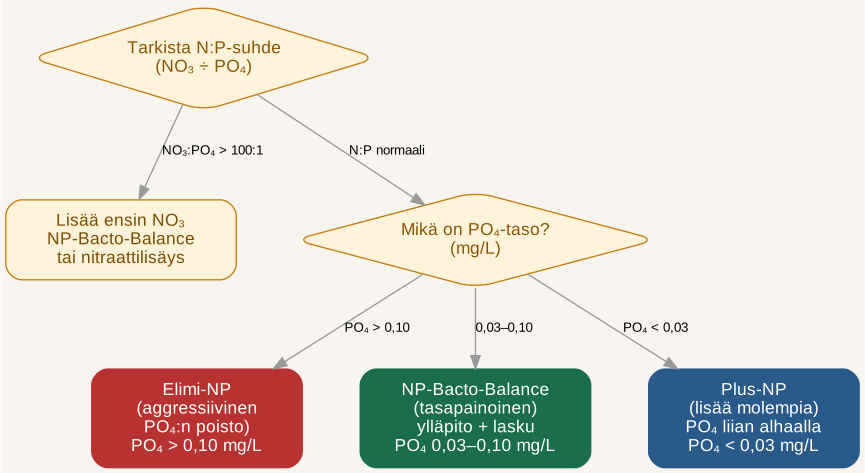
The Tropic Marin system is based on the idea that the right product is chosen according to the measured PO₄ level. The products are not used in parallel — only NP-Bacto-Pellets and Reef-AC can be combined with any of the three main products.
| Product | Use case | PO₄ level |
|---|---|---|
| Elimi-NP | Nutrients clearly above target — active reduction | PO₄ > 0.10 mg/l |
| NP-Bacto-Balance | Nutrients within target range — maintenance | PO₄ 0.02–0.10 mg/l |
| Plus-NP | Nutrients too low — raising to target | PO₄ < 0.02 mg/l |
Critical exception in N:P imbalance: If the NO₃:PO₄ ratio is above 10:1, use NP-Bacto-Balance even when PO₄ is above 0.10 mg/l. Elimi-NP would remove phosphate too aggressively and exacerbate the imbalance.
NP-Bacto-Pellets can be run alongside any of the main products — it acts as a continuous slow-release carbon source. Reef-AC contains natural biopolymers and supports the broader community of the microbiome.
Dosing in practice
Starting out
Start at half the manufacturer’s recommended dose. Carbon dosing is easier to increase than to decrease. Overdosing causes a bacterial bloom — a sudden explosive growth of bacteria that clouds the water, can deplete oxygen to critical levels, and seriously stress corals.
First 2–3 weeks: keep the dose constant and monitor.
Parameters to monitor during carbon dosing
| What to monitor | How often | Why |
|---|---|---|
| NO₃ + PO₄ | Weekly | Confirm downward trend, react to the zero/zero trap |
| pH (trend) | Daily reading or pH monitor | Carbon dosing lowers pH |
| Protein skimmer | Daily visual check | Bacterial load shows in skimmate volume and colour |
| Water clarity | Visual | Cloudiness = sign of bacterial bloom |
| ICP | Every 4–6 weeks | Nutrient balance and trace elements |
Dosing automation
Carbon dosing works best with an automatic dosing station. Small doses multiple times per day (e.g. 3–4 times) smooth out the pH impact and bacterial population fluctuations.
The role of the protein skimmer
A protein skimmer is essential. It is the mechanism by which bacterial biomass is exported from the tank — without it, bacteria grow and when they die, they return nitrate and phosphate to the water. Starting carbon dosing without a functioning protein skimmer is a biological dead end.
Risks and how to prepare for them
Bacterial bloom
Symptoms: Water turns white or yellowish. The protein skimmer starts producing unusually large amounts of wet, loose foam. Corals retract.
Action: Stop carbon dosing. Change 30–40% of the water. Monitor oxygen levels. Restart at ¼ dose once the water has cleared.
pH drop
Carbon dosing lowers pH in two ways: directly through H⁺ ions from acetic acid, and indirectly through CO₂ produced by bacterial metabolism. Tank pH may drop 0.1–0.2 units from normal.
Monitor pH regularly. If the night-time pH drops below 7.9, consider reducing the dose or improving gas exchange.
Cyanobacteria proliferation
If a reddish-brown film appears on rocks or sand after starting carbon dosing, switch to a different carbon compound or reduce the dose.
Excessive nutrient depletion (the zero/zero trap)
Carbon dosing is effective — too effective if the dose is not monitored. If NO₃ approaches 2 mg/l or PO₄ approaches 0.02 mg/l, reduce the dose immediately.
Increased DOC load
Carbon dosing adds to the total organic carbon load in the water. Keep water changes regular alongside carbon dosing — water changes are the single most effective method for removing DOC.
Stopping and pausing
Carbon dosing can be stopped — but not abruptly. If stopped suddenly, nutrients can rise rapidly: the bacterial population that has grown on the excess carbon dies and decomposes, releasing nitrate and phosphate back into the water.
To stop: reduce the dose by 25% per week over two weeks before stopping entirely.
Summary: the carbon dosing steps
- Verify the fundamentals are in order: moderate feeding, regular water changes, functioning skimmer
- Measure NO₃ and PO₄ before starting — both values must be known
- Choose a carbon source or commercial product based on the situation (guided by PO₄ level)
- Start at half the recommended dose
- Monitor weekly — pH, nutrients, skimmer, water clarity
- Raise the dose slowly if the response is insufficient — at most +25% at a time, every 2 weeks
- React immediately to signs of bacterial bloom or too-rapid nutrient decline
- Do not stop abruptly — taper down gradually
Sources
1. Peer-reviewed studies
- Cárdenas, A. et al. (2018). Excess labile carbon promotes the expression of virulence factors in coral reef bacterioplankton. The ISME Journal, 12(1), 59–76. https://doi.org/10.1038/ismej.2017.142
- Haas, A.F. et al. (2016). Global microbialization of coral reefs. Nature Microbiology, 1, 16042. https://doi.org/10.1038/nmicrobiol.2016.42
- Nelson, C.E. et al. (2013). Coral and macroalgal exudates vary in neutral sugar composition and differentially enrich reef bacterioplankton lineages. The ISME Journal, 7(5), 962–979.
2. Hobbyist literature and brand documentation
- Feldman, K.S. et al. (2011). Bacterial Counts in Reef Aquarium Water. Advanced Aquarist, Vol. X. https://www.advancedaquarist.com/2011/3/aafeature
- Tropic Marin (2024). Carbon Dosing in the Reef Aquarium — video transcript (Lou Ekus).
- Clemens, S. & Dank, K. (2024). The Dissolved Unknown. Beyond the Reef Podcast — Reef Science, Vol. 01.
3. Books and textbooks
- Borneman, E.H. (2001). Aquarium Corals: Selection, Husbandry, and Natural History. Microcosm.
- Munn, C.B. (2019). Marine Microbiology: Ecology & Applications, 3rd ed. CRC Press.