The microbiome as the tank's foundation
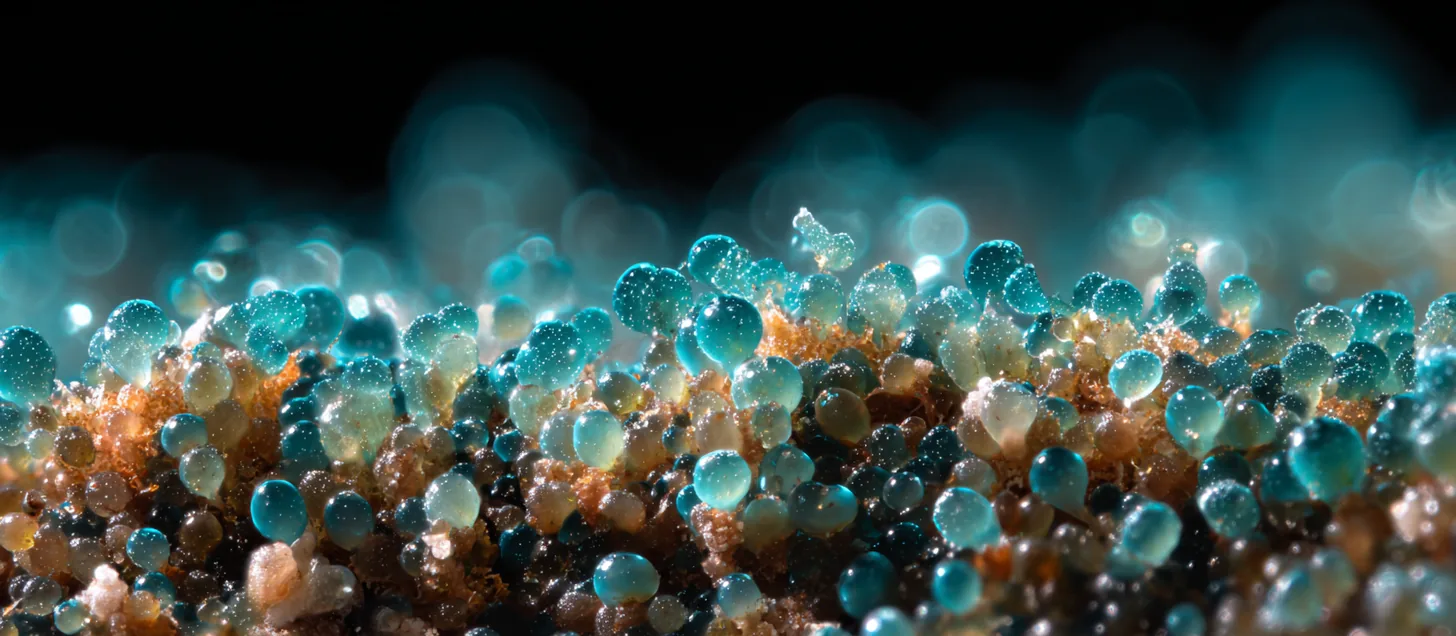
When a hobbyist describes their tank, they talk about corals, fish, rock and water. Rarely does anyone mention what actually makes a tank a functioning ecosystem: the invisible microbial community living on every water surface, grain of sand and layer of coral mucus.
A single drop of water contains thousands of single-celled organisms. An entire tank contains a trillion of them. The number is hard to grasp, but it has practical significance: the tank’s chemistry, nutrient cycling, pathogen control and coral health all flow through that community.
What the microbiome means
The microbiome simply means all microscopic organisms living in a given environment. In a reef tank this covers bacteria, archaea, dinoflagellates, fungi, viruses and bacteriophages — viruses that infect bacteria.
The vast majority of these species have never appeared in scientific cultures. It is estimated that fewer than one per cent of marine microbes can be grown by traditional methods. A hobbyist therefore cannot know much about their microbiome from what they can see in the tank — or from what water chemistry tells them.
Over the last decade, DNA sequencing technology has changed this dramatically. Microbial DNA can be identified directly from a water or biofilm sample without culturing, by comparing sequences to databases containing the genetic fingerprints of all known microbes.
What lives there
Microbiome studies spanning hundreds of reef tanks have identified a set of bacterial families that appear repeatedly.
| Bacterial family | Occurrence in tanks | Average proportion | Note |
|---|---|---|---|
| Rhodobacteraceae | ~100% | ~13% | Highly diverse, present in all marine environments |
| Vibrionaceae | ~97% | ~4% | Contains several pathogens; more abundant in open water than on surfaces |
| Alteromonadaceae | ~98% | ~6% | One of the most common groups in natural seawater |
| Flavobacteriaceae | ~95% | ~3% | On surfaces and as detritus decomposers |
| Pelagibacteraceae | ~65% | ~7% | The most abundant group in natural ocean; UV sterilisation reduces significantly |
Source: AquaBiomics/Eli Meyer, Ph.D. — sample data from hundreds of reef aquariums
The table figures are important for two reasons. First, they show that certain groups appear in virtually all tanks — this is not random dispersal but an established community structure. Second, they show how small a proportion nitrifying bacteria represent in the full community. Nitrification is often mentioned in the context of tank cycling as if it were the whole story — but it is just one function among dozens.
What microbes do
Nutrient cycling
Microbes break down organic matter — fish waste, food remnants, dead tissue — into inorganic compounds that plants, algae and coral Symbiodiniaceae symbionts can use. Without this decomposer community, nutrients would accumulate as dissolved organic compounds that cannot be removed by skimming alone.
Microbes also take nutrients into their own biomass — converting dissolved inorganic nitrogen and phosphorus into particulate form that filter-feeding animals such as sponges, bivalves and coral polyps can eat directly, or that a protein skimmer can remove.
Pathogen control
A healthy tank microbiome is a competitive community. A rich, diverse bacterial community keeps opportunistic pathogen growth in check simply by taking away their space, food and attachment surfaces. Some bacteria directly produce antimicrobial peptides, bacteriocins and antifungal compounds — natural counteragents.
This competitive pressure is one reason why Vibrio bacteria — some of which are pathogens — are found in almost all tanks without causing disease. They are present, but other community members keep their numbers in check.
Coral health directly
The coral mucus layer is an active habitat for the bacterial community. A community living in healthy coral mucus participates in coral nutrition, regulates the stress response and fends off intruders. This is an essential part of what is called the holobiont — the idea that a coral colony is ecologically more than just a coral: it is the combined entity of the coral, Symbiodiniaceae symbionts, bacteria, archaea and viruses.
Dysbiosis: when the community falters
A healthy microbiome is diverse, balanced and functionally redundant — meaning multiple different bacteria can handle the same task. This redundancy protects against disruption: the disappearance of a single species does not bring down an entire function.
Dysbiosis is the state in which this balance has been disrupted.
Research has identified three stages. In the first stage, the coral adapts by changing its microbiota — pathogen pressure is met by recruiting new groups or reinforcing existing ones. The second stage is active stress: Symbiodiniaceae symbiont numbers change, diversity decreases. In the third stage, buffer capacity has been exceeded — bleaching, disease or death follows.
The practically important observation is that microbial change occurs clearly before visually detectable symptoms. In studies of Acropora millepora colonies, immunity and microbiome diversity began declining two months before the colony developed white syndrome. The microbiome is therefore an earlier indicator than visual assessment alone.
Microbialization — the DOC and oxygen balance
American marine ecologist Forest Rohwer has studied what happens when reefs “microbialize” — when bacterial relative biomass grows too large relative to corals. The outcome is consistent: abundant dissolved organic carbon (DOC), low oxygen, algal blooms and coral deaths.
The paradox is explained by the dynamics between bacteria and their viruses — bacteriophages. Phages kill bacteria in two ways:
- Lytic cycle: the phage attaches to a bacterium, replicates inside it and bursts it open. The bacterium dies, the bacterial population stays in check. This is called the viralized state — a healthy reef.
- Lysogenic cycle: the phage does not kill the bacterium but integrates into its DNA as a prophage. The bacterium replicates freely and can become more virulent. This is called the microbialized state — a disrupted ecosystem.
The decisive variable is the ratio of easily degradable organic carbon to oxygen. When DOC is low and oxygen abundant, phages remain in the lytic cycle. When DOC rises and oxygen falls — the system microbializes.
This explains why the same interventions can produce different results in different tanks. Much of a hobbyist’s daily maintenance affects precisely this balance:
Reducing DOC: protein skimmer, activated carbon, mechanical filtration (filter floss, roller mat), adequate flow
Maintaining oxygen: adequate surface agitation, ozonation, gas exchange
Indirect effect: refugium with Chaetomorpha macroalgae, adequate fish and coral feeding without overfeeding
Most hobbyists do these things intuitively — but do not always know why they affect what they affect.
UV sterilisation: a measurable change in the microbiome
UV sterilisation has a clear, research-verified effect on the microbiome. The Pelagibacteraceae group — the world’s most abundant bacterial genus in natural seawater — is on average 18 times less abundant in UV tanks than in tanks without UV. In almost all UV tanks (98%), the group’s proportion falls below 5%.
The effect is so consistent that a microbiome testing laboratory can identify a UV tank from microbial data alone without looking at any other parameter.
What does this mean? Not necessarily anything good or bad — the significance of the effect for overall tank health remains unclear. But it clearly shows that UV sterilisation changes the tank microbiome in a way that diverges from the community structure of a natural reef.
Two microbial habitats
Microbes live in two distinct environments in a tank, qualitatively different from each other:
The open water column contains more Pelagibacteraceae, Alteromonadaceae and Vibrionaceae — open-ocean “plankton bacteria” specialised for life in low-nutrient water.
Surface biofilm — rock, sand, under coral mucus — contains more Rhodobacteraceae, Hyphomicrobiaceae and Thiotrichaceae groups that live attached to surfaces.
When starting a new tank, rock and sand transfer the surface microbiome — but water from a mature tank transfers the open-water community. Both matter. Seeding from both rock/sand and water from a mature, healthy tank helps build a more comprehensive microbial community faster.
What the hobbyist can do
The microbiome cannot be managed with the same precision as water chemistry. Most marine microbes do not grow in laboratories, so they simply cannot be bought in a bottle and added as needed. The microbiome is dynamic, continuously responding to conditions and self-organising — the hobbyist’s role is to create conditions in which it develops in the right direction.
Supporting diversity: Live rock and sand are still the best way to introduce a diverse founding community to a tank. The value of material from a mature, healthy tank is real — not just for nitrifying bacteria but for the whole community.
The role of livestock: The clean-up crew — shrimp, snails, urchins — does not only remove visible algae but affects the structure of the microbial community. Grazing animals modify substrate surfaces, vary the oxygen profile in sand and break down organic matter.
Consistent, calm maintenance: The microbiome is sensitive to disruption. Continuous fluctuations in salinity, temperature or nutrient load stress the community. A sufficient, consistently repeated maintenance routine is a better starting point than continuous adjustment.
Avoiding overfeeding: Excess feeding raises DOC rapidly. Particularly in a new tank where the decomposer community is not yet fully developed, too much organic load easily leads to bacterial overload.
Microbiome testing: DNA sequencing is already available to hobbyists. It does not replace water chemistry measurement, but provides earlier warning of problems than visual assessment or conventional parameters alone.
Summary
A tank’s microbiome is not an optional feature to consider if one wishes. It is infrastructure — the invisible structure on which everything else is built. Without a functional microbial community there is no functional nutrient cycling, no pathogen control, no normal immunological balance for corals.
Four principles worth internalising: the microbiome is broader than nitrification; diversity is strength; DOC and oxygen are the key parameters for microbial dynamics; disruptions linger in the microbiome and show there before they show in the coral.
References
1. Peer-reviewed studies
- Boilard, A. et al. (2020). Defining Coral Bleaching as a Microbial Dysbiosis within the Coral Holobiont. Microorganisms, 8, 1682. https://doi.org/10.3390/microorganisms8111682
- Pollock, F. J. et al. (2018). Coral-associated bacteria demonstrate phylosymbiosis and cophylogeny. Nature Communications, 9, 4921. https://doi.org/10.1038/s41467-018-07275-x
- Rädecker, N. et al. (2015). Nitrogen cycling in corals: the key to understanding holobiont functioning? Trends in Microbiology, 23(8), 490–497. https://doi.org/10.1016/j.tim.2015.03.008
- Rohwer, F. et al. (2002). Diversity and distribution of coral-associated bacteria. Marine Ecology Progress Series, 243, 1–10.
2. Hobbyist literature and brand documentation
- Aslett, C. G. (2023). Holosystemics Part I: Captive Reef Function versus Malfunction. Reef Ranch. https://reefranch.co.uk
- Aslett, C. G. (2024). Holosystemics Part III: The Prokaryotes of the Coral Holobiont. Reef Ranch.
- Aslett, C. G. (2024). Holosystemics Part IV: Dysbiosis and the Microscopic Coral Alliance. Reef Ranch.
- Meyer, E. Ph.D. (2022). The Reef Microbiome — An Invisible Force. CORAL Magazine. https://aquabiomics.com
- Sprung, J. (2024). Microbialization, Viralization, and the Carbon–Oxygen Ratio. Reef Science Series Vol. 02. Two Little Fishies.
3. Books and textbooks
- Munn, C. B. (2019). Marine Microbiology: Ecology & Applications, 3rd edition. CRC Press.
- Rohwer, F. & Youle, M. (2010). Coral Reefs in the Microbial Seas. Plaid Press.