
Refugium in practice — structure, macroalgae and daily management
The refugium is one of the most misunderstood structures in reef keeping. It is often presented primarily as a nitrate removal device — a macroalgae-growing compartment in the corner of the sump that “cleans the water.” The reality is more layered: a refugium is simultaneously a copepod reserve, a pH stabiliser, a dinoflagellate competitor and a substrate for biological diversity. Its value depends entirely on what you want from it and how it is built.
What a refugium actually does
A refugium is not a universal solution to all problems. Before building one, be clear about what you want it to do.
Copepod reserve. This is the single most important function of a refugium in most mixed reef tanks. Copepods cannot be maintained as a permanent population in the main tank where planktivorous fish are present — predation pressure is too great. In a refugium where water flows but fish are absent, the copepod population can reproduce and send a continuous stream of individuals into the main tank. Macroalgae provides shelter for copepod eggs and nauplii.
pH stabiliser. A reverse-cycle illuminated refugium is one of the most effective passive pH stabilisers. Macroalgae photosynthesises at night, consuming CO₂ and raising pH precisely when it would otherwise be falling. The effect is typically 0.1–0.2 units in the night-time pH minimum.
Nutrient export. Macroalgae binds nitrogen and phosphorus into its biomass as it grows — and when algae is harvested and removed from the tank, nutrients are physically exported from the system. There is an important caveat: nutrient export requires a large algae mass. A biologically significant refugium for nutrient management is at minimum 10% of total system volume, preferably 20–30%. Mark Levenson put it plainly: a small compartment in the corner of the sump is “just a decoration.”
Dinoflagellate competitor. A Chaetomorpha refugium can win the iron competition against dinoflagellates — the macroalgae takes iron before the dinos can, and their competitive advantage disappears.
Size — rules of thumb
| Goal | Recommended minimum size |
|---|---|
| Copepod reserve | No minimum — even 10–20 L helps |
| pH stabilisation | 10–20% of system volume |
| Nutrient export | 20–30% |
| Replace carbon dosing or GFO | 30–50% or more |
In most home tanks, a refugium is effective as a copepod reserve and pH stabiliser, but rarely sufficient for nutrient management on its own.
Macroalgae species — what works for what
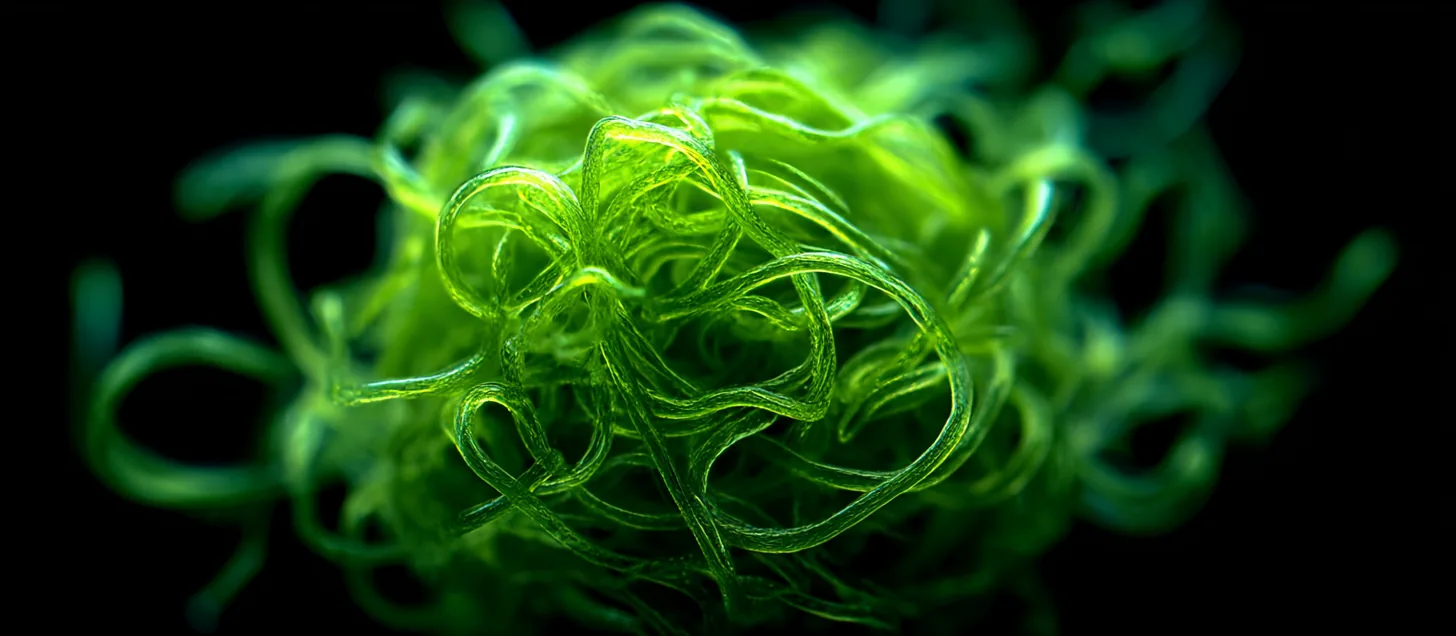
Chaetomorpha sp. — chaeto
Grows quickly, easy to harvest (round mass comes away by hand), does not go into crash mode and does not release spores into the main tank. Tolerates a wide nutrient range.
As a copepod reserve: Excellent — the dense filament structure provides shelter for nauplii.
Warning: Actively competes for trace elements — especially iron and manganese. A fast-growing Chaetomorpha refugium can deplete the tank’s manganese within days. Active trace element compensation is mandatory.
Recommendation: Primary choice for the majority of refugiums.
Caulerpa sp.
Grows very quickly and is an effective nutrient exporter — but can enter a crash phase where it releases all its contents into the water in a single night. Also excretes DOC compounds that can yellow the water. Requires frequent harvesting and monitoring. Not the first choice.
Gracilaria sp. — red macroalgae
Grows more slowly but produces fewer DOC compounds than Caulerpa. A good complement to Chaetomorpha, especially if DOC concentration is a concern.
Lighting
Spectrum
Macroalgae grows most efficiently with a broader spectrum than coral zooxanthellae — especially red (630–680 nm) and green light. A purely blue or actinic-heavy fixture is poor for macroalgae growth.
In practice: a full-spectrum LED or dedicated macroalgae light (e.g. Kessil H380) is optimal.
Reverse cycle — critical
The refugium should always be illuminated in the reverse cycle from the main tank: when the main tank lights go off in the evening, the refugium lights come on.
Mechanism: at night, main tank inhabitants respire but do not photosynthesise → CO₂ rises → pH falls. The reverse-cycle refugium photosynthesises during this same night and compensates for the drop. Without the reverse cycle, the pH stabilisation benefit disappears entirely.
Photoperiod
16–18 hours of light per day is most effective for macroalgae growth.
Flow
Refugium flow must keep Chaetomorpha slowly rotating — but not so strong that the algae mass breaks apart or copepods are drawn out before they can reproduce.
Trace element compensation — mandatory
Macroalgae — especially fast-growing Chaetomorpha — consumes significant amounts of trace elements. Iron (Fe) and manganese (Mn) deplete fastest and can drop to undetectable levels within days.
Practical consequence: When a refugium is running, trace element compensation is mandatory:
- ICP analysis before starting the refugium and 4–6 weeks afterwards
- Special attention to iron and manganese — these drop first
- Water changes alone are insufficient to compensate for fast-growing algae consumption
- Trace element dosing based on ICP results
Macroalgae harvest
Macroalgae binds nutrients as it grows. Nutrients only leave the system when algae is physically removed.
Harvest cycle: Once a week or every two weeks. Overly dense Chaetomorpha mass begins to die from the inside, and nutrients are released back into the water.
How much: Approximately one-third to one-half of the mass at a time. Do not harvest everything — the algae stock recovers faster when the base population remains.
Harvest timing: Before a large water change is a natural moment.
Copepod population management
Seed copepods into the refugium rather than the main tank. Switch off the pump for 30–60 minutes after adding copepods so nauplii have time to distribute through the algae mass. Monitoring: a torch in a dark refugium — copepods should be clearly visible at night.
Refugium vs. Chaeto reactor
| Feature | Traditional refugium | Chaeto reactor |
|---|---|---|
| Copepod production | Excellent | Poor — rotating mechanism damages nauplii |
| Nutrient export per volume | Moderate | Excellent |
| pH stabilisation | Good | Good |
| Space requirement | Large | Small |
| Biological diversity | High | Low |
A combination — reactor for nutrients, small refugium compartment for copepods — is the most effective solution.
Most common mistakes
Refugium without trace element compensation. Macroalgae consumes iron and manganese rapidly. ICP before and after is the only way to know what is happening.
Refugium too small for nutrient management. Use the refugium for its strengths — copepod production and pH.
Wrong lighting. An actinic fixture is poor for macroalgae growth.
No reverse cycle. A refugium illuminated at the same time as the main tank does not stabilise pH at night.
Harvest interval too long. Overly dense mass begins to die from the inside.
No copepod seeding. A refugium does not automatically fill with copepods.
References
1. Hobby literature
- Levenson, M., Joshi, S. & Petta, M. (2024). “Refugium Redux.” Tank Science podcast transcript. Reef Ranch.
- Aslett, C.G. (2024). Real Reef Talk: Intro Q&A — Nutrients, DOC, Refugiums & Trace Elements. Reef Ranch.
- Dong, T. (2024). Coral Garden Podcast — Clean aquarium chemistry guide. Podcast transcript.
- Holmes-Farley, R. (2024). “Randy’s Elements to Dose.” Reef2Reef. https://www.reef2reef.com/threads/randys-elements-to-dose.1030557/
- Dashti, E. (2023). “Ask The Expert: TRITON CEO Ehsan Dashti.” Reef Builders. https://reefbuilders.com/2023/12/13/ask-the-expert-triton-ceo-ehsan-dashti/
- CORAL Magazine (2024). “Macroalgae Aquascaping — Expert Interview.”
2. Books and textbooks
- Borneman, E.H. (2001). Aquarium Corals: Selection, Husbandry, and Natural History. Microcosm.
- Calfo, A. (2007). Book of Coral Propagation, Volume 1. Reading Trees Publications.