
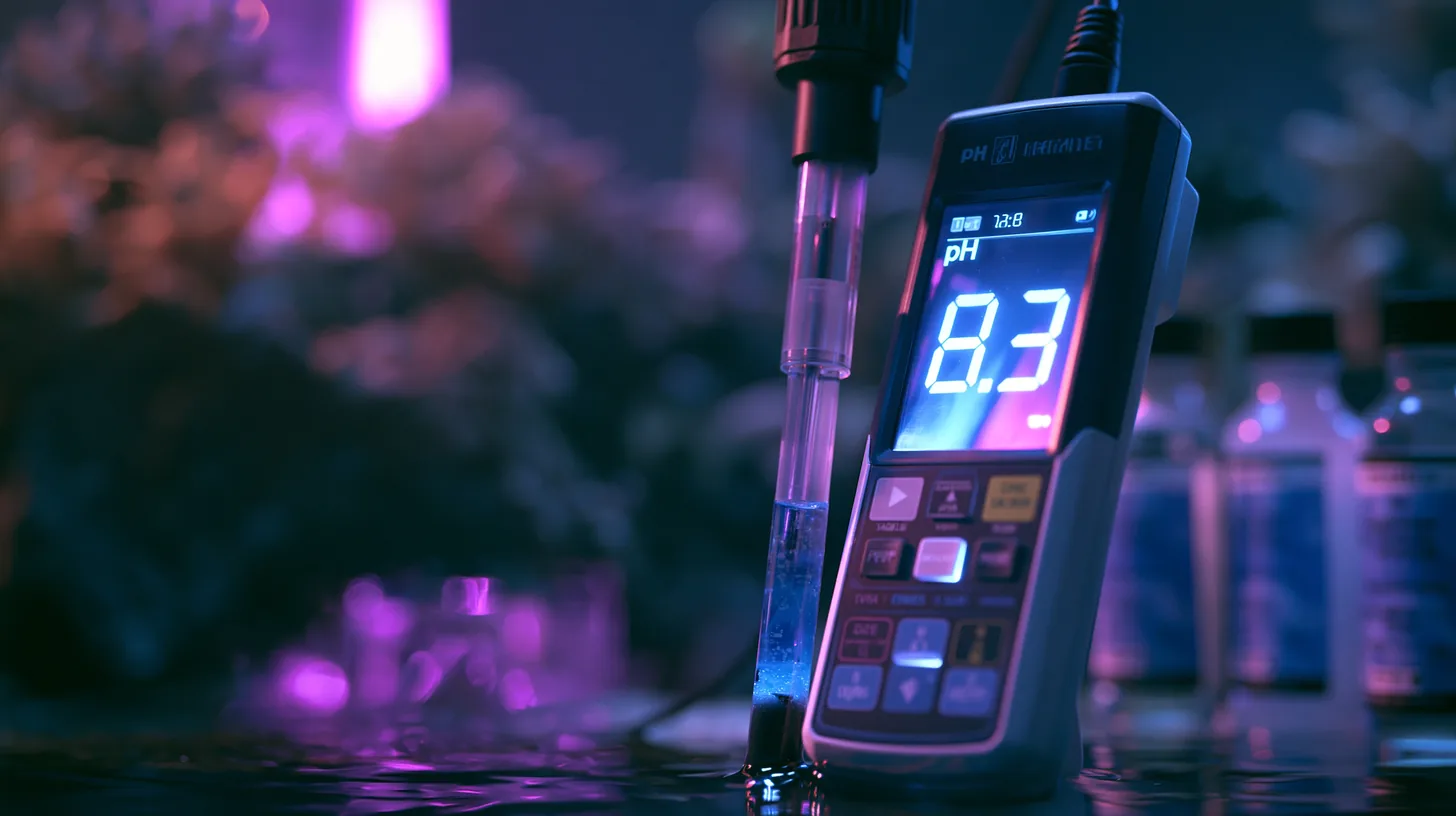
pH in practice — diagnosis, raising and management
Low pH is one of the most common problems hobbyists face — and one of the most frequently misdiagnosed. Before raising or adding anything, you need to understand why pH is low. This article covers everything from diagnosis to implementation.
Two main variables, one outcome
pH is governed in practice by two factors:
CO₂ concentration is the single strongest variable. When there is a lot of CO₂ in the water, pH is low. When CO₂ is removed or consumed by photosynthesis, pH rises.
Alkalinity is the buffer. It does not raise pH directly, but it determines how much CO₂ affects pH. Low alkalinity means a larger diel swing and a deeper night-time drop.
The combined effect of these two factors determines the tank’s pH profile. All pH management methods act on one or both of these.
Diagnosis first — the air test
Before doing anything, determine why pH is low. The air test separates the two most common causes.
Test:
- Take a cup (approximately 250 ml) of tank water
- Measure pH
- Take the cup outside or place it by an open window for 30–60 minutes — the water is in contact with outdoor air
- Measure pH again
Interpretations:
| Result | Meaning | Solution |
|---|---|---|
| pH rose clearly (>0.1) | Indoor CO₂ is the problem | Outdoor air connection for skimmer or open a window |
| pH did not rise or rose very little | Indoor CO₂ is not the main problem | Check alkalinity, electrode, calibration |
| Outdoor cup pH rose but indoor cup did not | Indoor CO₂ clearly higher than outdoor | Outdoor air connection solves it |
This is the fastest way to determine whether the issue is ventilation or chemistry. Do not buy a CO₂ scrubber or reagent before performing the air test.
Causes of low pH — in order of frequency
1. High indoor CO₂
The most common cause in Finland especially in winter. Tight buildings accumulate CO₂ from people and pets breathing. Indoor air can contain 800–1500 ppm CO₂ when outdoor air is approximately 420 ppm. The protein skimmer pumps this air directly into the water.
Identified by: pH rises when a window is opened. Air test positive.
2. Too low alkalinity
Alkalinity below 6–7 °dKH means buffer capacity is insufficient. Night-time CO₂ production drops pH further than it would at higher alkalinity.
Identified by: alkalinity test below 7 °dKH. Large diel pH swing (>0.3 units).
3. Calcium reactor in use
Calcium reactors use CO₂ to dissolve calcium carbonate. The reactor effluent introduces more acidic water into the tank, continuously lowering pH. Reactor tanks typically run at the lower end of the pH range.
4. Carbon dosing
Organic carbon lowers pH in two ways: acetic acid H⁺ ions immediately upon addition, and CO₂ from bacterial metabolism with a delay. All carbon dosing sources lower pH to some degree.
5. Insufficient surface agitation
If the water surface is static and CO₂ is not exchanged with the air, CO₂ accumulates in the water. Strong surface agitation is the simplest way to improve gas exchange.
pH raising methods — comparison
Outdoor air line for the skimmer
Mechanism: Outdoor air with lower CO₂ is pumped into the skimmer instead of indoor air.
Effect: High — often 0.1–0.3 unit rise within a few days.
Implementation: A tube through the wall or window to the skimmer’s air intake. The tube is protected from rain and insects (a plastic bottle filled with filter floss works as a filter). In Finland in winter, this is in practice the primary solution.
Limitations: In freezing temperatures, cold air can condense in the tube. A long tube may restrict flow — ensure sufficient diameter.
CO₂ scrubber
Mechanism: A canister of CO₂-absorbing media (typically calcium hydroxide or soda lime) at the skimmer’s air intake. Removes CO₂ from air before it is pumped into the water.
Effect: High — can raise pH by as much as 0.3–0.5 units, sometimes too much.
Implementation: Canister in the skimmer’s air tube. Media must be replaced when exhausted (colour-change media indicates when). More expensive than an outdoor air tube but works indoors.
Limitations: Can raise pH too high if used without monitoring. Media costs are an ongoing expense.
Reverse-cycle refugium or algae tank
Mechanism: Refugium is lit at night (during the main tank’s dark period). Macroalgae photosynthesise at night, consuming CO₂ and raising pH precisely when it would otherwise be falling.
Effect: Moderate — raises the night-time pH minimum by 0.1–0.2 units; larger algae mass = greater effect.
Implementation: Refugium light on its own timer, in reverse cycle from the main tank. Chaetomorpha or Caulerpa work well.
Limitations: Requires a refugium. Effect depends on algae growth rate and density.
Kalkwasser (calcium hydroxide)
Mechanism: High-pH solution (approximately 12) binds CO₂ and H⁺ ions when added to the water. Side effect: raises calcium and alkalinity.
Effect: Moderate — at best raises pH by 0.1–0.2 units depending on dosing volume.
Implementation: Dosed slowly via an ATO system as evaporation top-off. Clear solution only — sediment stays in the container.
Limitations: Cannot maintain elevated pH on its own if the CO₂ problem is large. Dosing is limited — maximum approximately 1–2% of tank volume per day.
Sodium carbonate (Na₂CO₃)
Mechanism: Very high pH (approximately 11.5), binds H⁺ ions and CO₂. Raises alkalinity but also pH significantly more than sodium bicarbonate (baking soda).
Effect: Good pH effect per unit of alkalinity — approximately double compared to baking soda.
Implementation: Dissolved in RO/DI water and dosed into the sump in a low-flow area. Never directly onto corals.
Limitations: Point dosing can cause locally high pH — always diluted and slowly.
Raising alkalinity
If alkalinity is below 7 °dKH, raising it to the target range (8–10 °dKH) reduces the diel swing and raises the night-time pH minimum. Does not raise absolute pH level as directly as reducing CO₂, but stabilises pH behaviour.
pH electrode calibration in practice
The electrode must be calibrated regularly — monthly or whenever pH readings seem suspicious. A poorly calibrated electrode can give a 0.2–0.4 unit error.
You need: pH 7.0 and 10.0 calibration solutions, a cup of RO/DI water, the electrode.
Process:
- Rinse electrode with RO/DI water, shake off excess
- Immerse in pH 7.0 solution, allow to stabilise, confirm calibration
- Rinse again with RO/DI water
- Immerse in pH 10.0 solution, allow to stabilise, confirm calibration
- Rinse and return electrode to tank water
Calibration solutions: Tested and reliable brands include Hanna, Milwaukee, Thermo Fisher and Pinpoint. The pH 10.0 solution is more sensitive to ageing than pH 7.0 — use fresh solution.
Double-junction electrode lasts longer than single junction. It prevents silver chloride reaction leakage through the electrode junction. Recommended for continuous monitoring use.
Electrode drift: The electrode drifts from calibration over time — typically after 1–2 months of use. Recalibrate also if readings begin to feel unrealistic.
pH too high — precipitation risk
High pH is rarely a problem in a normal tank, but it can occur with kalkwasser dosing or with a very active reverse-cycle refugium.
pH above 8.5 is not an immediate danger to corals, but precipitation risk increases. A 0.3 unit rise in pH increases precipitation risk as much as doubling alkalinity or calcium. First signs: white precipitate on pump impellers or the heater.
Action for too-high pH:
- Reduce kalkwasser dosing or reverse-cycle refugium lighting time
- Check CO₂ scrubber effectiveness — may be too powerful for a small tank
- Improve surface agitation to remove CO₂ — paradoxically increasing CO₂ gas exchange, which lowers pH
pH monitoring schedule
| What | How often | Why |
|---|---|---|
| Night-time minimum | Continuous electrode | Single most important reading |
| Daytime maximum | Continuous electrode | Identifying precipitation risk |
| Electrode calibration | Monthly | Correcting drift |
| Air test | As needed | Diagnosing pH problems |
| Alkalinity (for context) | Weekly | Understanding pH and alkalinity relationship |
A single pH measurement — for example in the afternoon — tells you nothing about the tank’s pH profile. The diel curve is the only useful information.
Summary: pH management sequence
- Perform the air test — determine whether the cause is indoor CO₂ or chemistry
- If CO₂ is the cause: outdoor air tube for skimmer or CO₂ scrubber
- If alkalinity is low: raise to 8–10 °dKH
- Reverse-cycle refugium as a supporting measure for raising the night-time minimum
- Kalkwasser or sodium carbonate only once the CO₂ problem is resolved — not as a replacement
- Do not add pH-raising products until you know why pH is low
References
1. Peer-reviewed studies
- Price, N.N. et al. (2012). Diel Variability in Seawater pH Relates to Calcification and Benthic Community Structure on Coral Reefs. PLOS ONE, 7(8), e43843. https://doi.org/10.1371/journal.pone.0043843
- Venn, A.A. et al. (2013). Impact of seawater acidification on pH at the tissue–skeleton interface and calcification in reef corals. PNAS, 110(5), 1634–1639. https://doi.org/10.1073/pnas.1216153110
- McCulloch, M. et al. (2012). Coral resilience to ocean acidification and global warming through pH upregulation. Nature Climate Change, 2(8), 623–627. https://doi.org/10.1038/nclimate1473
2. Hobby literature and brand documentation
- Holmes-Farley, R. (2016). pH and the Reef Aquarium. Reef2Reef. https://www.reef2reef.com/ams/ph-and-the-reef-aquarium.7/
- Miami Reef (2025). Understanding pH in Reef Tanks: Part One. Reef2Reef. https://www.reef2reef.com/ams/understanding-ph-in-reef-tanks-part-one.1127/
- Miami Reef (2025). How to Raise pH in Reef Tanks. Reef2Reef. https://www.reef2reef.com/ams/how-to-raise-ph-in-reef-tanks.1136/
- Holmes-Farley, R. (2004). Low pH: Causes and Cures. Reefkeeping Magazine. http://reefkeeping.com/issues/2004-09/rhf/index.htm
- Holmes-Farley, R. (2005). A Comparison of pH Calibration Buffers. Reefkeeping Magazine. http://reefkeeping.com/issues/2005-02/rhf/index.htm
- Fauna Marin (2024). pH Value — Knowledge Base. https://www.faunamarin.de/en/knowledge-base/ph-value/
3. Books and textbooks
- Borneman, E.H. (2001). Aquarium Corals: Selection, Husbandry, and Natural History. Microcosm. ISBN 1-890087-47-5.
- Dickson, A.G. (2010). The carbon dioxide system in seawater: equilibrium chemistry and measurements. Scripps Institution of Oceanography.