
Aiptasia and vermetids — identification and control
Aiptasia and vermetids are the two most common pests, and they enter the tank by the same route: hitchhiking in on the frag plug of a new coral or on live rock. They also share another trait — both are among the hardest to eradicate once they have had time to multiply, and many hobbyists make things worse by trying to remove them the wrong way. Aiptasia gets torn loose, and it multiplies. Vermetids get ignored until they smother coral growth.
This article covers identification of both, why they are a problem, and the control methods in order — plus the one thing that matters more than any treatment: prevention during the quarantine stage.
Related troubleshooting articles: Cyanobacteria · Dinoflagellates · Coral dipping and quarantine
Aiptasia — the glass anemone
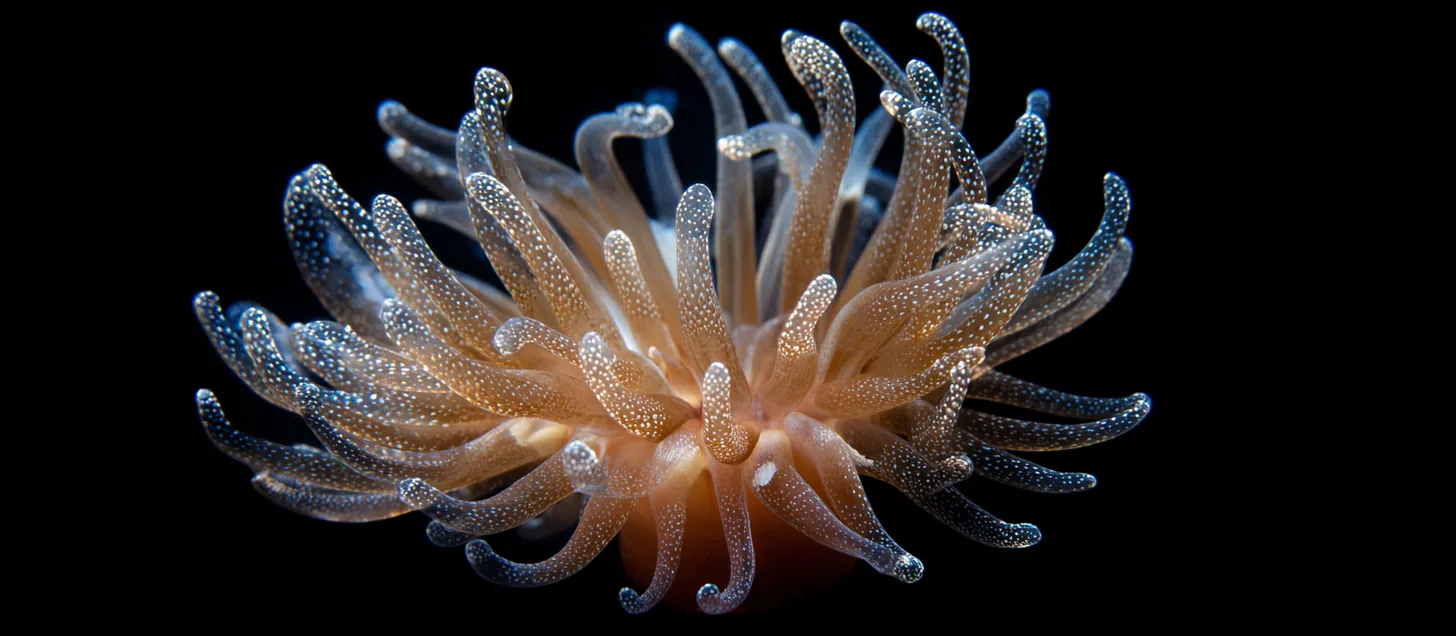
Aiptasia (scientifically Exaiptasia diaphana, formerly Aiptasia pallida and A. pulchella) is a small, brown or translucent anemone that looks like a tiny palm tree: a thin stalk topped with a disc of tapering, sharp-tipped tentacles. The colour is typically pale brown or yellowish, often with a greenish or reddish-brown hue in the centre of the oral disc. It is both photosynthetic — it hosts zooxanthellae like corals do — and a filter feeder that captures plankton with its tentacles. This double life makes it highly adaptable: it thrives both in bright light and in a nutrient-rich corner.
Identification — Aiptasia or Majano?
The most common confusion is between Aiptasia and the Majano anemone (Anemonia majano-type), and telling them apart matters, because the control methods differ. The most reliable feature is the tentacle tip:
| Feature | Aiptasia | Majano |
|---|---|---|
| Tentacle tip | Tapers to a point | Blunt, often bubble-tipped |
| Body | Thin, long stalk | Short, compact (under 3 cm) |
| Colour | Translucent–brown | Greenish-brown, neon or pink tips |
| Overall look | ”Tiny palm tree” | Low, wide disc |
The difference decides the treatment: the Berghia nudibranch, the standard Aiptasia solution, ignores Majano entirely. If the species is misidentified, biological control will not work.
Why Aiptasia is a problem
A single Aiptasia is not dangerous in itself, but rather for what it does over time. It has powerful stinging cells (nematocysts) with which it burns neighbouring corals as it competes for space and light — the same allelopathic and mechanical competition that troubles a dense mixed reef. Slow-growing corals, especially SPS, recede from contact with Aiptasia. The bigger problem, however, is the rate of reproduction.
Why it spreads — and why tearing is the worst mistake
Aiptasia reproduces asexually by pedal laceration: a small piece of tissue detaches from the edge of the pedal disc, attaches to a new surface, and within a few days develops into a new anemone. The key point is that this fragmentation accelerates under stress. Studies show that pedal laceration increases in darkness, in low oxygen, at higher temperatures and on unstable substrates — and multiplies several-fold under summer conditions compared with winter.
This leads to the hobbyist’s most common mistake: mechanically tearing, scrubbing or cutting Aiptasia detaches exactly the tissue fragments that grow into new anemones. One torn Aiptasia can become ten. Aiptasia is never removed by tearing — it is either killed in place or the whole rock is removed and treated out of the water.
Control methods in order
1. Chemical injection — for low numbers. When there are only a few anemones and they are within reach, the most effective method is to inject a substance into their mouth that kills them in place. The cheapest and most reliable is kalkwasser paste (calcium hydroxide mixed with RO/DI water into a thick paste), injected with a needle directly into the mouth. Commercial products such as Aiptasia-X work on the same principle — in practice many regard them as a pricier version of kalk paste. The key is to hit the oral disc so that the anemone swallows the substance before it retracts. Turn off the circulation pumps during the injection.
Note — “Aiptasia-X spreads them”: A common observation is that more anemones appear after an injection. This is usually not caused by the treatment but by the fact that the parent anemone already had small offspring around its base, which grow quickly once the parent is killed. The anemones had already spread before treatment.
2. Berghia nudibranch — for large, established infestations. The Berghia sea slug (e.g. Berghia stephanieae) eats Aiptasia exclusively. It is small (10–14 mm), nocturnal and needs weeks or months to build a working population — but it can clear Aiptasia from areas an injection cannot reach. Two limitations: Berghia starves once the Aiptasia is gone (it eats nothing else), and it is preyed upon by peppermint shrimp and many wrasses. Berghia should therefore not be combined with those species.
3. Peppermint shrimp — less reliable. Lysmata wurdemanni may eat Aiptasia, but there is wide variation between individuals — not all of them touch it. The species is also easily confused with the non-reef-safe camel shrimp (Rhynchocinetes durbanensis), and a shrimp capable of eating Aiptasia may also nip at coral polyps. Use with caution.
4. Laser. Looks effective but is unreliable in practice: the anemone often recovers by the next day. Kalk paste in a syringe is faster and more reliable.
Vermetids — the tube snails
Vermetids (e.g. Ceraesignum maximum, formerly Dendropoma maximum, plus several smaller species) are snails that live in a calcareous tube. Unlike an ordinary snail, a vermetid permanently cements its tube to rock or the base of a coral and does not move. It feeds by secreting a mucus net from the mouth of the tube, which drifts out into the water volume, collects particles, and is then pulled back in and eaten.
Identification
A vermetid is recognised by an irregular calcareous tube grown into the rock, from the mouth of which a thin, translucent strand of mucus rises into the water. The mucus net is the key feature: it distinguishes a vermetid from calcareous tube worms (such as feather dusters and spirorbid worms), which instead have a feathery feeding crown. If you see a fan of mucus rising from the end of a tube rather than a tuft of feathers, it is a vermetid.
Why vermetids irritate corals
A single vermetid on a remote rock is harmless. The problem arises when the mucus net repeatedly contacts coral polyps. The net irritates tissue and causes localised tissue recession, and the growth of SPS corals in particular flattens and slows beneath the net. A peer-reviewed field study on Porites corals showed that vermetids reduce coral growth and survival and alter the coral’s growth form.
Particularly interesting is the interaction with sediment: in the study, neither factor alone — vermetids or sedimentation — had a significant effect, but together they clearly reduced growth. In the presence of vermetids, seven times more sediment remained on the corals, because the mucus net binds particles onto the coral’s surface. A vermetid is therefore at its worst in a dusty tank with insufficient flow.
Control methods
1. Sealing with glue or putty. The most practical method for individual tubes: place a drop of reef-safe cyanoacrylate glue or epoxy putty over the mouth of the tube. A sealed snail cannot feed and dies. This is often easier than removing the tube, because the tube sits deep in the rock.
2. Mechanical crushing or removal. The tube can be crushed or cut off with a sharp chisel, side cutters or needle-nose pliers. Be careful not to damage surrounding corals and the rock structure. Simply cutting the tube is not always enough if the snail survives deeper inside — make sure by sealing.
3. Biological control. The bumblebee snail (Engina mendicaria) preys on vermetids, and some wrasses (e.g. Halichoeres species) eat their larvae and juveniles. Predators usually do not eradicate an infestation entirely, but they keep the population in check. More on predators in the cleanup crew article.
When to leave them be. A few vermetids far from corals do not require action. Intervene only when the mucus nets reach corals or when the numbers start to climb. Needless digging in the rock disturbs more than it helps.
Prevention — the most important control method for both
Both Aiptasia and vermetids are easier to prevent than to eradicate, and both enter the tank by the same route: on the frag plug, base rock or live rock of a new coral. Quarantine and inspection before introduction are more effective than any treatment after an infestation.
Inspect every new coral frag plug visually: small Aiptasia often hide on the underside and edges of the plug, and vermetid tubes show up as small calcareous bumps. In practice the most reliable approach is to detach the coral from its original plug and mount it on a new, clean one — the old plug is discarded along with any passengers. Suspicious vermetid tubes are sealed with glue already in quarantine. Removing Aiptasia is always easier in a quarantine tank than from among the rocks of the display tank.
A dip removes many pests but not all — a dip does not reliably kill Aiptasia or a vermetid, so visual inspection and a plug swap are more decisive here than the dip itself. Riuttareef’s full quarantine protocol is described in the article coral dipping and quarantine.
References
1. Peer-reviewed studies
- Clayton, W. S. Jr. (1985). Pedal laceration by the anemone Aiptasia pallida. Marine Ecology Progress Series, 21, 75–80. https://www.int-res.com/articles/meps/21/m021p075.pdf
- Schlesinger, A., Kramarsky-Winter, E., Rosenfeld, H., Armoza-Zvuloni, R., & Loya, Y. (2010). Sexual plasticity and self-fertilization in the sea anemone Aiptasia diaphana. PLoS ONE, 5(7), e11874. https://journals.plos.org/plosone/article?id=10.1371/journal.pone.0011874
- Shima, J. S., Osenberg, C. W., & Stier, A. C. (2010). The vermetid gastropod Dendropoma maximum reduces coral growth and survival. Biology Letters, 6(6), 815–818. https://royalsocietypublishing.org/doi/10.1098/rsbl.2010.0291
- Zill, J. A., Gil, M. A., & Osenberg, C. W. (2017). When environmental factors become stressors: interactive effects of vermetid gastropods and sedimentation on corals. Biology Letters, 13(3), 20160957. https://royalsocietypublishing.org/doi/abs/10.1098/rsbl.2016.0957
2. Hobbyist literature and brand documentation
- Bulk Reef Supply (2020). How to Eliminate Aiptasia Naturally: The Aiptasia Hit Squad. https://www.bulkreefsupply.com/content/post/md-2020-04-how-to-eliminate-aiptasia-naturally-the-aiptasia-hit-squad
- LiveAquaria. Aiptasia Control Options. https://www.liveaquaria.com/blogs/reef-aquarium-care/aiptasia-control-options
- TheSea.org. Majano Anemone: Identification, Removal, and Reef Tank Impact. https://thesea.org/majano-anemone/
- Salty Underground. Berghia Nudibranch — The Natural Choice for Aiptasia Control. https://www.saltyunderground.com/article/berghia-nudibranch-the-natural-choice-for-aiptasia-control
- Reef Builders (2023). How To Get Rid Of Vermetid Snails. https://reefbuilders.com/2023/05/11/how-to-get-rid-of-vermetid-snails/
- AquariumStoreDepot. Vermetid Snail Control and Removal. https://aquariumstoredepot.com/blogs/news/vermetid-snail-removal