Cleanup crew — the right animals, the right time
The cleanup crew is not decoration — it is an ecosystem service
The cleanup crew (CUC) is a group of invertebrates whose job is to keep the tank biologically functional by eating algae, detritus, dead organic matter and leftovers that other inhabitants do not process. A correctly sized cleanup crew is an invisible background force — it works quietly without constant care.
It is not a magic solution. And it does not replace water chemistry, flow or water changes.
The Riuttareef principle: no food, no cleanup crew
This is the single most important piece of advice in the article series on CUC:
A cleanup crew is not added to a tank that has nothing to eat.
During the cycling phase a freshly set up tank is biologically nearly empty. The sand is clean, the rocks are bare, surfaces are not covered in microscopic life. A snail or crab added to this environment will starve and die within days or weeks. Death produces ammonia. Ammonia loads the just-starting biological filtration. The outcome is the opposite of what was intended.
Right signs for the cleanup crew:
- Rock surfaces show a visible greenish or brownish coating — biofilm and the start of algae growth
- Visible detritus on the substrate
- The tank has passed the cycling process: ammonia and nitrite both at zero, nitrate declining
In practice this means roughly week eight after the start of cycling, when biological activity is already established.
Animals in detail
1. Turban snails — Trochus spp.
Role: Primary algae grazer. Feed on rock, glass and coral skeleton surfaces using a radula — a tooth plate feeding tool that requires iron and silica to develop. Effective against both diatom algae and film-forming green algae.
Special characteristics: Trochus can right itself when tipped over — unlike many other snails. This is a practical advantage: they do not end up lying on their backs dying between corals.
Suitable quantity: 5–7 individuals in a 100 litre tank is sufficient for maintenance. More can be added temporarily to tackle an algae problem.
Limitations: They need sufficient food. When algae runs out they move on to eating coralline algae — at this point the population is too large.
EU availability: Good. Species varies (T. histrio, T. niloticus, T. radiatus) — all are suitable.
2. Astraea snails — Astraea spp.
Role: Functionally close to Trochus — an effective algae grazer on flat surfaces: glass, substrate, horizontal rock surfaces. Particularly good for film-forming green algae coatings.
Special characteristics: Astraea cannot right itself when tipped over. This is its most significant weakness. In a shallow tank where flow can knock them onto their backs, they starve and rot in a place you cannot reach with your hands. Monitor regularly.
Suitable quantity: 5–7 individuals in a 100 litre tank.
Limitations: Cannot self-right. Not suitable for tanks with extremely strong flow or small crevices in which they can become trapped.
EU availability: Moderate.
3. Cerith snails — Cerithium spp.
Role: Substrate specialist. Lives in and on sand, feeding on diatom algae, detritus and organic matter in the top layer of the substrate. Keeps the substrate surface layer moving passively — does not burrow deep, but prevents the surface layer from compacting.
Special characteristics: Small, peaceful, do not damage corals. Well suited to sand-heavy areas. Often spontaneously reproduce in captivity — egg strings visible on the glass or rocks.
Suitable quantity: 8–10 individuals in a 100 litre tank.
Limitations: Do not eat algae off rock surfaces — their role is limited to substrate and low surfaces. A complementary role, not a primary one.
EU availability: Good.
4. Nassarius snails — Nassarius spp.
Role: Bottom cleaner. Burrow into sand and emerge when they detect food by smell. Feed on dead organic matter, leftover food and dead animals — functioning as a kind of ventilation helper inside the sand.
Special characteristics: Their role is purely in detritus removal — they do not eat algae at all. Their movement through the sand helps keep the substrate’s anaerobic layer in check. A rapid emergence from the sand to the surface is one of the healthiest signs a tank can show.
Suitable quantity: 5–8 individuals in a 100 litre tank, if sandy substrate is present.
Limitations: Cannot survive without enough organic matter in the sand. If the tank is very low-nutrient and the sand completely dead, they will starve. Note also: Nassarius vibex is widely sold, but some reports suggest it can occasionally go after immobile or recently deceased animals.
EU availability: Good.
5. Hermit crabs — Calcinus spp., Clibanarius tricolor, Paguristes cadenati
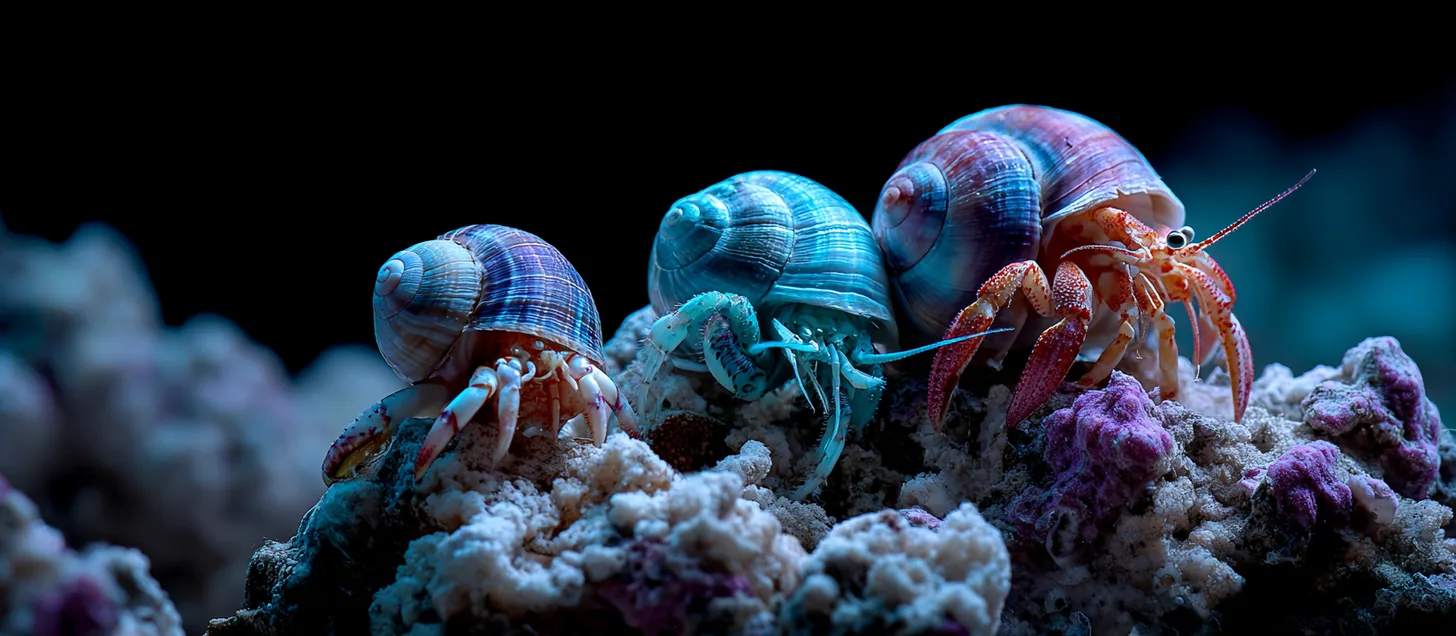
Role: Versatile all-rounders. Feed on algae from rocks and substrate, move detritus and continuously search for food. The most active and visible members of the cleanup crew.
Special characteristics: Here is a critical caveat that many hobbyists learn the hard way: hermit crabs kill snails. They need shells as they grow, and if no empty shells are available they take occupied ones by force. The result is a dead snail and a crab with a new home.
Riuttareef recommendation: if the tank has snails, always keep a supply of empty shells in multiple sizes. Without them, hermit crabs are your snails’ worst enemy.
Clibanarius tricolor is small and reasonably coral-safe. Calcinus species vary — some stay peaceful, others are more active. Paguristes cadenati is a good basic choice.
Suitable quantity: 4–6 individuals in a 100 litre tank. More means more shell demand and more risk to snails.
Limitations: Empty shells must always be available. Larger hermit crab species (e.g. Dardanus megistos) do not belong in a small tank — they are aggressive and can damage corals.
EU availability: Good.
6. Mespilia globulus — tuxedo urchin
Role: One of the most effective algae grazers in the tank. Systematically removes algae from all accessible rock surfaces, including spots snails cannot reach. Scientific literature shows M. globulus protects coral settlement surfaces by keeping competing algae in check (Craggs et al. 2019, Scientific Reports).
Special characteristics: Mespilia globulus is a small, peaceful urchin — a considerably better choice for a home reef than larger species such as Diadema or Echinometra, which can damage corals or knock coral pieces over as they move. M. globulus stays under 5–6 cm in diameter.
Very important limitation: The urchin needs enough algae to survive. On the first addition, one individual is sufficient — if algae is scarce, multiple urchins compete for the same food and all suffer. In scientific experiments with groups of multiple urchins, individual growth slowed significantly when food was insufficient for all (Craggs et al. 2019). Add a second individual only when algae visibly exceeds what one can eat.
Suitable quantity: 1 individual in a 100 litre tank in baseline conditions.
EU availability: Moderate — ask speciality shops in advance.
7. Sand-sifting sea star — Archaster typicus
Role: Bottom cleaner. Lives in and on the sand, constantly moving in search of organic matter and detritus. Keeps the sand surface layer active and helps break down accumulated organic matter.
Special characteristics: Archaster typicus is one of the few sea stars suitable for a home reef without significant reservations. It stays a reasonable size, is peaceful towards snails and corals, and its behaviour is predictable. It does not aggressively disrupt sand but moves steadily near the surface.
Suitable quantity: 1–2 individuals in a 100 litre tank if sufficient sandy substrate is present.
EU availability: Moderate.
8. Brittle sea star — Ophiolepis superba
Role: Bottom cleaner. Lives under rocks and inside sand, actively searching for detritus and organic matter at night. One of the most effective hidden members of the cleanup crew.
Special characteristics: Ophiolepis superba is completely peaceful toward corals and causes no harm to other tank inhabitants. It spends most of its time in hiding — the hobbyist rarely sees it during the day. This does not mean it is dead or ill; brittle stars are naturally nocturnal. Their night-time activity is a sign of healthy sand and organic matter cycling.
Warning — the wrong brittle star: Ophiarachna incrassata is often sold under the same name or confused with other brittle stars. It is absolutely not suitable for a reef tank — O. incrassata is an active and effective predator that kills snails, small crustaceans and fish at night. It can grow to a considerable size, making it even more dangerous. Always verify the species before purchase.
Suitable quantity: 1–2 individuals in a 100 litre tank.
EU availability: Variable.
9. Lysmata spp. — cleaner shrimp
Cleaner shrimp (Lysmata amboinensis, L. wurdemanni) are popular and ornamental. L. amboinensis provides a so-called cleaning station service — fish come to have parasites or dead tissue removed. L. wurdemanni is known as an Aiptasia anemone destroyer.
These are not, however, truly cleanup crew in the traditional sense — they do not eat algae and do not significantly recycle detritus.
Risk in an LPS tank: Both Lysmata species can invade large-polyp corals, particularly when they are relaxed at night or during feeding. Reports of damage to Euphyllia and Trachyphyllia corals are common. This is not an absolute rule — some individuals never cause problems — but the risk is real in an LPS-focused tank.
Riuttareef recommendation: If you want a cleaner shrimp, get one L. amboinensis, observe behaviour during the first weeks and be prepared to remove it if needed.
Total quantity and balance
Almost every hobbyist over-sizes their cleanup crew early on. The reason is understandable: the tank looks coated in dirty algae, and the temptation is to solve the problem by adding more animals. However, this leads to algae running out too quickly, cleanup crew members starving or moving to undesired targets, and the resulting decomposition adding to the nutrient load.
Practical rules of thumb for a 100 litre LPS/softie tank:
| Animal | Riuttareef recommendation |
|---|---|
| Trochus or Astraea | 5–7 individuals |
| Cerithium | 8–10 individuals |
| Nassarius | 5–8 individuals |
| Hermit crabs | 4–6 individuals + empty shells |
| Mespilia globulus | 1 individual (add more if needed) |
| Archaster typicus | 1–2 individuals |
| Ophiolepis superba | 1–2 individuals |
Roughly 25–36 invertebrates total. This is a maintenance cleanup crew, not an over-resourced rapid-cleaning squad.
The cleanup crew naturally self-balances over time: if food is too scarce, the population shrinks. If food is too abundant, the population can grow in a controlled manner or the nutrient load can be reduced through other means.
Quick summary: when and what
Week 6–7 (after cycling, before cleanup crew): Seed pods and phyto — Tisbe and Tigriopus pods start eating detritus and biofilm and form the foundation for the cleanup crew.
Week 8: Add the cleanup crew — snails and hermit crabs first, when rocks show clearly visible algae growth.
Weeks 14–16 onwards: Mespilia globulus, Archaster typicus and Ophiolepis superba can be added when the tank is biologically established.
This order is not coincidence. Pods first — they survive without competition and build a population that feeds future inhabitants. Cleanup crew next — there is food, animals survive. Corals and fish last — the tank is biologically mature enough to receive them.
References
1. Peer-reviewed studies
- Craggs, J., Guest, J., Bulling, M. & Sweet, M. (2019). Ex situ co culturing of the sea urchin, Mespilia globulus and the coral Acropora millepora enhances early post-settlement survivorship. Scientific Reports 9, 12984. https://doi.org/10.1038/s41598-019-49447-9
- Shaw, J.A., Macey, D.J., Brooker, L.R. & Clode, P.L. (2008). Tooth use and wear in three iron-biomineralizing mollusc species. Acta Biomaterialia 4(6), 1356–1360.
2. Hobbyist literature and brand documentation
- Aslett, C.G. (2024). Teach a Person to Fish… SPS Academy Part X. Reef Ranch. https://www.reefranch.co.uk/
- Coral magazine (2022, Jan/Feb). Cycling phase tips: biological helpers, CUC timing, and algae succession in new reef systems.
- AlgaeBarn (2023). How EcoPods Helps Keep a Reef Tank Healthy. https://www.algaebarn.com/
3. Books and textbooks
- Borneman, E.H. (2001). Aquarium Corals: Selection, Husbandry, and Natural History. Microcosm Ltd.
- Calfo, A. & Fenner, R. (2003). Reef Invertebrates. Reading Trees / Wet Web Media.
- Sprung, J. & Delbeek, J.C. (1994–2005). The Reef Aquarium (Vol. 1–3). Ricordea Publishing.