Dinoflagellates in the aquarium — identification and treatment
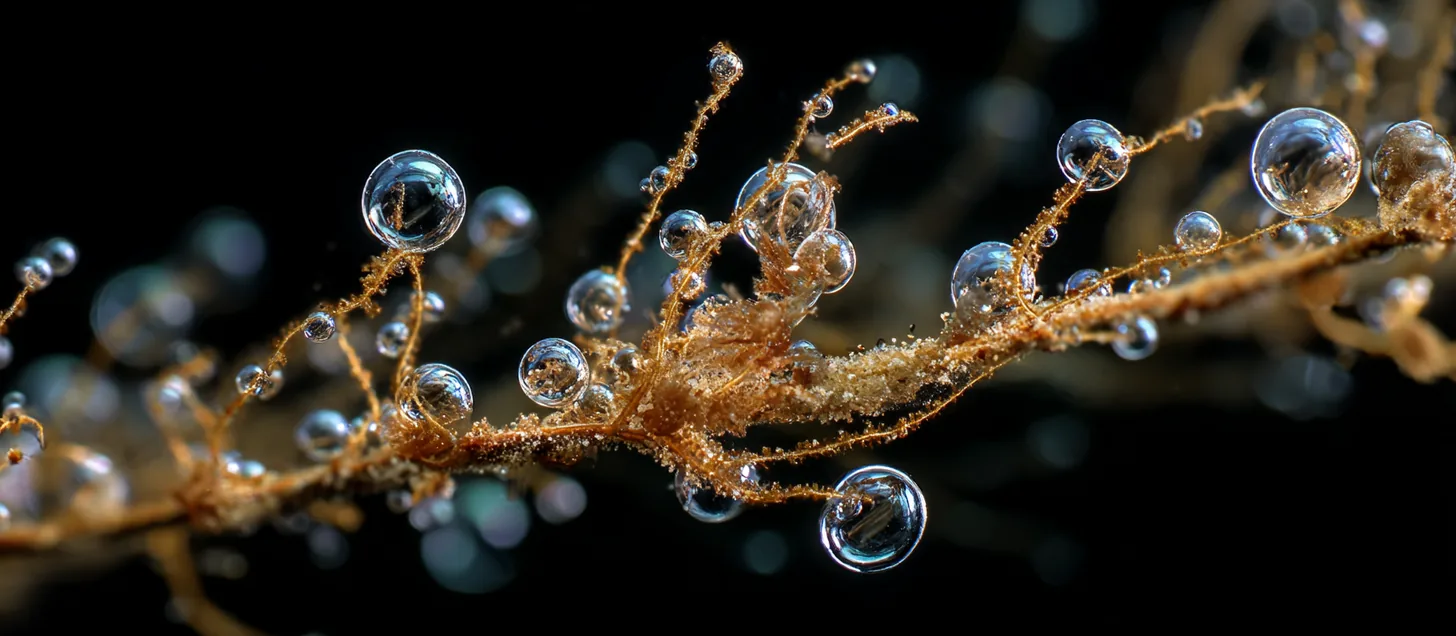
Dinoflagellates are the reef hobbyist community’s most feared problem — and one of the most misunderstood. The hobbyist recognises the brown slime whose bubble-dotted patches spread daily, finds a hundred different pieces of advice online and tries them in sequence. One says raise nutrients, another says lower them. One recommends a blackout, another a chemical treatment. Some succeed, some do not — and the difference is often whether the species was correctly identified and the treatment strategy matched accordingly.
This article gives a clear action model: identify first, treat second. Without identification, treatment is guesswork.
What dinoflagellates are
Dinoflagellates (Dinoflagellata) are single-celled protists — eukaryotic micro-organisms that are neither algae nor bacteria, though they are often called both in the hobbyist community. They are an evolutionarily exceptional group: their chromosomes remain permanently condensed unlike most eukaryotes, and many species are mixotrophs — they photosynthesise in light but are also capable of consuming organic matter.
The same group includes both the zooxanthellae symbiont (Symbiodiniaceae family) that makes reef life possible and some of the most toxic organisms in the marine environment. Species causing problems in aquariums belong to several genera whose biology, toxicity and treatment strategy differ significantly from each other.
Identify first — a microscope is an essential tool
The most common hobbyist mistake in a dino situation is to start treatment without identification. Brown slime can be cyanobacteria, diatoms, chrysophycean algae or dinoflagellates — and treatment strategies for these differ. Wrong treatment can worsen the situation or needlessly kill clean-up crew.
Quick field test: Take a sample and shake it vigorously in a sealed bottle. Cyanobacteria breaks apart and turns cloudy green. Dinoflagellates survive shaking — they form a diffuse suspension without a clear colour change. This test gives direction but does not replace microscope identification.
Microscope requirement: Minimum magnification is 400× (40× objective + 10× eyepiece). A standard light microscope works — electronic USB microscopes do not reliably reach this magnification. A few tens of euros is small compared to what the wrong treatment can cost in coral mortality and lost weeks.
Species identification table
| Species | Size | Toxicity | Night migration | Appearance in tank |
|---|---|---|---|---|
| Ostreopsis spp. | 40–80 µm | High | Into water | Long, slimy strands; spreads to all surfaces |
| Coolia spp. | 30–50 µm | Low–moderate | Into water | Short strands, concentrated on sand |
| Amphidinium (large cell) | 30–60 µm | Low | Into sand | Brownish dust or thin mat on sand and rock |
| Amphidinium (small cell) | 10–15 µm | Low–moderate | Into water | Thin film on all surfaces |
| Prorocentrum spp. | 30–60 µm | Moderate–high | Into water (weakly) | Thick, yellowish-brown mat on sand and rock |
Identification help can be found in the Reef2Reef forum dinoflagellate ID thread (Taricha, 2019) and the guide Defeating Dinos by Mack, Chartier and Logan (Rev C, 2021), whose ID section was prepared by Jonathan Begnaud.
Why dinos appear — the competition model
The most common misconception is that dinos are powerful invaders waiting for the right moment to strike. The reality is the opposite: dinoflagellates are slow-growing, nutrient-scarcity-adapted organisms that survive in conditions where faster competitors struggle. They do not take over the tank because they are strong — but because their competitors are weak or absent.
Typical triggering situations:
Nutrient starvation (zero-zero trap). When both nitrate and phosphate test at zero on consumer tests, the tank is living in chronic nutrient starvation. Beneficial heterotrophic bacteria, diatoms and other micro-organisms cannot sustain their populations. Competition collapses, a niche opens.
New tank with dry rock. Dry rock contains no mature microbiome. A competing community is entirely absent. Many dino cases begin in the tank’s first months for exactly this reason.
Microbiome destruction. Hyposalinity treatment, antibiotic courses, chemical treatments against cyanobacteria or aggressive carbon dosing can destroy the competing microbiome. A dino bloom typically follows 2–4 weeks later.
Sudden nutrient drop. Fluconazole treatment against bryopsis, fish loss from quarantine treatment or starting a GFO reactor raise dinos’ competitive advantage by the same logic.
The solution is not “poisoning” or chemically exterminating dinos — it is restoring competition. Treatment that does not support the rebuilding of a competing community leads to repeated relapse.
Two treatment strategies — species determines the approach
This is the article’s single most important piece of information. Ostreopsis, Coolia and small-cell Amphidinium migrate into the water at night — they are “swimmers”. Large-cell Amphidinium and Prorocentrum mostly stay in sand and on rock — they are “sand dinos”. These two groups require different treatment strategies.
Swimmer dinos: Ostreopsis, Coolia, small-cell Amphidinium
Because these species move into the open water column at night, UV sterilisation works on them. UV kills free cells in the open water column — and the daily cycle keeps the population in check.
UV sizing for dino treatment differs from normal use: manufacturer recommendations are sized for killing bacteria and soft parasites, not dinoflagellates. Dino treatment requires oversized UV and slow flow rate. Flow rate through UV: 1–3× tank volume per hour (e.g. 200 L tank → 200–600 L/h). Position the UV inlet as close to the sand bed as possible so cells rising at night enter circulation. Run UV 12–24 hours per day during treatment.
Special note for Ostreopsis: Add activated carbon to the sump immediately. This species is strongly toxic — see safety guidance below.
Sand dinos: large-cell Amphidinium, Prorocentrum
These species do not move significantly into the water at night, so UV does not work on them. The strategy is to induce a diatom bloom that competes with dinos for sand surfaces.
Sodium silicate (waterglass, 36–41%) raises water silicate concentration, favouring diatom growth. Target is 2–3 ppm Si. Starting dosing guidance: 0.1 ml of 36–41% waterglass solution per 57 L raises concentration by approximately 1 ppm. Diluting in approximately 250 ml of RO water before adding smooths the dose. The diatom bloom takes about 10 days to get going — do not overdose from impatience.
Important warning: If dosing silicate, do not use a Hanna phosphate test — silicate interferes with the test reaction and gives false results. Also monitor alkalinity, calcium and magnesium, as silicate can lower these in prolonged use.
Common measures for all species
These measures are started immediately, regardless of which species is present — can be started before microscope ID is ready.
Nutrients to target levels. Nitrate and phosphate must be measurable. Target for mixed reef: NO₃ 5–10 mg/L, PO₄ 0.05–0.1 mg/L. SPS-dominant: NO₃ 2–5 mg/L, PO₄ 0.02–0.05 mg/L. If both are at zero, restore normal feeding first.
Remove amino acids and bacterial food immediately. Amino acids, amino-bacto-type products and similar organic carbon sources feed dinos effectively. Stop these immediately when a dino suspicion arises. Normal fish feeding continues.
Shorten photoperiod. Reduce lighting to 5–6 hours per day during treatment. Emphasise blue light — reduce white, green and red.
Live microbiota regularly. Add live phytoplankton, copepods and bacterial inoculants weekly. These build the competing community whose absence originally gave dinos their niche.
Physical cleaning. Vacuum dinos from sand daily. Use a 5–10 micron filter sock in the sump — dinos are 10–80 µm, so coarser socks let them back into circulation. Blow rock with a turkey baster in the evening — dinos move into the water where UV or filtration removes them.
Hydrogen peroxide cautiously. Food-grade 3% hydrogen peroxide at 1 ml per 37 L per 24 h has been used as an auxiliary tool. H₂O₂ also affects beneficial microbiota — it should not be used as primary treatment.
Ostreopsis — special warning
Ostreopsis cf. ovata produces palytoxin-like compounds — ovatoxins — among the most toxic known natural compounds. This is not just an aesthetic problem or coral welfare issue. This is a human health risk.
Exposure routes in the aquarium: The most important risk is inhalation. Water changes, stirring the tank or skimmer maintenance produce small aerosols. Indoors these can accumulate in breathing air. Symptoms — fever, respiratory irritation, conjunctivitis, skin reactions — can begin after brief exposure. Multiple hospital cases have been documented in the Mediterranean during coastal blooms.
Practical safety guidance: Start activated carbon in the sump immediately. Do water changes in an open space or outdoors. Use an FFP2 or FFP3 respirator when doing intensive work with the tank. Do not add new clean-up crew — they will die from the toxin.
Note also that zoanthid corals (Palythoa spp.) kept in the aquarium contain palytoxin in the same category — an Ostreopsis situation and a zoanthid situation are dual alerts.
What to avoid
Carbon dosing products and vodka dosing. Carbon dosing targets nutrient removal — exactly the opposite direction to what is needed in a dino situation.
Chemical treatments. Dinoflagellates do not respond to antibiotics (they are eukaryotes). Cyanobacteria killers such as chemiclean work on cyanobacteria — not on dinos.
UV for the wrong species type. UV is an effective tool for swimmer dinos but pointless for sand dinos. If the species is unidentified and UV is started in a sand-dino situation, the competing microbiome may be destroyed without any effect on the actual problem.
Silicate for the wrong species type. Silicate’s purpose is to start a diatom bloom competing with sand dinos. For swimmer dinos it is an unnecessary additional measure.
Relapse risk — why visual settling does not mean victory
Ostreopsis and some other species form resting stages — cysts — that sink to the sand bed. A cyst is a dormant cell, invisible, resistant to most chemicals and viable while waiting.
This is why many hobbyists report that “dinos came back a month later.” The problem never fully disappeared — it went dormant.
Relapse prevention means long-term microbiome building, not a single treatment round. A living microbiome, stable nutrients and a functional competing community are the only sustainable protection.
Summary
Dinoflagellates do not take over the tank by force — they fill the empty space created when the competing community has weakened. Treatment is not exterminating dinos but restoring competition.
1. Identify first. Microscope at 400×, identify the species before starting treatment.
2. Choose strategy by species. Swimmer dinos → UV + nutrients + microbiome. Sand dinos → silicate + nutrients + microbiome. All species → no amino acids, no chemiclean, no carbon dosing.
3. Build the microbiome long-term. Visual settling does not mean victory. Cysts are waiting.
References
Peer-reviewed studies
- Accoroni, S. et al. (2015). Allelopathic interactions between the HAB dinoflagellate Ostreopsis cf. ovata and macroalgae. Harmful Algae, 49, 147–155.
- Ciminiello, P. et al. (2012). Isolation and structure elucidation of ovatoxin-a. Journal of the American Chemical Society, 134(3), 1869–1875.
- Miele, V. et al. (2024). Isolation of ovatoxin-a from Ostreopsis cf. ovata cultures. Journal of Chromatography A, 1736, 465350.
Hobbyist literature and brand documentation
- Aslett, C. G. (2024). Holosystemics: Captive Reef Function versus Malfunction. Reef Ranch Publishing.
- Mack, J., Chartier, S., & Logan, A. (2021). Defeating Dinos (Rev C). Dino-ID: Jonathan Begnaud.
- Reef2Reef.com — “Dinoflagellate Identification Guide” (Taricha, 2019). https://www.reef2reef.com/threads/dinoflagellate-identification-guide.671466/
- Reef2Reef.com — “A Dinoflagellate Treatment Guide” (Mack et al., 2022). https://www.reef2reef.com/threads/a-dinoflagellate-treatment-guide.884961/