
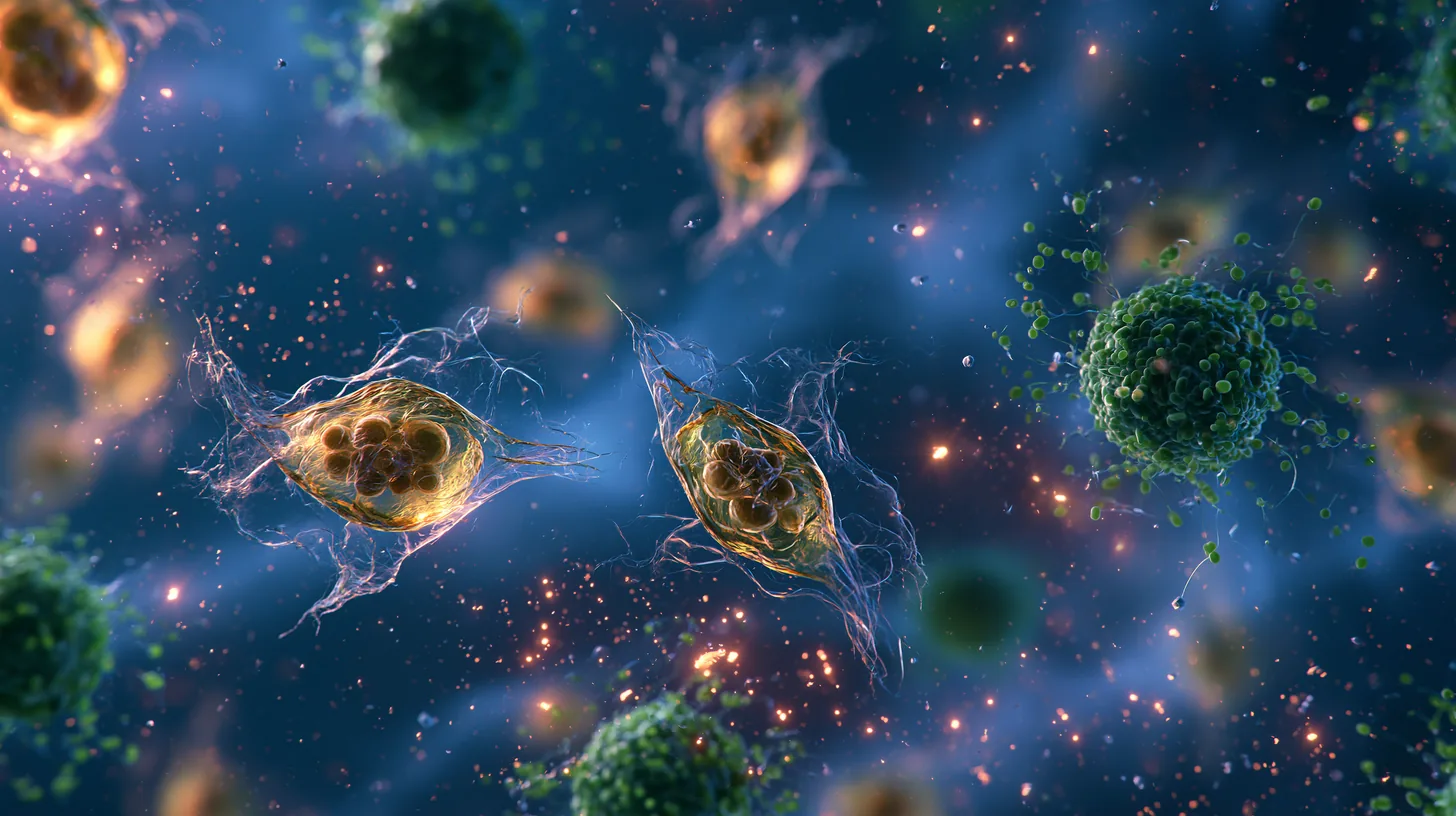
Iron and dinoflagellates
In managing dinoflagellates, the absolute level of iron is a misleading starting point. What matters is not whether there is too much or too little iron, but who in the tank wins the competition for available iron. That is determined by the nutrient ratio, not iron alone.
Two contradictory pieces of advice circulate in the hobbyist community for combating dinoflagellate outbreaks. One says that dinos are caused by iron deficiency and you should dose iron to fight them. The other says iron should be removed from the tank to starve the dinos. Both approaches look at iron concentration as an absolute number, and that is precisely why both lead astray.
1. Why staring at concentration leads astray
Iron cannot be removed from the tank without problems, because all photosynthetic life needs it — including coral zooxanthellae. Iron removal would not work against dinos anyway, since dinoflagellates are the organism group that performs best under iron scarcity (section 3). Dosing iron, on the other hand, can worsen the situation if nitrate and phosphate are simultaneously at the bottom.
The common error in both pieces of advice is the same framing: is there too much or too little iron? A more useful question is who in the tank wins the competition for available iron — and the answer to that is determined by the nutrient ratio.
2. The competition model
Iron is not the outbreak trigger in itself. Nitrate and phosphate set the rules and give some organism group a competitive edge in the contest for iron. There are roughly four situations:
| Iron | NO₃ / PO₄ | Competitive advantage |
|---|---|---|
| Abundant | Low | Dinoflagellates |
| Abundant | High | Green algae (filamentous and macro) |
| Scarce | Low | Green algae |
| Scarce | Low N, high P | Nitrogen-fixing cyanobacteria |
The first row is the most common dino trap in modern reef aquariums. When phosphate and nitrate have been stripped close to zero — through GFO, lanthanum, carbon dosing, large water changes or dead start rock — competing filamentous and macroalgae cannot compete, and dinos have a free playing field to contest iron.
The competition model explains a set of observations that otherwise appear contradictory:
- Dino outbreak after a large water change. The change lowers nutrients and replenishes trace elements including iron. The tank moves to the first situation in the table.
- GFO triggers dinos. GFO lowers phosphate and weakens competing algae.
- A chaetomorpha refugium makes dinos disappear. Macroalgae wins the iron competition when conditions allow its growth.
- Dosing nitrate helps. It feeds microalgae that start competing for iron and take the competitive edge from dinos.
- Sterile tanks or dead start rock get dinos more easily. They lack the diverse algae community and microbiota that would otherwise compete for iron and other trace elements.
In all of these, the absolute iron level is secondary. What matters is whether the tank contains a competitor that takes iron from the dinos.
3. The mechanism
The competition model is not just a hobbyist observation. It has a clear biological mechanism documented in peer-reviewed literature.
Dinoflagellates have high iron requirements compared to other phytoplankton groups. Yet they appear in abundance in the iron-scarce HNLC (high-nutrient, low-chlorophyll) regions of the open ocean. The apparent contradiction resolves when you look at how they acquire iron under scarcity.
A transcriptomic study of the Karlodinium genus (Jang, Lin & Marchetti 2025) identified several parallel survival strategies:
- High-affinity iron uptake system. Under iron-scarce conditions, cells increase expression of iron-scavenging genes (ISIP3, pTF, FRE, NRAMP) and capture scarce iron more efficiently than competitors.
- Replacing ferredoxin with flavodoxin. The cell switches an iron-requiring photosynthesis protein for a less iron-demanding version, reducing its own iron requirement.
- Mixotrophy. Some strains eat other cells to obtain particulate iron when dissolved iron is unavailable.
Iron limitation slowed cell growth but did not kill them. There is also another mechanism in the chemistry of dissolved iron in marine environments: prokaryotes release siderophores — organic molecules that bind and transport iron — and this siderophore-mediated competition affects who ultimately obtains the iron.
From the aquarium perspective, a dino is an evolution-refined iron competition specialist. This is why removing iron does not starve dinos: they survive scarcity better than their competitors. The same mechanism explains why adding iron when NO₃ and PO₄ are at the bottom may feed the dino rather than help.
4. What to do in practice
The practical conclusion follows directly from the competition model. The goal is not to adjust the absolute iron level but to shift the competitive advantage away from dinos by growing a competitor that wins the iron contest on the hobbyist’s behalf.
- Restore nutrients off zero. NO₃ and PO₄ must not be at zero. Target NO₃ around 5–10 ppm and PO₄ around 0.05–0.1 ppm. The primary adjustment tool is feeding, not bottle dosing.
- Grow a competing algae population. A Chaetomorpha refugium or algae scrubber gives macroalgae the opportunity to win the iron competition. The solution is biological, not chemical.
- Build microbiota and diversity. Live phytoplankton, copepods and bacterial preparations introduce competitors into the empty niche.
- Remove GFO. In a dino-affected tank, iron-based phosphate removal both weakens competing algae and can act as an iron source. Switch to plain activated carbon if needed.
- Check source water and metals. An old RO/DI cartridge, iron-rich raw water, a rusty float-switch magnet or other metal component can be a continuous iron source. ICP reveals elevated iron; absorption media can remove the excess.
- Avoid blind iron removal. The goal is to limit, not eliminate. Iron is essential to all photosynthesis, corals included.
5. Limits of the evidence
In the interest of accuracy, it is worth separating what has been demonstrated from what is a plausible hypothesis.
The competition model is a hypothesis, not a controlled result. The four-situation framework explains observations well and is consistent with marine biology, but its original formulation is based on one hobbyist’s observations from two tanks.
The dosing test gives a direction, not a timeline. One hobbyist isolated Amphidinium and dosed iron, silica and iodine separately in controlled containers. Dino growth followed iron dosing, not silica or iodine. The direction supports the competition model, but the test was rough — effectively one replicate per condition and no measured elemental concentrations — and no published quantitative population curve exists.
The order of magnitude is the single most important caveat. The iron increases in that test were approximately 0.1 and 0.5 ppm, or around 100 and 500 µg/l. Fauna Marin’s reef target for iron is 0.1–0.2 µg/l and the ceiling is below 5 µg/l. The test doses were therefore hundreds of times higher than reef targets — closer to open-ocean iron fertilisation experiments. The result supports the claim that adding iron produces more dinos, but it says nothing about whether normal reef aquarium iron scarcity drives dinos.
ICP iron does not reflect biological availability. ICP shows the element, not its chemical form. Much of the iron in salt mixes (anticaking agents) is biologically unusable and removed by skimming. A high ICP reading does not automatically mean iron available to dinos.
6. Summary
Iron and dinoflagellates are connected, but not through a deficiency–bloom mechanism. Three key points:
It is about competition, not level. Both “iron deficiency causes dinos” and “dose iron to get rid of dinos” are faulty conclusions, because both look at absolute concentration. What matters is who wins the iron competition.
The nutrient ratio sets the rules. Nitrate and phosphate determine whether dinos, green algae or cyanobacteria get the competitive edge. Zero nutrients combined with available iron is the dino’s ideal situation.
The solution is biological, not chemical. Restore nutrients off zero, grow a competing algae population and microbiota, remove GFO and check source water and metal iron sources. Do not remove iron blindly, and do not dose iron for a dino problem.
References
Peer-reviewed studies
- Jang, S. H., Lin, Y., & Marchetti, A. (2025). Distinct iron acquisition strategies in oceanic and coastal variants of the mixotrophic dinoflagellate Karlodinium. The ISME Journal, 19(1), wraf099. https://doi.org/10.1093/ismejo/wraf099
- Doucette, G. J., & Harrison, P. J. (1991). Aspects of iron and nitrogen nutrition in the red tide dinoflagellate Gymnodinium sanguineum. Marine Biology, 110, 165–173.
- Marchetti, A., & Maldonado, M. T. (2016). Iron. In The Physiology of Microalgae, 233–279. Springer.
- Sanchez, N. et al. (2018). Effect of Siderophore on Iron Availability in a Diatom and a Dinoflagellate Species. Frontiers in Marine Science, 5, 118.
- Hopkinson, B., & Morel, F. (2009). The role of siderophores in iron acquisition by photosynthetic marine microorganisms. BioMetals, 22(4), 659–669.
Hobbyist literature and brand documentation
- Fauna Marin Knowledge Base — Iron page. https://www.faunamarin.de/en/knowledge-base/iron/
- Holmes-Farley, R. (2002). Chemistry And The Aquarium: Iron In A Reef Tank. Advanced Aquarist.
- Mack, J., Chartier, S., & Logan, A. (2021). Defeating Dinos, Rev C.
- Reef2Reef.com — “Defeating Dino’s by controlling the fate of Iron” discussion thread.
Books and textbooks
- Aslett, C. G. (2024). Holosystemics: Captive Reef Function versus Malfunction. Reef Ranch Publishing. https://www.reefranch.co.uk/