
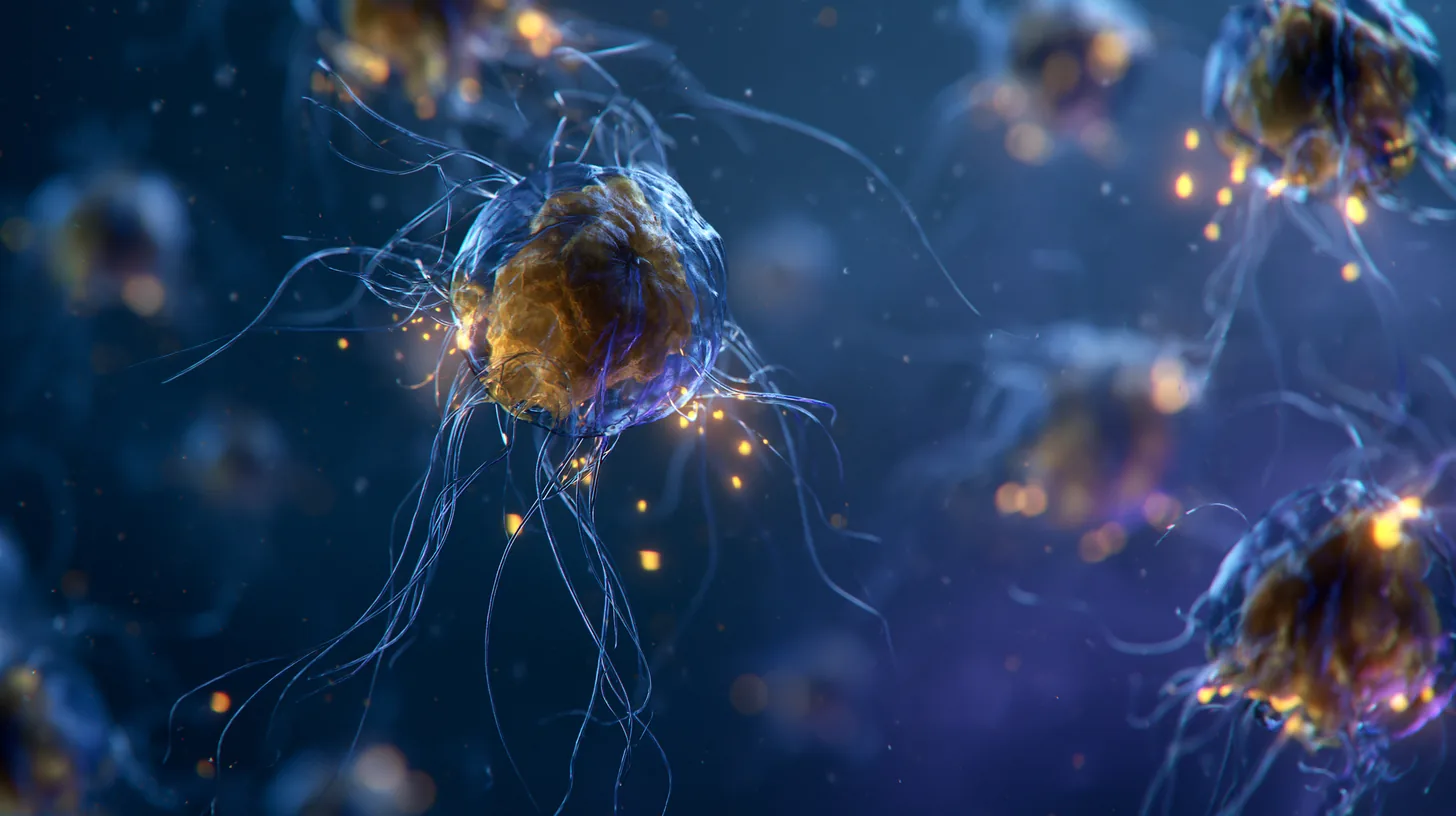
Dinoflagellates — ecology, toxins and biological control
The practice article gave the action model: identify the species, choose the strategy, restore competition. This article opens up why those actions work — and why some only work against a specific species. This is about ecology, biochemistry and how the natural reef’s biological control system functions, and what happens when it collapses in an aquarium.
Dinoflagellates are not algae
Hobbyist literature often calls dinoflagellates algae. Biologically, this is misleading. Dinoflagellates (Dinoflagellata) belong to the protists — single-celled eukaryotes closer to apicomplexa parasites (the malaria causatives) than to green or brown algae. Their cell biology is exceptional: chromosomes remain permanently condensed unlike other eukaryotes.
Evolutionarily interesting: the same Symbiodiniaceae family that includes coral zooxanthellae symbionts are dinoflagellates. The symbiont that makes the reef possible and the organism that makes hobbyist nights long belong to the same group. This is not coincidental — it tells something essential about what a dinoflagellate biologically is: an ecological opportunist specialised in finding a niche in scarcity.
The microbial competition model — why the dino wins
When a hobbyist asks “why do dinos appear”, the answer is in ecology, not chemistry. Dinoflagellates are not invasive conquerors — they are opportunists that fill a vacuum.
On a natural reef, benthic space is contested. Diatoms, bacteria, microfungi, cyanobacteria and juvenile macroalgae inhabit every available surface. Dinoflagellates are slow competitors in this community — their growth rate is low compared to many other groups. They do not win in competition under favourable conditions.
In an aquarium, this competing community is rarely complete. Dry rock, a sterilised system, nutrient zeroing, antibiotic courses and chemical treatment cycles remove competitors. When the competing community is sufficiently weakened, a dino finds free surface.
Here lies the treatment paradox: the more a hobbyist tries to eliminate dinos with chemicals or sterilisation, the more the competing community is simultaneously destroyed — and the stronger the dino becomes relative to its competitors.
Iron’s role in competition
Iron is one of those rare trace elements whose availability can shift the competitive advantage in an ecosystem. Dinoflagellates have high iron requirements compared to many other phytoplankton groups, but have evolved multiple parallel strategies for acquiring iron under scarcity.
A transcriptomic study on the Karlodinium genus (Jang, Lin & Marchetti 2025) documented these mechanisms at the molecular level. Under iron-scarce conditions, the dino upregulates expression of its high-affinity iron uptake genes (ISIP3, pTF, FRE, NRAMP). Simultaneously it replaces the iron-requiring photosynthesis protein ferredoxin with the less iron-demanding flavodoxin — reducing its own iron requirement extends competitive viability. Some strains resort to mixotrophy: eating other cells to obtain particulate iron.
Result: when nutrients are low and iron is scarce, the dino outcompetes faster-growing rivals. This explains why a GFO reactor and aggressive nutrient reduction are such common dinoflagellate bloom triggers — they do not “clean” the tank, they create the dino’s ideal competitive environment.
Iron’s biological availability is also ICP measurement’s blind spot. ICP shows total iron — but much of the iron in salt mixes is bound in chemical forms that biology cannot access. This makes “monitor iron via ICP” advice unreliable in the context of dinos.
Toxin production — an ecological defence strategy
Ostreopsis and Prorocentrum genus species produce powerful toxic compounds. This is an active ecological strategy.
Palytoxin and ovatoxins
Ostreopsis cf. ovata produces ovatoxins (OVTX-a, -b, -c, -d, -e, -f) and palytoxin analogues. Ovatoxin-a is the most abundant and best characterised. Its structure was isolated and elucidated by NMR spectroscopy (Ciminiello et al. 2012), and purification from cultured O. cf. ovata strains was achieved in 2024 (Miele et al. 2024).
Palytoxin binds to the cell membrane Na⁺/K⁺-ATPase pump — the pump all animal cells use to maintain their ionic balance. The toxin converts the pump into an ion channel: it stays open, uncontrolled Na⁺ influx begins, K⁺ leaks out. Ionic balance collapses in all cell types. The result is simultaneous respiratory muscle failure, cardiac muscle disruption and widespread inflammatory response.
Why does the dino produce such a powerful toxin? In ecological context, the toxin is a competitive weapon. It disrupts competing micro-organisms, deters predators and inhibits grazing invertebrates.
The phosphate stress-toxin production link: phosphate deficiency increases toxin production in several dinoflagellate species. Interpretation: stress triggers the most aggressive ecological defence.
Ostreopsis as a Mediterranean public health crisis
Ostreopsis cf. ovata has caused repeated public health crises on Mediterranean coasts since 2005 — in Italy, Spain, France and Greece. People have developed symptoms from nothing more than beach water aerosol exposure during a bloom. Multiple hospital cases have been documented.
An interesting climate change connection: the species’ distribution expanded to temperate areas likely with warming seawater. This means European reef hobbyists face a potentially growing risk of encounter with this species through imported fish and corals carrying cysts.
Toxicity of other species
Prorocentrum genus species produce okadaic acid and dinophysistoxins — fatty acid esters that inhibit protein phosphoproteinases. Amphidinium genus species are mostly less toxic, but some strains produce amphidinols and other bioactive compounds.
Shewanella — the biological control system
One of hobbyist literature’s central problems is that biological control is presented as a vague reference to a “living microbiome” without a mechanism. Research gives a much more concrete picture.
Shewanella sp. IRI-160 is a marine bacterium isolated in Delaware, USA. It secretes water-soluble compounds — IRI-160AA — that target dinoflagellates specifically. The effect does not require direct bacterium-dino contact: secreted compounds are sufficient. The mechanism involves multiple parallel pathways: photosynthetic efficiency (Fv/Fm) falls, cell cycle progression halts, and programmed cell death — apoptosis — is activated in cells (NOAA NCCOS 2017, 2024).
Critical detail: IRI-160AA is dino-specific. Test after test has shown it does not affect other phytoplankton — not diatoms, not green algae, not cyanobacteria. This means that on natural reefs, Shewanella genus bacteria act as a biological balancer keeping dinoflagellate populations in check without disturbing the rest of the community.
The DinoSHIELD project (NOAA, 2020–2025) took this into practice: Shewanella was immobilised using alginate beads in a slow-release system and tested at mesocosm scale, targeting use against Karenia brevis blooms in Florida.
The important conclusion for hobbyists: when biological literature says “a living mature microbiome protects against dinos”, this is not a metaphor. Shewanella genus and similar bacteria are a concrete mechanism. Dry rock, sterilisation and chemical treatment cycles do not just remove “microbes” — they remove an active biological pest control system.
Shewanella halifaxensis strain (0YLH) showed equivalent algicidal effect against Prorocentrum triestinum in a 2023 study (Cruz-Balladares et al. 2023). The bioactive compounds secreted by bacteria retained activity across an extremely broad pH and temperature range (pH 3–11, 20–120°C), suggesting structurally stable compounds.
Macroalgal allelopathy — chemical warfare on surfaces
A 2015 study (Accoroni et al. 2015) tested three Mediterranean macroalgae’s effect on Ostreopsis cf. ovata in three different experimental setups: fresh algae in direct contact, culture medium filtrate, and dried powder.
Dictyota dichotoma (brown alga) inhibited Ostreopsis growth in all test conditions — including as a culture medium filtrate alone without physical contact. This means Dictyota releases chemical compounds into the water phase that disrupt dino growth without direct surface competition. Ulva rigida (green alga) inhibited fresh and dried but not as filtrate — it does not appear to passively release allelopathic compounds into the environment. Rhodymenia pseudopalmata (red alga) worked only at high powder concentrations.
The mechanism likely involves polyunsaturated aldehydes (PUAs), which brown algae produce in abundance.
A later study (2025) expanded this to the Cystoseira genus: these macroalgae methanol extracts inhibited up to 88–100% of Ostreopsis cyst germination — practically cutting the dino bloom recurrence route at source.
Hobbyist observations confirm the same logic with different species: Chaetomorpha placed directly on Amphidinium patches has in several cases shifted the competitive advantage away from dinos.
Silicate and diatoms — food web manipulation
The silicate strategy used against sand dinos is based on ecological manipulation: start a competitor.
Diatoms (Bacillariophyta) need silica (SiO₂) to build their frustules — glass-like cell shells. Natural seawater silicate on reefs is 1–5 ppm; in aquarium water made with RO/DI it is typically close to zero. Diatoms lose the competition in such an environment simply because the building material is absent.
When silicate concentration is raised to 2–3 ppm with sodium silicate, diatoms gain an advantage. They grow rapidly — faster than dinoflagellates — and fill sand and rock surfaces.
Why the diatom bloom shifts the competitive advantage is multifaceted. Physical competition for surface is part of the answer. Diatoms’ own chemical allelopathy may be another part. Competition for iron and other trace elements is a third possibility.
Cysts — the invisible relapse risk
Ostreopsis and some other benthic dinoflagellates form resting cysts under stress conditions. A cyst is a dormant cell that has sunk to the sand bed or settled into surface crevices. It is invisible, resistant to most chemicals and viable while waiting.
Cyst formation typically occurs when conditions deteriorate: light reduction, nutrient changes, temperature drop or chemical treatment. In other words: many hobbyist treatment measures do not kill dinos — they drive them into cysts.
Cystoseira genus macroalgae extracts inhibited Ostreopsis cyst germination by 88–100%, suggesting that allelopathic strategy can specifically target the relapse route — not just the active bloom.
Collapse of biological control in the aquarium
On a natural reef, dinoflagellates are part of a functioning ecosystem where they have a limited niche. They do not dominate surfaces because Shewanella genus bacteria keep populations in check, macroalgae compete for surfaces and release allelopathic compounds, diatoms fill free space before dinos, and grazing invertebrates keep benthic biomass in check.
In an aquarium, all of these are incomplete or partially or entirely absent. There is no complete Shewanella community — a mature aquarium may have strains, a young one may have none at all. Diatoms may be entirely absent if there is no silicate.
This does not mean an aquarium cannot be in balance — but maintaining balance requires deliberate actions that replace the natural reef’s own mechanisms.
Summary
Dinoflagellates are evolution-shaped opportunists specialised in living in scarce environments, stealing iron more efficiently than their competitors, producing toxin as a competitive weapon and waiting for favourable conditions as cysts. They are not strong — they are resilient.
On a natural reef, they are managed by a complete biological system: algicide-secreting bacteria, allelopathic macroalgae, competing diatoms and grazing animals. In an aquarium, this system is incomplete.
The solution is ecological: build a competing community that replaces the natural reef’s biological control chains. Understanding why this works — Shewanella bacteria, Dictyota allelopathy, diatom competition — makes interventions more purposeful and helps avoid treatment errors that accidentally make the situation worse.
References
Peer-reviewed studies
- Accoroni, S. et al. (2015). Allelopathic interactions between the HAB dinoflagellate Ostreopsis cf. ovata and macroalgae. Harmful Algae, 49, 147–155. https://doi.org/10.1016/j.hal.2015.08.001
- Ciminiello, P. et al. (2012). Isolation and structure elucidation of ovatoxin-a. Journal of the American Chemical Society, 134(3), 1869–1875.
- Cruz-Balladares, V. et al. (2023). Identification of a Shewanella halifaxensis strain with algicidal effects on Prorocentrum triestinum. Marine Drugs, 21(9), 501.
- Jang, S. H., Lin, Y., & Marchetti, A. (2025). Distinct iron acquisition strategies in Karlodinium. The ISME Journal, 19(1), wraf099.
- Miele, V. et al. (2024). Isolation of ovatoxin-a from Ostreopsis cf. ovata cultures. Journal of Chromatography A, 1736, 465350.
- Sanchez, N. et al. (2018). Effect of siderophore on iron availability. Frontiers in Marine Science, 5, 118.
Hobbyist literature and brand documentation
- Aslett, C. G. (2024). Holosystemics: Captive Reef Function versus Malfunction. Reef Ranch Publishing.
- Mack, J., Chartier, S., & Logan, A. (2021). Defeating Dinos (Rev C).
- NOAA NCCOS — DinoSHIELD project (2020–2025). https://coastalscience.noaa.gov/project/dinoshield-a-slow-release-natural-algicide-produced-by-shewanella-sp-iri-160-for-management-of-red-tide/