
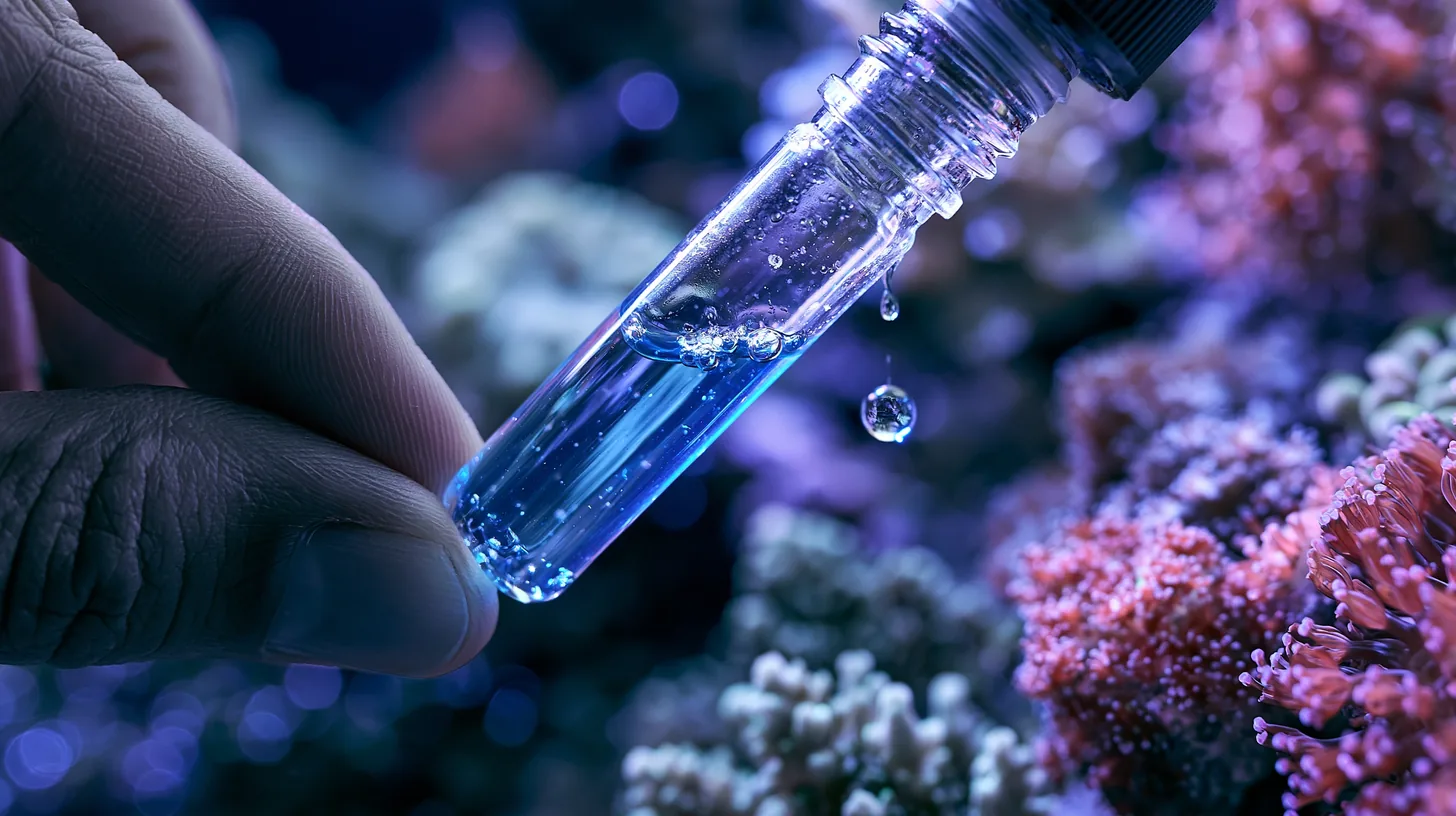
Phosphate in practice — measurement, target values, management
Managing phosphate is a balancing act between two dangers: too high slows calcification; too low kills the microbiome, opens the door to dinoflagellates and causes tissue damage in stony corals. The target range is not zero — it is a biologically functional interval, measured regularly and managed with the nutrient pair in mind.
Why phosphate is biologically essential — short version
Phosphate is the cell’s fundamental molecule. ATP — every cell’s immediate energy currency — is built from phosphate groups. The backbone of DNA and RNA is a phosphate chain. Cell membranes consist of phospholipids. Everything living in the tank uses phosphorus continuously.
For stony corals there is one additional dimension: they store phosphate in their skeletons — and this is a one-way process. Once phosphate is bound in the aragonite skeleton, it does not return to the water column. This means the tank’s phosphate reserves must be continuously replenished through feeding.
1. Target values by tank type
| Tank type | PO₄ target range (mg/l) |
|---|---|
| Softie tank | 0.05–0.15 |
| LPS-dominant | 0.05–0.12 |
| Mixed reef (LPS + easy SPS) | 0.04–0.10 |
| SPS-dominant (Acropora) | 0.03–0.08 |
| NPS / cryptic tank | 0.08–0.20 |
| Fish-dominant FOWLR | 0.10–0.30 |
Natural seawater phosphate is typically 0.01–0.02 mg/l near the surface — a reference point, not a target for a closed system.
The single most important guideline: phosphate must never be at zero simultaneously with nitrate. Oceamo’s Christoph Denk warns directly: the risk of RTN (Rapid Tissue Necrosis) rises sharply when phosphate has been extremely low for a prolonged period.
2. Measurement methods and error sources
Home tests
Hanna HI-774ULR Checker HC (ULR) — photometer, digital readout. Measures very low concentrations (0.00–0.90 mg/l). Measures only inorganic orthophosphate. Reliable when used carefully: reagents are sensitive to moisture, waiting time after reagent addition must be followed precisely. According to Oceamo, phosphate is one of the few parameters where home test and laboratory result correspondence is good — when the home test is done correctly.
Salifert PO₄ Profi-Test — colour change, accuracy sufficient for trend monitoring. Good rough indicator: is phosphate clearly above or below 0.10 mg/l?
Red Sea Phosphate Pro — wider measurement range than Hanna ULR, colour change.
All home tests share the same limitation: they measure primarily dissolved inorganic phosphate. Organic phosphate compounds do not appear in standard home tests.
ICP laboratory
ICP measures total phosphorus. ICP results and home tests can differ because they measure different things — both can still be technically correct. ICP schedule: every 4–6 weeks in an established tank.
”Zero is not zero”
Home test detection limits are typically around 0.01–0.02 mg/l. If the test repeatedly shows zero, the situation should be taken seriously — phosphate is likely in biological limitation.
3. N:P ratio in practice
Phosphate is not read without nitrate. The general consensus is to keep phosphate and nitrate in a ratio of PO₄ : NO₃ ≈ 1 : 100 (e.g. 0.05 mg/l phosphate + 5 mg/l nitrate). This is a mass ratio (mg/l), not a molar ratio.
When the ratio is strongly skewed, biology suffers — in both directions:
N:P too high (phosphate too low relative to nitrogen): Excess nitrogen without phosphorus balance disturbs coral symbiosis. Zooxanthellae density can rise (coral darkens), algae may thrive even though phosphate is low.
N:P too low (phosphate too high relative to nitrogen): Less common at home, but possible if feeding is sharply reduced without a phosphate adsorbent. Calcification inhibition intensifies.
4. GFO and other adsorbents — important considerations
Granular ferric oxide (GFO) is an effective phosphate remover — but it removes much else too. Oceamo’s ICP-MS study results on GFO trace element removal:
| Trace element | GFO effect |
|---|---|
| Barium, Chromium, Cobalt, Iron | Removed almost completely (~100%) |
| Fluoride, Copper, Manganese, Molybdenum | Removed almost completely (~100%) |
| Nickel, Selenium, Vanadium, Zinc, Tin | Removed almost completely (~100%) |
| Rubidium, Caesium | Removed significantly (~80%) |
| Iodine | Minimal effect |
| Lithium | No significant effect |
GFO is not a selective phosphate remover — it is a broad-spectrum adsorbent. Active trace element replacement is mandatory during GFO use. Oceamo recommends ICP measurement before introduction and shortly after.
Activated carbon significantly binds copper, zinc and tin. Aluminium oxide-based adsorbents release aluminium into the water — Holmes-Farley has demonstrated this irritates corals, causing polyp retraction.
5. Raising phosphate — when phosphate is too low
Primary: feeding
Food is the most natural phosphate source — it brings phosphorus in biologically correct ratios. Increasing feeding by 20–30% is most often the first and sufficient corrective measure.
Secondary: particulate phosphate
Particulate phosphate does not significantly raise dissolved phosphate in open water — instead, corals take it up directly through their polyps as a particulate suspension. Tropic Marin Phos-Feed is the first commercial product bringing this principle to aquarium use (starting dose 1 ml / 200 litres per day).
Third option: dissolved phosphate
Directly dissolved phosphate (e.g. sodium phosphate or potassium dihydrogen phosphate) can be dosed into the water. The downside is that dissolved phosphate at higher concentrations can inhibit calcification — unlike particulate phosphate, which bypasses this mechanism.
6. Lowering phosphate — when phosphate is too high
Rapid drops must be avoided: corals can be stressed by sudden phosphate changes. Especially if the tank has been accustomed to a higher level for weeks or months, suddenly targeting near-zero is as harmful as prolonged deficiency.
Water changes are the most controlled method. A 20–25% change lowers phosphate by about 20–25%.
Reducing feeding is a long-term approach. Food is the biggest single phosphate source, and reducing it shows in levels slowly but reliably — usually within 2–4 weeks.
Macroalgae remove phosphate by growing. A Chaetomorpha refugium from which algae is regularly harvested is a biologically sustainable phosphate remover. Note: macroalgae also consume considerable trace elements — active daily trace element replacement is mandatory, as with GFO.
GFO is most effective short-term, but trace element removal cannot be ignored. Small quantity in reactor, no aggressive fluidisation, ICP before and after.
Lanthanum chloride is an alternative phosphate adsorbent — effective but risky: overdosing is toxic to fish. For experienced hobbyists only.
7. Reading phosphate together with nitrate
| Situation | Interpretation | Action |
|---|---|---|
| Both in target range | Nutrient pair healthy | Continue as is |
| NO₃ fine, PO₄ below range | Phosphorus missing | Increase feeding; consider particulate phosphate |
| PO₄ fine, NO₃ below range | Nitrogen missing | Increase feeding; consider nitrogen supplement |
| Both at zero | Zero-zero trap | Increase feeding immediately |
| Both elevated | Overload | Reduce feeding; consider export |
| NO₃ high, PO₄ low | Typical GFO error | Reduce GFO or add phosphorus |
8. The zero-zero trap from a phosphate perspective
Phosphate deficiency consequences are more immediate for stony corals than nitrate deficiency. If the tank is in zero-zero state and tissue damage (STN) appears at coral bases, phosphate is likely a factor alongside nitrate or more than nitrate. Immediate increase in feeding is the correct first action — not chemical dosing.
Correction takes time. In a serious zero-zero situation, biological recovery takes weeks.
9. Practical checklist
- Never target zero — phosphate target range is 0.03–0.15 mg/l depending on tank type
- Always read phosphate together with nitrate
- Measure regularly — home test weekly or every two weeks; ICP every 4–6 weeks
- GFO removes trace elements — ICP before and after introduction, compensate losses actively
- Feeding is the primary phosphate management tool in both directions
- Do not lower phosphate rapidly — lower slowly, follow the biology
- N:P ratio above 50:1 (mass) is a warning sign
- Phosphate and algae are not synonyms
References
1. Peer-reviewed studies
- Kinsey, D. W. & Davies, P. J. (1979). Limnology and Oceanography 24(5): 935–940.
- Lapointe, B. E. et al. (2019). Marine Biology 166(8): 108.
- Buckingham, M. C. et al. (2022). Coral Reefs 41: 1147–1159.
2. Hobbyist literature and brand documentation
- Holmes-Farley, R. Phosphate in the Reef Aquarium. ReefEdition.com.
- Holmes-Farley, R. (2026). Forget Redfield, Liebig is the Man! Reef2Reef.
- Balling, H.-W. Phosphate — A Nutrient with Diverse Effects. CORAL Magazine.
- Oceamo (2019 & follow-up). Reactor media under the ICP loupe. https://en.oceamo.com/reaktormedien2/
- Tropic Marin. Phos-Feed and Phos-Start — product documentation.
3. Books and textbooks
- Sprung, J. & Delbeek, J. C. (1994). The Reef Aquarium, Vol. 1. Ricordea Publishing.
- Balling, H.-W. (2010–2015). Das Meerwasseraquarium. Natur und Tier-Verlag.