Euphyllia Genus: A Deep Dive
Euphyllia Genus: A Deep Dive
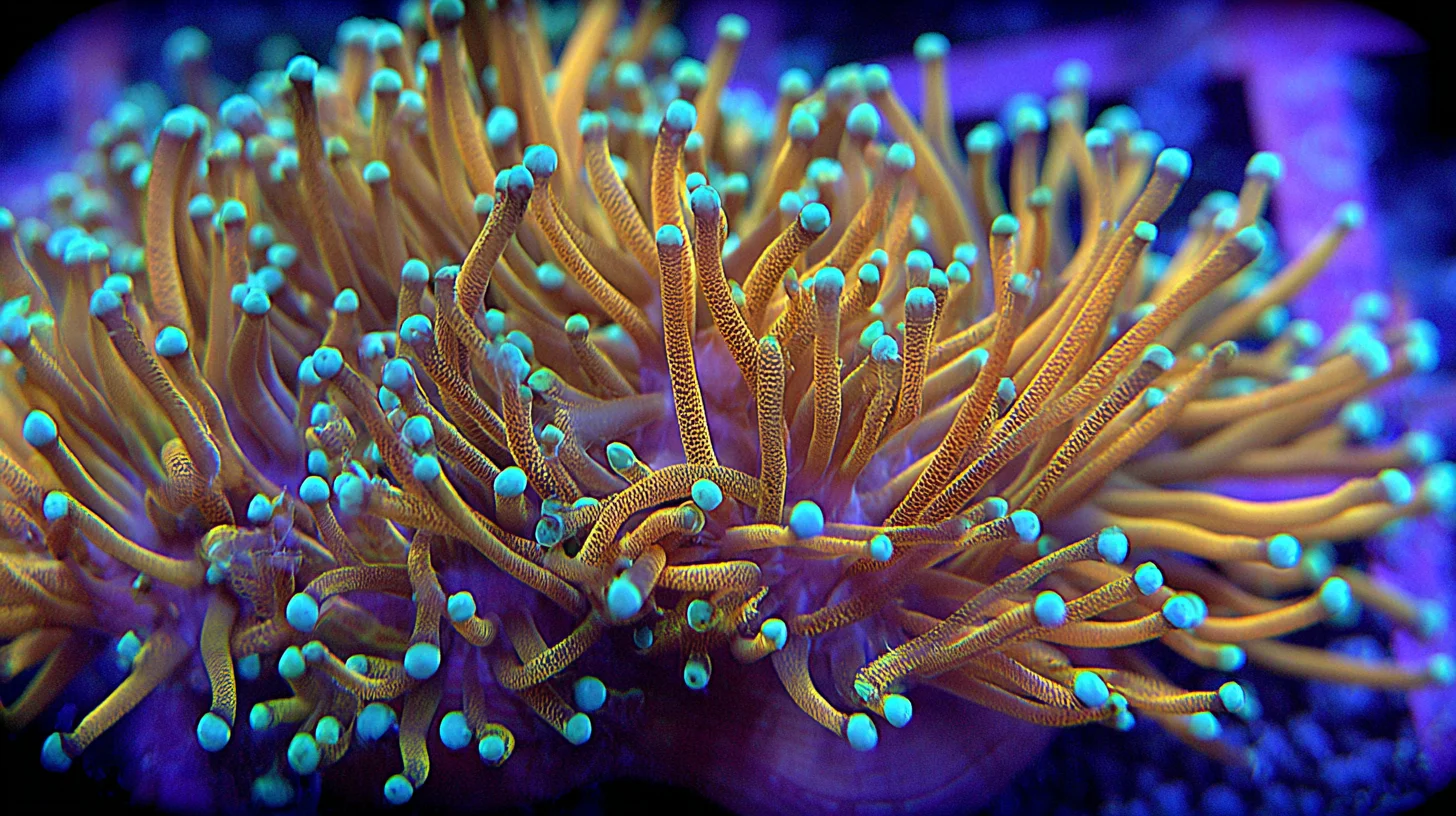
Euphyllia is the most popular LPS genus in the reef aquarium hobby. Their tentacles — bubble-tipped, hammer-shaped, or branching heads swaying in the current — are for many the image that first sparked interest in keeping a reef aquarium. That same popularity makes the genus one of the most misunderstood: Euphyllia looks easy, but species-specific differences, origin questions, and specific problems have caught many hobbyists off guard.
This article covers the genus thoroughly — from biology to care and common problems.
Taxonomy: One Genus or Several?
The family Euphylliidae was only separated as its own family in 2016 (Arrigoni et al.), with species previously classified under Caryophylliidae. In older sources — both scientific and hobbyist literature — Euphyllia still appears under Caryophylliidae. Worth keeping in mind when reading older references.
Most common species in the aquarium trade:
| Species | Common name | Tentacle shape |
|---|---|---|
| Euphyllia ancora | Hammer coral | Hammer- or anchor-shaped, often flattened |
| Euphyllia divisa | Frogspawn | Branched, globular tips |
| Euphyllia glabrescens | Torch coral | Long, tubular |
| Euphyllia cristata | Grape coral | Short, dense clusters |
| Euphyllia paradivisa | Branching frogspawn | Branching frogspawn form |
The taxonomic position of torch coral is notable. In current classification, torch corals belong to Euphyllia, but in practice they are a clearly distinct group — more aggressive, more delicate, and adapted to different conditions than hammer and frogspawn. We cover them together here for genus context, but care requirements differ significantly.
Growth Forms: Branching vs. Wall
Both hammer and frogspawn come in two growth forms:
- Branching: individual corallite tubes are separate, forming distinct branches. Noticeably hardier, faster growing, better at handling relocation.
- Wall: polyps grow as a continuous fused mass, elongated or rounded. Slower growing, more susceptible to infections and tissue damage.
For beginners, the branching form is the safer choice.
Natural Habitat
Euphyllia glabrescens and other species of the genus are found across a wide range in the tropical and subtropical Indo-Pacific: in the Coral Triangle (Indonesia, Philippines, Papua New Guinea, Solomon Islands), on Australia’s Great Barrier Reef, in the Red Sea, and along the Japanese coast south of Okinawa. In Japan, populations have been documented at depths of up to 40 metres.
The typical habitat is the mid-reef zone, 5–25 metres depth. Conditions here differ significantly from the reef crest, where Acropora and clear-water, high-energy surge dominate:
- Light is diffuse and weaker than on shallow crests
- Flow is moderate but not turbulent
- Water is often slightly more turbid than on the upper reef
- Nutrient levels are slightly elevated
This translates directly to aquarium conditions: Euphyllia does not belong in the high-light upper section of a tank, and does not require SPS-grade crystal-clear water or strong flow.
Morphology
Euphyllia forms a phaceloid structure: individual corallite tubes are separate from one another on a shared basal skeleton. The skeleton is calcium carbonate aragonite, with tissue extending down and attaching firmly to it. This tissue attachment is one of the most important indicators of health when purchasing a coral — we return to this later.
Polyps retract fully into the skeleton under stress or mechanical disturbance. The tentacles contain nematocysts — stinging cells — that serve both prey capture and defence.
Zooxanthellae (dinoflagellates of the genus Symbiodinium) live within polyp tissue and provide up to 90% of the coral’s energy needs through photosynthesis. The practical conclusion: Euphyllia needs light, but not maximum intensity — diffuse, moderate light is sufficient.
Indonesia vs. Australia — The Most Important Practical Difference
Origin is one of the least understood factors in Euphyllia keeping, and it affects both care requirements and compatibility between individuals.
Indonesian Euphyllia:
- Generally acclimate faster to a new tank
- Grow faster
- Handle variation in conditions better
- Most common origin in the commercial hobby trade
Australian Euphyllia:
- More sensitive to fluctuations in conditions
- Grow more slowly
- Often include rarer morphs and colours
- Branching forms from Australia exist — hardier than wall forms, but still more sensitive than their Indonesian counterparts
Compatibility: Individuals of the same origin — same species, same source region — generally do well living near each other. Individuals of different origins can react aggressively in contact, even if they are the same species. In practice: keep Euphyllia of different origins well separated, and don’t assume that “all Euphyllia get along.”
Care Requirements
Parameters
| Parameter | Recommended range |
|---|---|
| Alkalinity | 7.5–9 dKH |
| Calcium | 400–450 ppm |
| Magnesium | 1300–1400 ppm |
| Nitrate | 2–10 ppm |
| Phosphate | 0.02–0.1 ppm |
| Temperature | 24–26 °C |
| Salinity | 1.025–1.026 |
Special note on alkalinity swings: a daily fluctuation under 0.5 dKH is a safe limit. Faster changes can cause tissue recession or, in the worst case, RTN.
On nutrients: Euphyllia does not want a zero-nutrient environment. A ULNS tank (nitrate effectively undetectable, phosphate below 0.01 ppm) is too clean — corals lose colour and may grow slowly or poorly. A mild nutrient load is natural and beneficial.
Lighting
Euphyllia is more adaptable to lighting than often assumed. A practical starting range is 50–150 PAR, and well-kept colonies do fine even lower.
A key observation on colour: Euphyllia looks good under white light, but is at its best under blue-dominant light — fluorescence and tentacle colours are dramatically enhanced. A blue-biased lighting profile also suits Montipora plates, mushrooms, and zoanthids, which are often kept in the same tank.
Note: Montipora plates are often assumed to be high-light SPS, but they can do very well in the same lower-light environment suited to Euphyllia — useful to know when planning a mixed reef.
When adding a new Euphyllia, start it low and move it gradually to its final position over a few weeks. A sudden jump to high light is one of the most common stress triggers.
Flow
Flow is one of the most misunderstood factors in Euphyllia keeping. Because the tentacles move easily in water, they look like they are in strong flow — but in reality very little current is needed to make them sway. This optical illusion often leads hobbyists to set flow too high.
A practical test: place a leather coral (Sarcophyton or Sinularia) next to Euphyllia in the same flow. If the leather coral moves noticeably less, the flow may already be too strong for the Euphyllia.
In nature, hammers and frogspawn grow in calmer areas — reaching a large colony size does not require strong flow.
Flow guidelines:
- The desired effect is gentle swaying, not tentacles bending or constantly forced to one side
- Avoid direct, targeted flow — soft, indirect, or oscillating flow is better
- If a coral that opened well has closed up after a month, flow is usually the first thing to check
Hammer and frogspawn tolerate slightly more flow than torch, but the main principle applies to all species.
Placement
- Lower or middle section of the tank is the most natural position — not at the top competing with other LPS or SPS
- Distance from other corals: hammer tentacles reach 10–15 cm, torch up to 20 cm or more. Plan placement with the mature colony size in mind, not the current frag size
- Torch separate from other Euphyllia — covered in the aggression section below
Aggression
Hammer and Frogspawn Together
Hammer and frogspawn (Euphyllia ancora and E. divisa) can generally live in contact with each other without problems. Multiple hammers and frogspawn can be grouped closely, as long as origin is the same or compatibility has been tested. This makes them good candidates for an “Euphyllia corner” — a dedicated zone within the tank.
Torch Separate
Torch coral (E. glabrescens) is significantly more aggressive than hammer or frogspawn. It does not belong in contact with hammer or frogspawn, and even compatibility between torch individuals varies — some tolerate neighbours, others refuse to. This cannot be predicted from species identification alone.
Practical solution: place torches in their own zone, separated from other Euphyllia, with ample space. Directing flow if needed can prevent tentacles from reaching neighbours.
Chemical Warfare
Euphyllia is not as aggressive in chemical warfare as leather corals, but chemical release does occur. In a mixed reef with both Euphyllia and other stony corals or soft corals nearby, using activated carbon is a sensible precaution.
Pests
Euphyllia Flatworms
Flatworms are the most common Euphyllia pest. They are small and often difficult to spot before the infestation is already significant. A coral can look normal for months while flatworms multiply. Regular inspection of the substrate beneath the coral is therefore important.
The dipping problem with Euphyllia: Unlike most corals, standard chemical dips do not work as reliably on Euphyllia. The reason: when Euphyllia stresses — even just moving it to a dipping container is enough — it retracts its tentacles. The tentacles close around the flatworms, physically shielding them from the dip solution.
Correct dipping protocol for Euphyllia:
- Transfer the coral to a dipping container with tank water
- Wait for the coral to fully open — this can take up to 30 minutes
- Only once the coral is fully open, add the dip solution slowly and gently — do not pour directly onto the coral
- Recommended dip: Reef Primer (Polyplab) — effective against flatworms, reasonably gentle on the coral
- Alternative: 50–100 ml of 3% hydrogen peroxide per litre — more aggressive, use only when necessary
Euphyllia-Eating Flatworm
A particular, larger-than-normal flatworm species is a serious threat especially to torch corals. These worms crawl into the coral’s mouth to avoid chemical treatments and can kill the coral. They are significantly more common on wild-caught torch than aquacultured specimens, because long-term aquaculture is not possible when these worms are present.
Recommendation: 60-day quarantine for wild-caught torch corals. Extended quarantine reveals the infestation either by clearing (dipping has worked) or by losing the coral — neither outcome introduces worms into the display tank.
Other Pests
- Crabs and shrimp: can tear Euphyllia tissue, especially at night. The presence of all crabs and shrimp should be verified.
- Clownfish: Torch coral attracts clownfish as a host. Clownfish are, however, poor hosts — they repeatedly rub themselves against the sharp corallite septa of the skeleton, which tears tissue. A clownfish with a torch coral can cause ongoing tissue damage over time.
Diseases
Brown Jelly Disease
Brown Jelly Disease (BJD) is Euphyllia’s most feared disease — hammer, frogspawn, and torch are all susceptible. It presents as rapid tissue disintegration into brown, mucus-like material. Affected tissue is typically completely dead within 24 hours, leaving bare white skeleton behind.
The disease spreads readily to neighbouring corals, especially in densely populated systems.
What causes BJD? Current understanding is that it is not a single pathogen. It is a cascade failure: bacteria and ciliates are present normally in every aquarium, but some environmental change or imbalance activates them as pathogens. Why these microorganisms shift from harmless to lethal is not yet fully understood.
Response protocol when active BJD is detected:
- Do not move corals through open water — this spreads the infection
- Remove as much affected material as possible without disturbing surrounding live rock or the coral’s skeleton
- Place a container around the dead coral underwater and slowly lift it out inside the container — minimise water disturbance
Prevention is more effective than treatment. Routine observation is key: any coral that is not opening normally should be dipped promptly. Fresh activated carbon is a sensible precaution even before a problem becomes visible. Early intervention prevents a full outbreak.
RTN (Rapid Tissue Necrosis)
RTN is less common in LPS than in SPS, but possible. Tissue is lost within hours, not days (cf. STN). Most common triggers: rapid alkalinity change, temperature spike, mechanical damage, or a pest.
If RTN is detected: cut the healthy section immediately (at least ½ inch ahead of the receding tissue), dip, and move to a separate tank or quarantine.
Polyp Bailout
Polyp bailout is a rare but dramatic stress response. The coral destroys its own connective tissue through apoptosis (programmed cell death) and releases the polyp. Unlike necrosis, apoptosis is a controlled biological process — the coral is making a deliberate decision to detach. It is like a fighter pilot’s ejection seat firing — a last resort for survival.
Bailout typically affects one head on one coral at a time, which makes identifying the exact trigger difficult. Possible causes:
- Temperature shift: small tank volumes can heat or cool rapidly. A new coral encounters the change without having had time to acclimate gradually.
- Salinity drift: refractometers can fall out of calibration. A reading that shows 1.025 may in reality be 1.030 or more. Established corals have adapted slowly; a new coral encounters the extreme immediately.
- Chemical imbalance: alkalinity too low, trace elements depleted, or another water chemistry issue.
- Pest or infection: a localised pest or pathogen can trigger bailout, possibly in combination with other factors.
Recovery possibility: a detached polyp can sometimes be saved. Treat with a potassium-based or iodine-based dip and place in a calm, shallow tank — it may attach to a new substrate and begin growing.
Assessing Health When Buying
When purchasing Euphyllia, pay particular attention to tissue attachment to the skeleton. On a healthy, well-conditioned coral — especially an aquacultured specimen — the tissue extends down the skeleton and is clearly adhered. The tissue should be thick and grip firmly.
Warning sign: if the tissue is receding upward toward the polyp, there is a risk it will continue receding and eventually detach entirely. A healthy coral lifted out of water should immediately produce visible mucus on the underside of the skeleton.
Aquacultured vs. wild-caught:
- Aquacultured specimens are generally acclimated to aquarium conditions, suffer less transport stress, and carry lower pest risk
- Wild-caught may be commercially interesting for a specific morph or colour, but quarantine is especially important
Growth and Reproduction
Vegetative Reproduction
Euphyllia grows both upward and outward simultaneously. A single polyp head expands and eventually splits into two. New shoots rise from the base tissue of the colony toward the light, while existing heads continue expanding. This produces the characteristic “bouquet” form of a mature Euphyllia colony.
Fragging: Euphyllia is cut at the junction between the skeleton and a branch. Ensure each piece has both skeleton and tissue. Make the cleanest possible cut with a thin saw or bone cutters.
Sexual Reproduction
Euphyllia glabrescens is a broadcast spawner — it releases gametes directly into the water column, and the species has separate sexes. This means:
- You need at least one female and one male individual for fertilisation
- Sex cannot be determined by appearance without microscopic examination or direct observation of a spawning event
- The coral releases eggs (females) or sperm (males) into the water column, where fertilisation takes place
Spawning is regulated by lunar phases, temperature, and photoperiod. In nature, spawning timing varies by region: on Australia’s GBR in October–November, in Japan/Okinawa in June–July, in the Philippines in March–May.
Home aquarium conditions — constant temperature, no natural lunar light cycle — often suppress spontaneous spawning. Simulation is possible with seasonal temperature variation (a 1–2 °C seasonal drop) and a moonlight simulator.
A fertilised egg develops into a planula larva within 48–96 hours. Larvae are initially azooxanthellate — without symbiotic algae — and require external food sources until a new symbiosis is established after settlement.
Buying and Adding a New Coral
Acclimation
- Equalise temperature by floating the sealed transport bag in the tank for 20–30 minutes
- Transfer the coral directly to quarantine — do not use the drip method, as opening the bag immediately changes the pH and is harmful to the coral
- Give the coral at least 48 hours of rest before dipping — low light, stable temperature, good oxygenation, no feeding. Corals delivered to Finland are always after an overnight transit, and a stressed coral cannot handle dipping. Read the full protocol in the dipping article.
- After dipping, place in the lowest section of the tank under low light — allow 1–2 weeks of acclimation before moving to the final position. A dedicated quarantine tank is optimal, but a display tank works well for this purpose too.
Dipping a New Coral
All new Euphyllia should be dipped. Remember the protocol’s specific requirement: wait for the coral to fully open before adding the dip. If the coral closes in the dipping container, wait patiently — it will typically open within 15–30 minutes.
A 60-day quarantine is recommended for wild-caught torch corals due to the risk of Euphyllia-eating flatworms.
Sources
Hobbyist Sources and Videos
- Euphyllia Care — Store Expert Interview. Video transcript, 2024.
- Tidal Gardens. Euphyllia & Fimbryphyllia Troubleshooting Guide. Video transcript, 2024. tidalgardens.com
- Fröhlich, P. (Peets Reef). Successfully Breeding Euphyllia glabrescens: Practical Guide to Spawning and Larval Rearing. 2024.
Scientific Sources
- Arrigoni, R., et al. (2016). A new family-level classification of the order Scleractinia (Cnidaria: Anthozoa). Zootaxa, 4060(1), 1–88.
- Huang, D., et al. (2014). The evolutionary origin and diversification of coral families in the suborder Euphylliina (Anthozoa, Scleractinia). Zoological Journal of the Linnean Society.
- Coral Reefs (2021). Study on Indo-Pacific Euphyllia population decline. [Cited in Fröhlich 2024]
Books
- Borneman, E. H. (2001). Aquarium Corals: Selection, Husbandry, and Natural History. T.F.H. Publications.
- Delbeek, J. C., & Sprung, J. (2005). The Reef Aquarium, Vol. 3. Ricordea Publishing.
Websites
- Extreme Corals. Euphyllia Coral Care Guide. https://www.extremecorals.com/CoralCare_Euphyllia.html
- Manta Systems. Ultimate Guide to Euphyllia & Fimbriaphyllia Corals. https://www.mantasystems.net/a/blog/post/Euphyllia
- Reef2Reef Community. Euphyllia care and troubleshooting threads. https://www.reef2reef.com