Coral dipping and quarantine protocol
Coral dipping and quarantine protocol
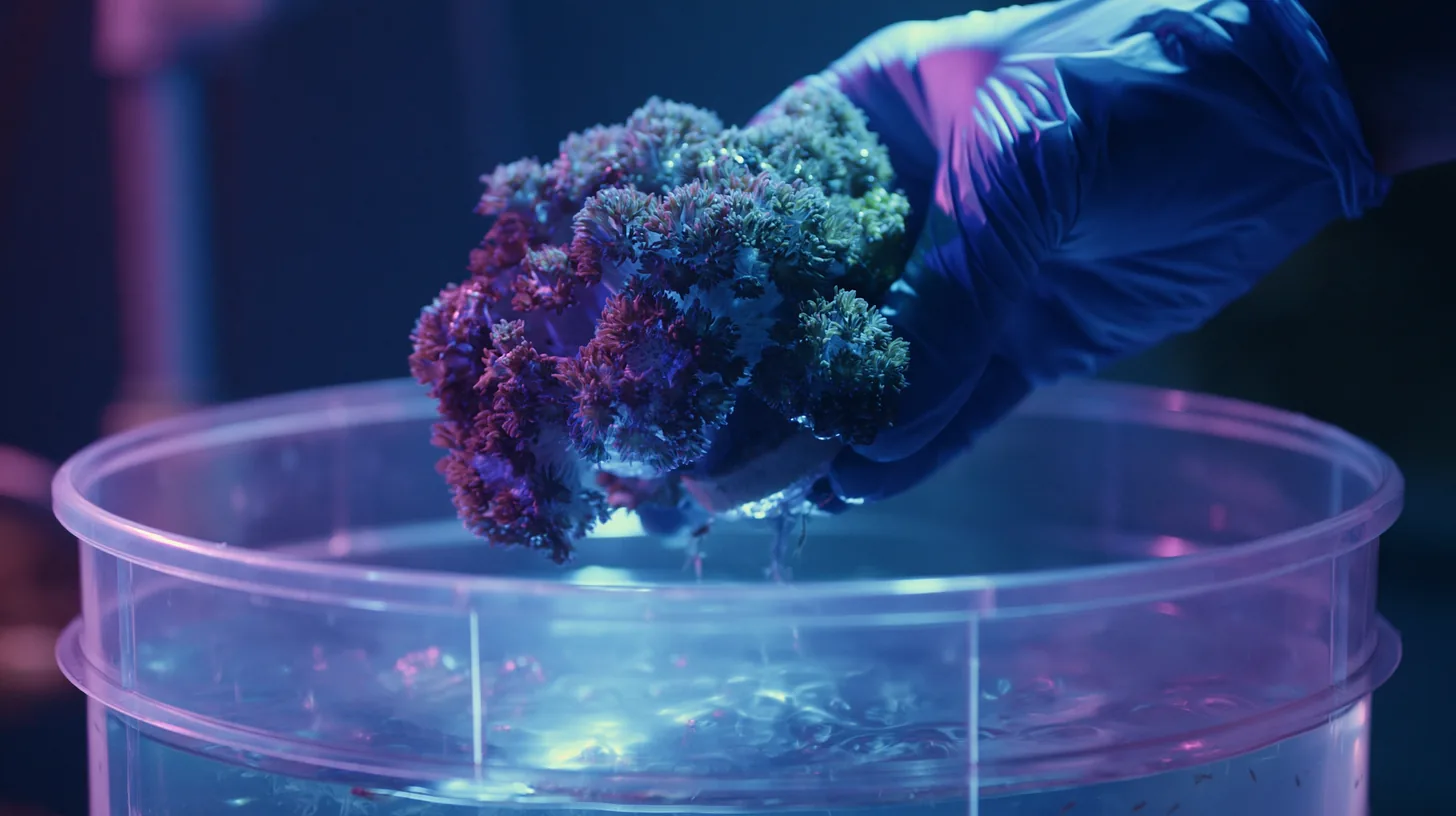
A new coral is an unknown variable. Even if it looks healthy, it may arrive with pests, bacterial infections or parasites that are invisible to the naked eye. Dipping is the procedure that reveals hidden problems and gives the coral a chance to recover before it meets the other inhabitants of the tank.
In this article we walk through Riuttareef’s recommended protocol for maricultured and wild-caught corals, the use of individual dips for aquacultured corals, and one rule that applies to all of them: do not dip immediately after an overnight shipment.
What can be lurking in a new coral
Before the dipping protocol makes sense, it helps to understand what it is designed to counter.
AEFW (Amakusaplana acroporae) — flatworms that feed on Acropora species are the most feared pest in the hobby. They live beneath the coral tissue and feed on it overnight, leaving white patches behind. At small sizes they are nearly invisible — only a dip reveals them as they try to escape the irritating solution. Species that feed on Euphyllia are particularly dangerous because they crawl into the mouth opening to avoid chemical treatments.
Montipora-eating nudibranchs (Phestilla sp.) are small, white and almost impossible to detect without a dip. They lay egg masses on the coral surface that the dip does not always destroy — which is why repeated dips at weekly intervals are necessary.
Zoanthus-eating nudibranchs and spiders hide among the polyps of zoanthus colonies. With the naked eye they can be found only under the best of conditions.
Red planaria (Convolutriloba retrogemma) is a reddish-brown, roughly 3–6 mm flatworm that occurs in eutrophic tanks. It is more of a nuisance than an immediate threat to the coral, but the population explodes quickly under favourable conditions.
Filamentous algae attach to the surface of a coral frag plug already at the farm. The algae itself does not necessarily kill coral tissue, but it competes for space, shades it, and accelerates microbial growth.
Bacterial infections — in particular Rapid Tissue Necrosis (RTN) and Slow Tissue Necrosis (STN) — can spread into the tank via a stressed new coral. Dipping does not prevent all infections, but it reduces the bacterial load on surfaces before the coral is added to the tank.
The first rule: 48 hours of rest before anything
This applies to all corals without exception.
An overnight shipment is a significant stressor for a coral: darkness, temperature fluctuation, oxygen-poor water and mechanical stress during packaging all burden the tissue. A stressed coral is vulnerable — dipping immediately upon arrival can cause more damage than the pest it is intended to remove.
A minimum of 48 hours from delivery. During this time the coral rests in the quarantine tank under calm conditions: low light, stable temperature, good aeration, no feeding.
Three dips — why the order matters
Riuttareef’s protocol for maricultured and wild-caught corals uses three different dips spaced three days apart. The dips are not copies of one another — each does a different thing and targets a different threat.
Nyos Coral Dip — first dip
Nyos Coral Dip was launched in January 2025 following the Nyos–ATI merger. It was developed in collaboration with leading coral farms and extensively tested before release. The product is based on a blend of five plant oils: lavender oil (Lavandula hybrida, listed active ingredient 0.125 %), lemongrass oil (Cymbopogon citratus), lemon peel oil (Citrus limon), thyme oil (Thymus zygis) and oregano oil (Origanum vulgare). No iodine, no inorganic salts, does not discolour the dip.
Lavender oil is a natural terpene that disrupts the nervous system and respiration of pests without affecting the coral at normal dosing levels. The product is suitable even for the most sensitive species and is the first step in the protocol precisely because it is the gentlest option for a stressed coral — yet still broad-spectrum.
Targets: flatworms, nudibranchs, spiders, general surface cleaning.
Dose and duration: in a separate container of tank water, 10 minutes, water agitated throughout. Dose varies by pest: 5 ml/l for flatworms, 12 ml/l for nudibranchs, 10 ml/l for standard use. Rinse the coral in clean tank water before returning it to the quarantine tank.
Special note on eggs: if egg masses are visible on the skeleton after the dip, repeated dips at weekly intervals for 4 weeks are required, as the dip does not destroy eggs.
Reef Primer — second dip
Reef Primer (PolypLab) is a potassium-salt-based dip: potassium salts, 5 minutes, 45 g/4 litres. The mechanism is osmotic — the potassium salts disrupt the ion balance of pests, causing them to detach from the coral surface and attempt to escape the solution. This makes them visible: use a bright lamp or torch during the dip and watch the bottom of the container.
Reef Primer contains no iodine, no disinfectants and no inorganic salts. It is gentle on corals and can be used on SPS, LPS and soft corals.
Targets: pests that survived the first dip (AEFW, flatworms, nudibranchs, spiders), bristle worms, filamentous algae and RTN/STN bacterial infections.
Dose and duration: 45 g/4 litres (or 9 g/litre), maximum 5 minutes, water agitated. Do not exceed 5 minutes.
Important: polyps must be open during the dip for the product to take full effect — if the polyps are closed the dip will not work to its full potential. Wait in calm water until the polyps open before starting the dip.
Hydrogen peroxide — third dip
Hydrogen peroxide (H₂O₂) is the most potent stage of the protocol and the last precisely because it is the most stressful. The three days of rest after Reef Primer give the coral time to recover before the oxidative treatment.
H₂O₂ is a powerful oxidiser that destroys filamentous algae, biofilm on the plug surface and some bacterial infections — it targets things that Nyos and Reef Primer cannot. At the same time it is the most stressful option and requires species-specific judgement.
Dosing: always use tank water as the diluent — not RO/DI water. Typical starting dose of 3 % pharmacy-grade H₂O₂ diluted in tank water:
| Coral type | Ratio (H₂O₂ : tank water) | Duration |
|---|---|---|
| Hardy SPS (Acropora, Montipora) | 1:4 | 2–5 min |
| LPS (Euphyllia, Lobophyllia) | 1:6 | 2–3 min |
| Soft corals (Sinularia, zoanthus) | 1:8–1:10 | 1–2 min |
| Highly sensitive | Not recommended | — |
Sinularia is a well-known exception: it reacts strongly to hydrogen peroxide even at low concentrations. If the species is sensitive or the coral is already stressed, consider skipping the H₂O₂ dip entirely or use the most dilute ratio with the shortest duration.
Targets: filamentous algae, biofilm on the plug, surface layers of bacterial infections.
Important: observe the coral throughout the dip. If the tissue begins to retract strongly or the colour changes, stop immediately and rinse with tank water.
Full protocol — maricultured and wild-caught
Arrival
    ↓
minimum 48 h rest (low light, aeration, no feeding)
    ↓
Nyos Coral Dip
    ↓
3 days rest
    ↓
Reef Primer
    ↓
3 days rest
    ↓
Hydrogen peroxide
    ↓
3 days rest in quarantine tank + FM Recon daily
    ↓
Display tank
    ↓
FM Recon can be continued in the main tank if needed, up to 4 weeks max
Fauna Marin Recon — aftercare
After three dips the coral has been through a significant period of stress. Fauna Marin Recon is an aftercare product that supports coral immunity and tissue recovery — it contains amino acids, vitamins and microbes that help the coral balance its holobiont.
Recon dosing begins immediately during the 3-day quarantine period following hydrogen peroxide — daily. After that the coral is transferred to the display tank. Recon dosing can be continued in the main tank if needed for up to a further 4 weeks.
Plug and base replacement — mandatory before moving to the main tank
When transferring maricultured and wild-caught corals to the main tank, all original plugs and bases must be replaced or cut to new ones. This is an absolute requirement — original plugs and bases can harbour pest eggs, encysted parasites or bacterial infections that the dips do not eliminate.
The most practical time is the 3-day rest period following hydrogen peroxide: the coral has already been through all the dips, the tissue is recovering and the plug swap causes minimal additional stress. Use a clean new plug soaked in tank water.
Handling aquacultured corals
Aquacultured corals — produced in long-term aquarium cultivation, not from the ocean or a farm — are generally a lower risk than maricultured or wild-caught. A full three-dip series is not routinely required.
Approach: one dip depending on the situation.
- If the coral looks healthy and there is no suspicion of pests: Nyos Coral Dip is sufficient as a preventive measure
- If the plug has algae or biofilm: hydrogen peroxide applied specifically
- If pests are suspected: Reef Primer will reveal them
The 48-hour rest rule also applies to aquacultured corals.
Quarantine tank — minimum requirements
The dipping protocol requires a separate tank. Dipping in the display tank is not possible — dip agents do not belong in the display tank water volume.
Minimum requirements for a quarantine tank:
- Dedicated filtration (not connected to the display tank)
- Stable temperature and salinity
- Adequate aeration
- Low but sufficient lighting
- No live rock — the quarantine tank is intentionally simple
The quarantine period before transfer to the display tank is at least the time the protocol requires — in practice approximately 2–3 weeks including dips, plus the Recon period.
Myths
“An aquacultured coral is always clean.” Not necessarily. A long-cultivated aquacultured coral is a lower risk than maricultured or wild, but not zero. Pests can attach at any stage — in transit, at the dealer’s, near other corals. 48 h rest and at least one dip is always justified.
“One dip is enough.” A single dip does not address all threats simultaneously. Nyos, Reef Primer and H₂O₂ each do different things. Furthermore, eggs survive all dips — which is why repeated dips are necessary if egg masses are observed.
“I dip as soon as the coral arrives.” After an overnight shipment, a stressed coral does not tolerate a dip as well as a rested one. 48 hours of rest first — always.
“Hydrogen peroxide is suitable for all corals.” It is not. Sinularia and other sensitive soft corals react strongly to it. Dosing is always species-specific and duration must be actively monitored.
References
1. Peer-reviewed studies
- Rawlinson, K. A., et al. (2011). Taxonomy and life history of the Acropora-eating flatworm Amakusaplana acroporae nov. sp. (Polycladida: Prosthiostomidae). Coral Reefs, 30, 693–705.
- Wijgerde, T., et al. (2011). Convolutriloba retrogemma and the population dynamics of photosynthetic flatworms in eutrophic reef systems. In Leewis, R. J. & Janse, M. (eds.), Advances in coral husbandry in public aquariums. Burgers’ Zoo, Arnhem.
- Bourlat, S. J., & Hejnol, A. (2014). Acoelomorpha — structure, phylogeny and ecology. Current Biology, 24(10).
2. Hobbyist literature and brand documentation
- Aslett, C. G. (2024). Teach a Person to Fish… SPS Academy Part X. Reef Ranch. https://www.reefranch.co.uk/
- PolypLab (2025). Reef Primer — product description and instructions. https://www.polyplab.com/products/reef-primer
- Nyos Aquaristik (2025). Nyos Coral Dip — product description and instructions. Whitecorals DE. https://www.whitecorals.com
- Gay, J. (2025, January). Nyos launch four new Reef Aquarium Products. Reefkeeping News. https://reefkeepingnews.com
- Reef2Reef Community (2020). Coral Dip Guide. https://www.reef2reef.com/threads/coral-dip-guide.769149/
- Humble.fish Community. Peroxide dipping guidelines for corals (Justin Credabel). https://humble.fish/community/threads/peroxide-dipping-guidelines-for-corals.4715/
- Tidal Gardens (2024). Euphyllia Troubleshooting Guide — AEFW and dipping protocol.
- Rawlinson, K. A. & Borneman, E. H. (2011). AEFW Archives — Coral Ever After. https://coraleverafter.org
3. Literature and textbooks
- Delbeek, J. C., & Sprung, J. (1994). The Reef Aquarium, Vol. 1. Ricordea Publishing.
- Borneman, E. H. (2001). Aquarium Corals: Selection, Husbandry, and Natural History. T.F.H. Publications.