
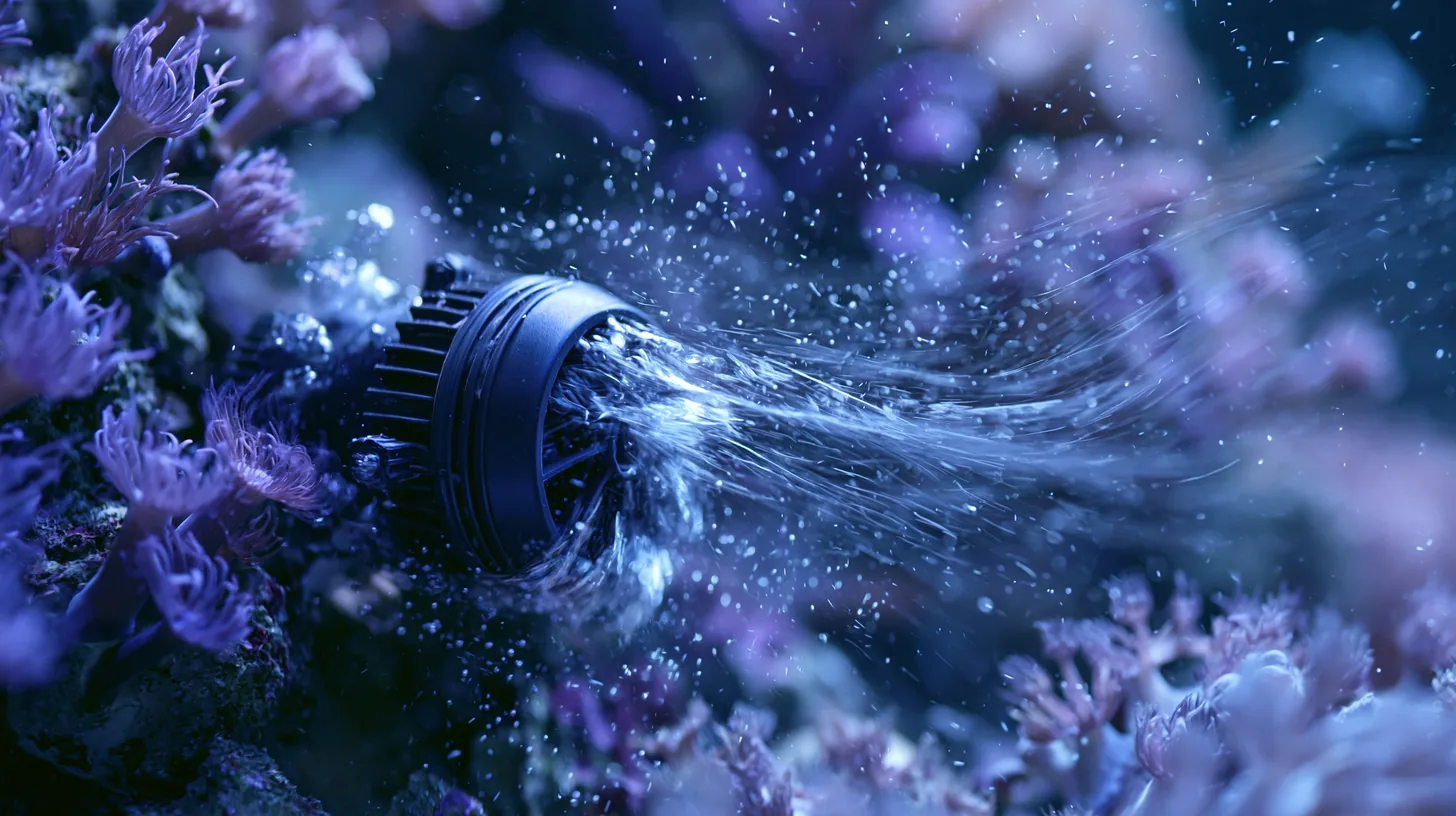
Water flow in practice — pumps, placement and dead zones
Flow is the only parameter whose removal kills tank inhabitants within hours. Everything else — light, chemicals, feeding — is secondary. Yet flow is one of the least understood topics in reef keeping, and several persistent myths have grown up around it.
The turnover rate myth
Hobbyists describe their tank’s flow almost exclusively with one number: turnover rate. “I have 20x turnover per hour.” The number sounds concrete, but it tells us nothing meaningful.
Turnover rate means how many times the tank’s entire water volume is cycled per hour. It describes the pump’s nominal capacity — not the speed at which water moves across a coral’s surface. These two things are entirely different.
Riddle (1996) measured with a digital flow meter: water leaving a Hagen 802 pump moved at 70 cm/s. Measured at 60 centimetres from the same pump, flow speed was 0 cm/s. The pump had not stopped — water was still moving, but in many directions simultaneously, so net flow in the meter’s direction was zero.
In practice this means: two identical pumps, pointed in different directions, produce entirely different flow conditions for corals — even if turnover rate is exactly the same in both arrangements.
Turnover rate is a useless number for assessing flow quality. What matters is the speed and quality of flow at the coral’s surface — not the pump’s nominal capacity. Use turnover rate as a rough starting point for sizing equipment, not as a quality metric.
What flow does for corals
Flow has five distinct biological functions in the tank. All are essential, but they optimise at different flow speeds and types.
Food delivery. A coral is a sessile animal — it cannot move toward food. Zooplankton, particles and dissolved organic compounds must be delivered by flow within reach of the polyp. Too little flow means starvation even in heavily fed tanks.
Waste removal. Corals continuously produce mucus, dead cells and metabolic waste products. These accumulate on the surface and form a substrate for bacteria and algae if flow does not flush them away. LPS corals’ large soft tissue surfaces are particularly susceptible.
Gas exchange. O₂ and CO₂ move to and from the coral’s surface by diffusion. Diffusion is a slow process, and a thicker boundary layer at the surface slows it further. Flow thins this boundary layer and speeds gas exchange — directly affecting photosynthesis and respiration efficiency.
Temperature equalisation. A heavily lit tank heats unevenly. Flow mixes the water mass and prevents localised temperature plateaus that can create microclimatic stress points, particularly for corals positioned highest in the tank.
Detritus transport. Dead organic matter does not leave the tank on its own — it settles on the substrate or rock unless flow keeps it moving and carries it to the sump or skimmer. Dead zones are detritus accumulation sites and continuous sources of nitrate and phosphate.
Flow types — what actually forms in the tank
Laminar flow is organised, unidirectional movement. The water jet leaving a pump is laminar near the nozzle. Laminar flow is useful for mass transport over long distances, but hitting coral tissue directly can damage it.
Turbulent flow is chaotic, multidirectional movement. It forms when fast laminar flow strikes an obstacle — rock, coral or glass. Turbulent flow is best at the coral surface: it thins the diffusive boundary layer efficiently and delivers nutrients from all directions.
Oscillating flow changes direction repeatedly. On natural reefs this is the predominant flow type — waves move the entire water mass back and forth. Programmable pumps can simulate it by varying power and direction regularly.
Gyre flow is organised pump use so that the entire water mass rotates as a unified current. Gyre is effective because the moving water mass gains momentum — it continues moving even in areas a single pump does not directly reach. Gyre dramatically reduces dead zones compared to a “firing squad” arrangement where pumps point in different directions toward the centre.
Species-specific flow requirements
| Coral type | Flow need | Type | Examples |
|---|---|---|---|
| SPS — branching | Strong, variable | Turbulent | Acropora spp., Stylophora pistillata, Pocillopora spp. |
| SPS — plating | Moderate–strong | Indirect | Montipora spp. (plating forms) |
| LPS — Euphyllia | Moderate, indirect | Oscillating | Euphyllia ancora, E. divisa, E. glabrescens |
| LPS — Caulastrea | Weak–moderate | Indirect | Caulastrea furcata |
| LPS — Goniopora | Moderate | Indirect | Goniopora spp. |
| LPS — Fungia | Weak | Indirect | Fungia spp., Heliofungia actiniformis |
| LPS — Blastomussa | Weak | Indirect | Blastomussa wellsi |
| Soft — Sarcophyton | Moderate–strong | Variable | Sarcophyton spp. |
| Soft — Xenia | Moderate | Variable | Xenia spp. |
| Soft — Discosoma | Weak | Indirect | Discosoma spp. |
| Gorgonians | Strong | Oscillating | Gorgonia spp., Plexaura spp. |
Important note: “Moderate” and “strong” describe flow speed experienced at the coral’s surface, not the pump’s nominal capacity.
Pump placement in practice
The fetch principle
Flow effectiveness depends on how long a distance water has to travel before hitting an obstacle or opposing current. Long fetch means the water mass has time to build momentum and move a large volume of water. Pumps are placed pointing along the tank’s longest dimension.
Gyre at its simplest
Two pumps at opposite ends of the tank, both at the same height, both driving water in the same rotational direction — not toward each other. Water circulates through the tank as a single vortex. A third pump — on the back wall or in the tank’s rear — fills dead zones that the gyre’s main current leaves.
Placement mistakes to avoid
Pumps directly opposing each other. Two pumps pointing straight at each other cancel each other out — flow speed between them is low, and all energy goes into water “fighting” rather than circulating the tank.
Pump too close to coral surface. A nozzle close to coral tissue produces laminar, direct flow — exactly what you do not want for LPS corals. A nozzle 30–50 cm from the coral produces flow that has had time to break into turbulence before reaching the coral surface.
All pumps on the same wall. This produces strong flow on one side and a dead zone on the opposite wall.
Pump too close to the substrate. Sand bed begins to fly.
Dead zone diagnosis
Paper drift test. Drop a small piece of thin paper or plastic wrap in different areas of the tank. A stationary or slowly sinking piece reveals a dead zone.
Detritus observation. Check the same rocks and substrate areas weekly. Repeatedly accumulating grey or brown material is a dead zone indicator.
Algae growth on the substrate. Algae preferentially grows in low-flow areas.
Bubble test. Inject a small air bubble (syringe) at a suspicious spot. Follow where it moves — or does not move.
Coral behaviour as a flow indicator
Signs of good flow:
- Polyps are fully extended
- Tentacles sway rhythmically with the current
- LPS soft tissue is inflated and moves gently
- No detritus on the coral surface
Signs of too-strong flow:
- Polyps continuously retract
- LPS soft tissue presses against the skeleton on the pump side
- Tentacles flap uncontrollably
- Euphyllia species: tentacles blow inward like an umbrella
Signs of too-weak flow:
- Mucus layer or cloudiness on the coral surface
- Detritus settles and stays on the coral surface
- Slow polyp opening — or no opening during daytime
- Algae growth on the coral surface or base
A recently added coral may retract even if flow is perfectly appropriate — it needs acclimatisation time. Give a coral 1–2 weeks before drawing conclusions about flow suitability.
Night vs. day — reducing flow
Reducing night-time flow to 30–50% of the daytime level is a common and proven practice. It is important to maintain sufficient flow so that oxygen levels do not drop critically.
Feeding pause. Briefly stopping pumps during feeding (5–15 min) allows food to settle within reach of corals. Particularly important for direct LPS feeding. Longer pauses (over 20 min) can significantly lower oxygen levels in densely stocked tanks.
Practical checklist
Pump placement:
- Two main pumps on opposing walls or opposite corners
- Fetch as long as possible — pumps point along the tank’s longest dimension
- Third pump to fill dead zones as needed
- Nozzle sufficiently far from corals (LPS: min. 30–50 cm)
Flow quality:
- Programmable, variable flow is better than constant
- Gyre produces a more uniform flow environment than a scattered pump arrangement
- Night reduction 30–50% is biologically justified
- Feeding pause max 15 min
Diagnostics:
- Check for detritus accumulation weekly at the same spots
- Read coral behaviour — it is the most reliable indicator
- Change one thing at a time when adjusting flow
References
1. Peer-reviewed studies
- Hossain, M.M. & Staples, A.E. (2020). Effects of coral colony morphology on turbulent flow dynamics. PLoS ONE, 15(10): e0225676. https://doi.org/10.1371/journal.pone.0225676
- Shapiro, O.H. et al. (2014). Vortical ciliary flows actively enhance mass transport in reef corals. PNAS, 111(37), 13391–13396. https://doi.org/10.1073/pnas.1323094111
- Riddle, D. (1996). Water motion in the reef aquarium, Part 1. Aquarium Frontiers, 3(4), 32–39.
- Thomas, F.I.M. & Atkinson, M.J. (1997). Ammonium uptake by coral reefs: effects of water velocity and surface roughness on mass transfer. Limnology and Oceanography, 42(1), 81–88. https://doi.org/10.4319/lo.1997.42.1.0081
2. Hobby literature
- Paletta, M.S. (2020). Water Flow in a Reef Aquarium: A Comprehensive Guide. CoralVue. https://www.coralvue.com/blog/reef-aquarium-flow-and-turnover-rate-hydros-waveengine-michael-s-paletta-september-2020
- Bulk Reef Supply (2023). The Science of Reef Aquarium Water Flow. https://www.bulkreefsupply.com/content/post/science-of-water-flow
3. Books and textbooks
- Borneman, E.H. (2001). Aquarium Corals: Selection, Husbandry, and Natural History. Microcosm. ISBN 1-890087-47-5.
- Delbeek, J.C. & Sprung, J. (1994). The Reef Aquarium, Vol. 1. Ricordea Publishing. ISBN 1-883693-12-7.