
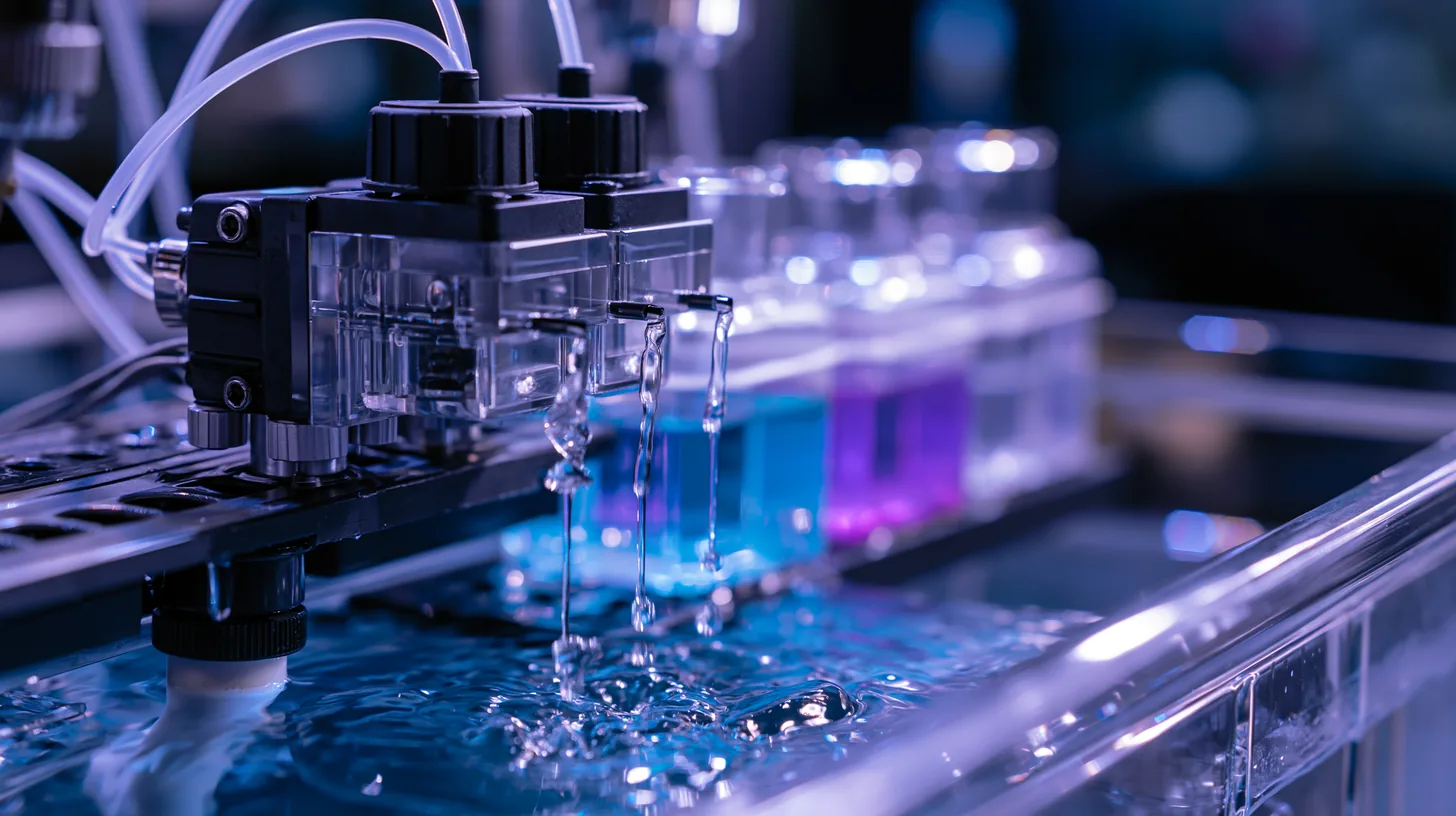
Dosing Methods — How to Choose the Right System for Your Reef
Calcium (Ca), alkalinity (KH), and magnesium (Mg) are continuously consumed in a reef aquarium — coral skeletons are built from these elements. The more growing coral you have, the faster these parameters deplete and the more important reliable replenishment becomes. This article covers the most widely used dosing methods in Europe: how they work, which products are available, and how to choose the right system.
One-Part Systems (1-Part)
A one-part system means a single solution combining all required elements — calcium, alkalinity, and magnesium in one bottle (or two smaller ones). Chemists have solved the compatibility challenge using organic compounds: calcium formate and similar organic salts stay dissolved where a traditional carbonate-calcium mix would precipitate.
These systems are excellent for beginners, smaller aquariums, and mixed reef or soft coral tanks with moderate consumption. One pump, one parameter to track.
The limitation appears in SPS-dominated tanks with high consumption: dosing volume increases and the cost per unit of replenishment becomes higher than most alternatives.
Tropic Marin All-For-Reef
All-For-Reef is one of the most recognized 1-part products in Europe. It delivers calcium, alkalinity, magnesium, and trace elements in a single solution. One pump, one bottle, one measured parameter (alkalinity). Best suited for mixed reef and soft coral tanks.
Fauna Marin Ready2Reef
Fauna Marin’s Ready2Reef is an all-in-one solution designed to simplify getting started. It contains Ca, KH, and Mg in a balanced ratio — a good option for tanks that don’t yet need the precision of multi-component systems.
Reef Zlements Z-inOne
The Reef Zlements Z-inOne is the 1-part counterpart to D&D’s H2P system. It combines Ca, KH, and Mg in a single ionically balanced formulation with no salt imbalance — the same high-quality chemistry as the manufacturer’s 2-part lineup.
Note on potency: In 1-part products, an ml/dKH comparison is not directly relevant because the same solution replenishes Ca, Mg, and KH simultaneously. All-For-Reef: ~18 ml / 100 L / 1 dKH (alkalinity component). Ready2Reef and Z-inOne are in the same range — the exact figure depends on the tank’s consumption ratio.
Two-Part Systems — Modern 2-Part Dosing
Traditional Balling-derived 2-part dosing used calcium chloride (CaCl₂) and sodium bicarbonate (NaHCO₃). The chemistry is clean in isolation, but the byproduct is sodium (Na⁺) and chloride (Cl⁻) accumulation over time — known as ionic drift or salt imbalance. Long-term use requires larger water changes to correct.
Modern 2-part systems have solved this problem. They use different salt forms that replenish ions naturally present in seawater without harmful accumulation. These systems are the clear choice in the 2-part category today.
ATI Essentials
ATI Essentials is a German premium system available in two versions:
ATI Essentials SPS is optimized for high-consumption SPS-dominated tanks. Solution #1 (alkalinity) contains 10,000 dKH per liter — 10 ml raises alkalinity 1 dKH in a 100-liter tank. Solution #2 contains calcium and magnesium. The solutions cover 25 elements in total — macros and trace elements included.
ATI Essentials Mixed Reef is formulated for mixed reef tanks and SPS tanks with more moderate consumption. Solution #1 contains 14,250 dKH per liter — approximately 7 ml raises alkalinity 1 dKH in a 100-liter tank. Solution #2 contains calcium and magnesium. The solutions cover 25 elements in total — macros and trace elements included.
Both versions have optional add-on products for reefers who perform regular laboratory testing and want to fine-tune their water profile based on results: Daily Traces A and B (daily trace supplement), Essential Nitro (nitrogen), and Essential Phospho (phosphate). These are not part of the base system — they should never be used without analysis data. More on laboratory testing: ICP analysis.
Potency: SPS #1: 10 ml / 100 L / 1 dKH. Mixed Reef #1: ~7 ml / 100 L / 1 dKH.
Nyos ION-B
Nyos ION-B is a German 2-part system that stands out through ionic balancing. Rather than traditional calcium chloride, it uses a sodium carbonate-based alkalinity solution (ALK/PH+) that also contains sulfate, bromide, and fluoride in correct seawater ratios. This prevents ionic drift and keeps the water’s ion profile close to natural seawater.
- ALK/PH+: sodium carbonate base, stabilizes pH, 10,000 dKH per liter.
- CA/MG+: 72,000 mg/L calcium. Ca:KH ratio 1:7 — both solutions run out simultaneously, simplifying replenishment.
Trace elements — ION Elements system
Trace elements are divided into three separate ION Elements solutions that are mixed into the main solutions before use: two are mixed into ALK/PH+ and one into CA/MG+. Trace elements are thus dosed automatically with the main solutions — no separate pump needed.
The system works in two stages: initially the manufacturer’s default ratio is used, covering typical tank consumption. When regular laboratory tests (ICP) reveal the true trace element profile of the specific tank, the ION Elements mixing ratios can be adjusted — making the system adapt to that tank’s exact needs. More on laboratory testing: ICP analysis.
Potency: ALK/PH+: 10 ml / 100 L / 1 dKH.
Reef Zlements H2P
D&D Reef Zlements H2P is a British high-quality 2-part system with multiple solution options:
Part 1 — alkalinity, two variants:
- Complete: gentle pH effect, suitable for tanks where pH is already elevated
- pHplus: active pH boost, good where pH tends to run low
Both contain 10,000 dKH per liter.
Part 2 — Universal: calcium + magnesium + 13 macro and trace elements in one solution. 72,000 mg/L calcium — 10 ml raises calcium 7.2 mg/L in a 100-liter tank.
Additional trace supplements:
- Type A (anions): iodide, molybdenum, selenium, sulfur, vanadium
- Type C (cations): barium, cobalt, chromium, iron, copper, manganese, nickel, rubidium, zinc
The D-D KH Manager is the manufacturer’s automated KH measurement device designed specifically for H2P, allowing tighter control.
Potency: Part 1: 10 ml / 100 L / 1 dKH.
Three-Part Systems — Balling Method and Variants
Original Balling — Tropic Marin
Hans-Werner Balling developed his method in 1994. Original Balling is a three-solution system:
- Solution A: calcium chloride (CaCl₂) — calcium replenishment
- Solution B: sodium bicarbonate (NaHCO₃) — alkalinity replenishment
- Solution C: sodium chloride (NaCl) — ion compensator, balancing the Na⁺/Cl⁻ buildup from solutions A and B
Important note in 2026: The original Tropic Marin Balling method does not contain trace elements or magnesium. Users must add separate magnesium supplementation and a trace element product to maintain a healthy water profile. Balling A+B+C alone is not sufficient for a modern reef aquarium — it is a solid foundation but not a complete system.
Tropic Marin recommends complementing it with their own products: A- Elements (anion-based trace supplement), K+ Elements (cation-based trace supplement), and Bio-Magnesium for magnesium replenishment. With these three additions, Original Balling forms a complete working system.
Potency: Solution B (liquid): ~36 ml / 100 L / 1 dKH.
Fauna Marin Balling Light + Bolus Method
Fauna Marin Balling Light is a completely different product from Tropic Marin’s Original Balling, despite the similar name. Balling Light is a complete system containing all required components:
- KH solution: bicarbonate-based (NaHCO₃) alkalinity solution — the core of the Bolus method
- Ca solution: calcium replenishment
- Mg solution: separate magnesium source
- Trace element bottles: separate trace supplements mixed into specific main solutions before use — in the same way as Nyos ION-B
Unlike Original Balling, Fauna Marin Balling Light is a ready-to-use complete package straight from the box.
The Bolus method is an innovative single-daily-dose technique developed by Fauna Marin:
The entire day’s alkalinity requirement is dosed all at once, 30 minutes before the photoperiod begins. This leverages a carbonic acid “battery” phenomenon: bicarbonate dissolves into the water and forms carbonic acid (H₂CO₃), which acts as a pH buffer. When corals begin photosynthesis as lights come on, they consume CO₂ — at exactly this point, the bicarbonate conversion reaction smooths out pH shifts.
The result is the “tabletop effect”: alkalinity remains more stable throughout the photoperiod compared to distributed dosing. SOLUS raises light intensity by 20% at the start of the photoperiod to maximize the increased photosynthetic potential.
Calcium is dosed by a separate pump approximately one hour after the Bolus dose, spread across the photoperiod.
Restrictions: The Bolus method works only with Fauna Marin Balling Light. It is not compatible with kalkwasser, calcium reactors, carbonate- or hydroxide-based solutions.
Potency: Fauna Marin Balling Light alkalinity: 20 ml / 100 L / 1 dKH.
Red Sea Reef Foundation A/B/C
Red Sea Reef Foundation is a three-component system dosing calcium, alkalinity, and magnesium separately:
- Foundation A: calcium
- Foundation B: alkalinity (carbonate/bicarbonate)
- Foundation C: magnesium
Red Sea also offers an ICP-guided monitoring system. Products are widely available in Europe and suit reefers who want independent control over the three main parameters without classic Balling’s ionic drift concerns.
Potency: Foundation B (liquid): ~10 ml / 100 L / 1 dKH.
Aquaforest Component 1+2+3+
Aquaforest Component is a Polish three-part system with a meaningful advantage over traditional Balling: trace elements are included in the base solutions. The ”+” notation means each component also contains trace elements.
- Component 1+: calcium + traces
- Component 2+: alkalinity + traces
- Component 3+: magnesium + traces
This simplifies the dosing program — a separate trace element bottle may not be required. Aquaforest is known for quality and availability across Europe.
Potency: Component 2+: ~38 ml / 100 L / 1 dKH.
Triton Core7 Flex — Configurable Four-Part System
Triton Applied Reef Bioscience is a science-based company that grounds its products in water analysis and ionic balance. Core7 Flex is a flexible system delivered as one kit but configurable in three different ways.
One Kit — Three Configurations
The Core7 Flex kit contains four powder sachets (A, B, C, D) and a liquid bottle (1b). Reefers choose their configuration based on their needs:
| Configuration | Solutions | Starting dose |
|---|---|---|
| 4-Part (recommended) | Sol. 1 (Mg/K/Sr + traces) + Sol. 2 (Ca) + Sol. 3a (Alk) + Sol. 3b (Alk) | 2 ml / 100 L / day |
| 3-Part | Same as 4-Part but 3a + 3b combined | 2 ml / 100 L / day |
| 2-Part | Sol. 1 (Ca/Mg/K/Sr + traces) + Sol. 2 (Alk) | 4 ml / 100 L / day |
4-Part is recommended for best trace element stability and independent Ca/Mg control. The system is 7× more concentrated than traditional Balling — the same consumption is replenished with significantly less volume.
Two Product Lines
- Base Elements: contains Infusion trace supplement, designed for refugium-based Triton Method systems.
- Reef Supplements: without Infusion — suitable for all other dosing methods. This is the relevant version for reefers not running the full Triton ecosystem.
Ionic Balance and Contents
Core7 Flex replenishes Ca, Mg, K, Sr, F, B, Br, and all essential trace elements in ionic balance. The formulation contains no toxic elements, organic carbon, phosphorus, or silicon. Target alkalinity with the system is approximately 7 dKH.
ICP analysis is recommended 2–3 weeks after starting, with follow-up every 2–3 months in an established tank.
Potency: 3a + 3b combined: ~10 ml / 100 L / 1 dKH (each solution ~5 ml separately).
Triton MYTE — Personalized Trace Element Dosing
Triton MYTE (Master Your Trace Elements) is a monthly subscription service where TRITON mixes two personalized trace element bottles each month based on the reefer’s ICP results.
How it works: the reefer sends a water sample to a TRITON laboratory → ICP-OES analyzes 41+ parameters → TRITON formulates two bottles containing the exact 15 trace elements needed by that specific tank in the right concentrations → next month’s data updates the formulation.
15 trace elements: B, Br, Cr, Co, F, I, Fe, Li, Mn, Mo, Ni, K, Sr, V, Zn — split across two bottles for chemical compatibility reasons (certain ions would precipitate together).
MYTE works alongside any dosing system and does not require Core7 Flex.
Availability: MYTE is not currently available in Europe — the service operates in the United States and Australia only.
Tropic Marin BAS — Trace Element Protocol
Tropic Marin Block Analysis System (BAS) is a new approach to trace element dosing — not a new primary dosing method, but a tool for trace element management.
The Problem It Solves
Traditional ICP-guided trace element replenishment could easily require 15–20 individual element bottles. This was complicated, expensive, and error-prone. Tropic Marin developed BAS to simplify this: elements are grouped by consumption ratio into a maximum of five combination solutions.
Five Block Solutions
| Block product | Contains |
|---|---|
| Block Iodine | I (iodine), F (fluorine), Br (bromine), Se (selenium) |
| Block Molybdenum | Mo, Rb (rubidium), V (vanadium), W (tungsten), Te (tellurium), Hf (hafnium) |
| Block Nickel | Ni (nickel), Mn (manganese), Fe (iron), Co (cobalt), B (boron) |
| Block Strontium | Sr (strontium), Ba (barium) |
| Block Zinc | Zn (zinc), Cu (copper), Cr (chromium), Ga (gallium) |
Each Block solution has an indicator element: its ICP concentration tells you how much of the entire element group needs replenishment. This eliminates the need to calculate each element separately.
Single-element Components solutions are also available for targeted corrections.
BAS works alongside any dosing system — Balling, All-For-Reef, calcium reactor, or anything else — and is guided by Tropic Marin’s waterLAB ICP analysis service.
Kalkwasser (Nilsen Method)
Kalkwasser is a saturated solution of calcium hydroxide Ca(OH)₂ — simple, effective, and nearly free. The method is also called the Nilsen method after its developer Peter Nilsen.
The Chemistry
When calcium hydroxide dissolves in water, it releases calcium ions (Ca²⁺) and hydroxide ions (OH⁻). The hydroxide reacts with dissolved CO₂ to form bicarbonate — raising alkalinity simultaneously:
Ca(OH)₂ → Ca²⁺ + 2OH⁻
OH⁻ + CO₂ → HCO₃⁻
Additionally, kalkwasser’s high pH (approximately 12–12.5 for a saturated solution) precipitates phosphate — OH⁻ reacts with orthophosphate in the water and binds it into biologically unavailable form. This side effect is extremely useful in tanks where phosphate tends to rise.
Dosing and Limitations
Kalkwasser must be dosed slowly and steadily — too fast raises pH to harmful levels.
Capacity limitation: A saturated Ca(OH)₂ solution contains a maximum of ~2 g/L (~1.5 mmol/L Ca). Covering the consumption of large SPS-heavy tanks with kalkwasser alone may require more liquid than the tank evaporates — in this situation, kalkwasser cannot be the sole method.
Equipment: The Deltec KM500S is a popular European kalkwasser reactor that keeps the solution mixed and automatically removes precipitated Ca(OH)₂.
Chris Meckley / ACI Method — pH-Triggered Night Dosing
Chris Meckley is the owner of ACI Aquaculture, an American wholesale coral company, and one of the most respected coral farmers in the industry. He developed a way to maximize kalkwasser’s benefits through pH automation:
Kalkwasser is dosed only at night, when pH naturally drops (coral respiration, reduced photosynthesis). A pH controller monitors the water and activates the dosing pump whenever pH falls below a preset threshold (typically 8.2–8.3). This prevents excessive daytime pH spikes and keeps the diurnal pH swing as small as possible.
Requirements:
- A reliably calibrated pH electrode (service every 2–4 weeks)
- A sufficiently large kalkwasser reservoir for overnight dosing
- Dosing equipment with pH controller input compatibility
The Meckley method is considered one of the most optimal ways to use kalkwasser — it fully exploits the natural pH cycle without manual monitoring.
Calcium Reactor
A calcium reactor is a sealed reaction chamber fed with CO₂ gas. Inside the chamber is aragonite or another calcium carbonate media. CO₂ acidifies the water inside the chamber (pH ~6.3–6.8), dissolving the aragonite — the effluent flowing back into the tank replenishes calcium and alkalinity simultaneously.
How It Works
CO₂ + H₂O → H₂CO₃ (carbonic acid)
H₂CO₃ + CaCO₃ → Ca²⁺ + 2HCO₃⁻
The reaction is nearly fully ionically neutral — it doesn’t introduce extra ions the way Balling chemistry does. This makes a calcium reactor ideal for long-term stability, if setup cost and complexity aren’t barriers.
Operation
Most reactors are two-chamber designs: the first chamber is the main reaction zone, the second (recirculation chamber) removes dissolved CO₂ before effluent returns to the tank — excess CO₂ would lower tank pH. Tuning involves:
- CO₂ flow rate (bubbles per minute) — affects dissolution speed
- Effluent flow rate — affects Ca/KH concentration
Manufacturers
Deltec (Germany) is the leading calcium reactor brand in Europe, with a range from nano reactors to large SPS setups. The PF 509 and 601 are popular mid-range options.
Korallin (Germany/Switzerland) is another established European manufacturer whose B-series reactors are extremely well-regarded and long-lived.
Challenges
A calcium reactor requires monitoring chamber pH, regular media top-ups, and CO₂ cylinder changes. Phosphate accumulation in the media can be an issue, especially if tank phosphate is elevated — dissolving aragonite can release phosphate into the tank. Choosing quality media (coral rubble, ARM, Caribsea) is an important decision.
Important note: A calcium reactor handles calcium and alkalinity but does not replace magnesium or trace element supplementation. To function as a complete system, a calcium reactor requires a separate Mg source and a trace element protocol — either a regular trace supplement or an ICP-guided system such as Tropic Marin BAS.
Hybrid Solutions
It is rare to use just one system in isolation. Common working combinations:
Kalkwasser + 2-part: kalkwasser handles part of the Ca/KH replenishment at night and aids pH management, 2-part covers daytime consumption. The weaknesses of each method compensate for the other.
Calcium reactor + Balling: reactor covers baseline replenishment, Balling corrects deviations or covers consumption spikes. A popular solution in large SPS tanks.
1-part + trace supplement: a practical combination for small and mixed reef tanks — easy to run. Trace element supplementation should only be added based on ICP test results — never dosed blind.
Potency Comparison — How Much Solution Is Needed
The table below shows how many milliliters of alkalinity solution (or equivalent) are needed to raise alkalinity by 1 dKH in a 100-liter tank. Useful for comparing cost-effectiveness between products.
| System / Product | ml / 100 L / 1 dKH |
|---|---|
| ATI Essentials SPS #1 | ~10 ml |
| ATI Essentials Mixed Reef #1 | ~7 ml |
| Nyos ION-B ALK/PH+ | ~10 ml |
| Reef Zlements H2P Complete/pHplus | ~10 ml |
| Red Sea Reef Foundation B (liquid) | ~10 ml |
| Triton Core7 Flex (3a + 3b combined) | ~10 ml |
| Tropic Marin All-For-Reef (1-part) | ~18 ml — also includes Ca + Mg |
| Fauna Marin Balling Light (KH part) | ~20 ml |
| Tropic Marin Original Balling B | ~36 ml |
| Aquaforest Component 2+ | ~38 ml |
Kalkwasser and calcium reactors don’t fit the same table — their dosing logic is fundamentally different.
Which System Is Right for You?
Nano and mixed reef (< 200 L, soft corals and LPS)
1-part is the easiest choice. Tropic Marin All-For-Reef, Fauna Marin Ready2Reef, or Reef Zlements Z-inOne — one pump, one tracked parameter. No need to worry about ionic balance or multiple bottles.
Mixed reef and growing LPS/SPS combination (200–1000 L)
Modern 2-part (ATI Essentials, Nyos ION-B, or Reef Zlements H2P) is an excellent choice. No ionic drift, trace elements covered, easy to automate with two pumps.
Triton Core7 Flex fits well in this category — especially if you want high concentration, ionic balance, and comprehensive traces from one system. The 4-Part configuration is recommended.
Alternatively, Fauna Marin Balling Light + Bolus if you want to explore the single-daily-dose philosophy — requires more understanding, rewards you with stable pH throughout the photoperiod.
Mixed reef / SPS — large tanks (1000 L+)
In large tanks, consumption grows so significant that the cost of liquid dosing solutions can become substantial. The recommended solution for cost management is a hybrid combination:
Calcium reactor + kalkwasser reactor + Tropic Marin BAS + separate Mg source.
The calcium reactor handles calcium and alkalinity replenishment cost-effectively. The kalkwasser reactor (e.g., Deltec KM500S) supports pH at night and helps phosphate management. A separate magnesium source (e.g., Bio-Magnesium) keeps Mg in balance. Tropic Marin BAS guides trace element replenishment via ICP analysis with a maximum of five bottles.
This combination requires the most effort to set up, but is the most cost-effective long-term solution for a large, high-consumption tank.
All tank types — trace element management
Any primary system can be complemented with Tropic Marin BAS as a trace element protocol. It works alongside any method and simplifies ICP-guided correction down to a maximum of five bottles.
Getting Started in Practice
-
Measure first. Establish your current Ca, KH, and Mg levels before starting any system. Reference values: Ca 420 mg/L, KH 8–9 dKH, Mg 1300 mg/L.
-
Choose a system based on consumption. Calculate how much alkalinity drops per day — this tells you the required dosing capacity.
-
Start low and adjust. All systems work best when dosing is increased slowly toward target — sudden changes stress coral.
-
Automate. Manual dosing is uneven. Dosing pumps (e.g., Kamoer, Ecotech, Jecod, Red Sea) or a controller-integrated system keeps parameters stable.
-
Monitor and respond. Measure alkalinity at least 2–3 times per week — daily until the system stabilizes. ICP analysis every 2–3 months reveals trace element status.
See also: Calcium — The Foundation Builder, Alkalinity, Trace Elements
Sources
- Tropic Marin Original Balling Liquid Set — product page
- Tropic Marin Balance — BAS Block Analysis System
- ATI Essentials — System Guide (PDF, fi) — internal document
- Nyos ION-B — Complete System Guide (PDF, en) — internal document
- D&D Reef Zlements H2P — Dosing System Manual (PDF, en)
- Fauna Marin Bolus — How-To-Use Guide (PDF, en) — internal document
- Tropic Marin Balling Method — Complete Guide (PDF, fi) — internal document
- Triton Core7 Flex — product page
- Triton Core7 Base Elements — manual (PDF, en)
- Triton Core7 — potency and concentration analysis (BeanAnimal)
- Triton MYTE — product page
- Red Sea Reef Foundation — user manual (PDF, en)
- Aquaforest Component 1+2+3+ — dosing guide
- ACI Aquaculture — Chris Meckley kalkwasser method
- Triton Core7 — consumption calculator