
Calcium — the skeleton's building block
What corals are made of
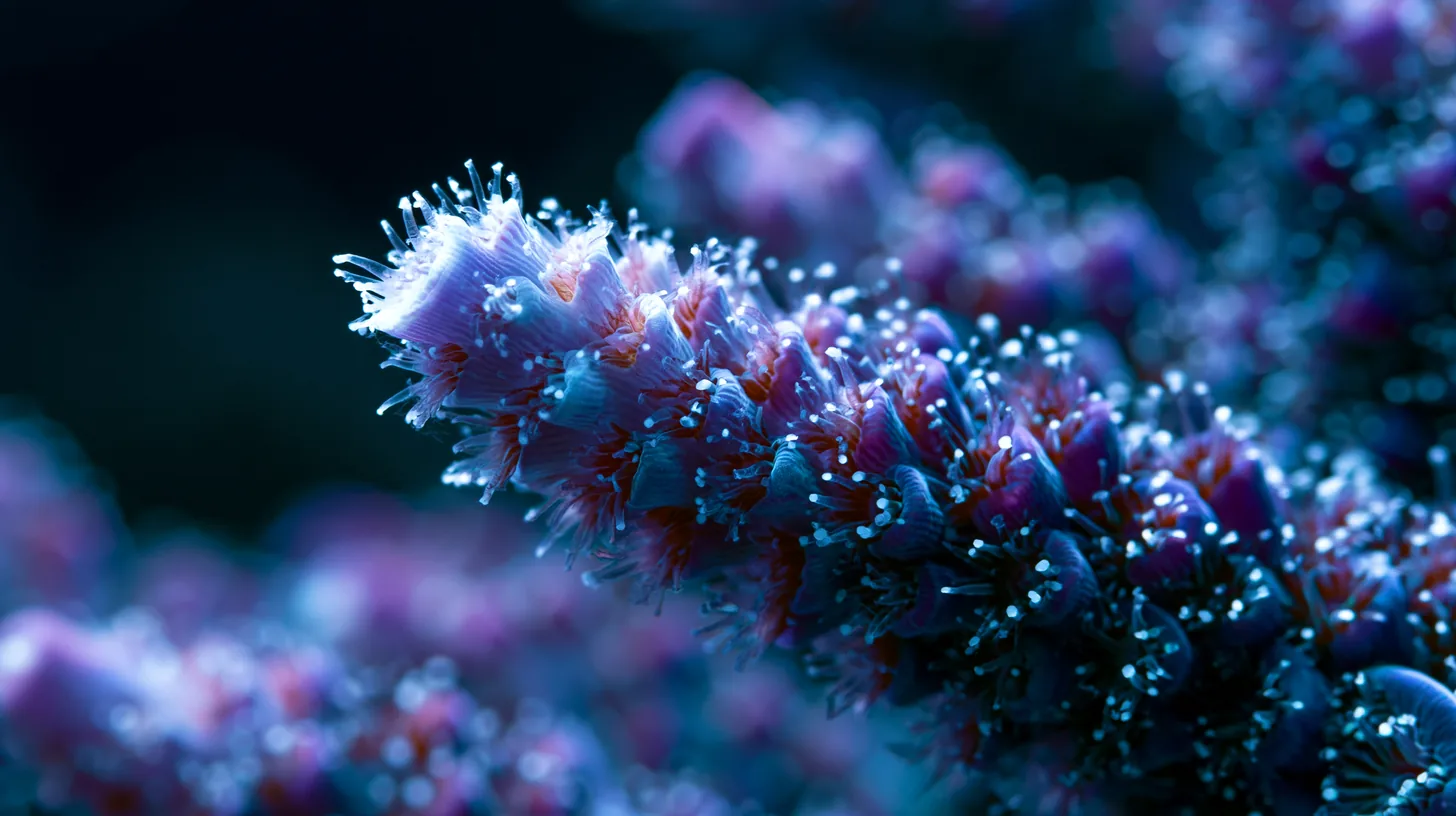
Stony coral skeletons are calcium carbonate — the same mineral found in limestone and seashells. Corals build it continuously: growing, consolidating, repairing damage. The process never stops as long as the coral lives.
This means calcium is consumed continuously. In the open ocean, consumption is automatically replaced because the water volume is practically unlimited and calcium concentration stays stable. In a closed aquarium, consumption shows directly in measurements: without replenishment, calcium levels fall.
Calcium is not the only component in this process — corals simultaneously need carbonate ions (in the form of alkalinity) and magnesium, which directs crystallisation into the correct mineral form. But calcium is the raw material from which the skeleton literally consists, and its concentration in the water is the first thing that changes as coral mass in the tank grows.
Natural seawater levels
In the open ocean, calcium concentration is typically 410–420 mg/l. This value is surprisingly stable worldwide — in seawater, calcium is relatively supersaturated, but biological and chemical mechanisms prevent its spontaneous precipitation.
In a reef aquarium, this level does not need to be hit exactly. Corals grow well across a wider range. What matters more is that the value stays stable — covered in more detail in the practice article.
In natural seawater, the molar ratio of calcium to magnesium is approximately 1:3. There is therefore three times as much magnesium. This ratio is not coincidental — it reflects the chemical interaction between these two elements in the calcium carbonate system.
Why calcium depletes — and what that actually means
When a coral calcifies, it takes Ca²⁺ ions from the water and combines them with carbonate ions (CO₃²⁻). The result is calcium carbonate (CaCO₃), which crystallises in aragonite form and builds the skeleton.
The reaction simplified:
Ca²⁺ + CO₃²⁻ → CaCO₃
This means calcium consumption is inseparably linked to alkalinity consumption. A coral does not consume one without the other. If calcium falls but alkalinity stays put — or vice versa — something is off in either the dosing balance or measurement accuracy.
The practical implication: the calcium-to-alkalinity consumption ratio is predictable. Well-formulated two-part and Balling systems are sized so that both components deplete at roughly the same rate. If one component runs out noticeably faster than the other, the system is out of balance.
Magnesium’s role in the calcium system
Magnesium is not a separate parameter — it is the calcium system’s stability mechanism.
Mg²⁺ ions fit well into calcite crystal lattice positions but not into aragonite crystal lattice positions. When magnesium is sufficient, it disrupts calcite crystal growth so effectively that calcium carbonate is “forced” to crystallise in aragonite form — exactly the mineral form stony corals need.
The other key effect: magnesium keeps calcium dissolved in the water. Without adequate magnesium, calcium precipitates spontaneously onto equipment, pipes and rock surfaces before corals can use it. This shows up practically as calcium deposits on heaters and pump impellers — a sign that the system’s chemical balance is skewed.
A stable calcium level is simply not possible without adequate magnesium. This is not a recommendation — it is chemistry.
Calcium and other consumers
Beyond stony corals, many other organisms consume calcium in the tank: coralline algae (especially CCA, crustose coralline algae), bivalves, echinoderms, some soft corals with calcium spicules, and bacterial biofilms.
This means calcium consumption does not scale exactly linearly with coral biomass. A well-developed coralline algae coverage can consume significant amounts of calcium even when the number of calcifying corals is modest. In a young tank consumption is small; in a vigorously growing SPS tank it can be considerable.
Dosing requirements grow over time — this is normal and not a sign of a problem.
What happens when calcium drops too low
Low calcium slows calcification. The result is generally not a dramatic collapse — corals adapt gradually to deteriorating conditions. Visible signs often come with a delay:
- growth slows or stops
- colours fade, especially in SPS corals
- tissue may begin to recede from skeleton tips
A calcium decline is often not noticed until the change has been under way for weeks. This is one reason why regular measurement matters more than reactive correction.
References
1. Peer-reviewed studies
- Tambutté, S. et al. (2011). Coral biomineralization: From the gene to the environment. Journal of Experimental Marine Biology and Ecology, 408(1–2), 58–78. https://doi.org/10.1016/j.jembe.2011.07.026
- Falini, G., Fermani, S. & Goffredo, S. (2015). Coral biomineralization: A focus on intra-skeletal organic matrix and calcification. Seminars in Cell & Developmental Biology, 46, 17–26. https://doi.org/10.1016/j.semcdb.2015.09.005
- Holcomb, M. et al. (2010). Coral calcification regulated by kinetics and not saturation state. Geochimica et Cosmochimica Acta, 74(17), 4926–4938. https://doi.org/10.1016/j.gca.2010.05.012
2. Hobbyist literature and brand documentation
- Fauna Marin (2024). Calcium — Knowledge Base. https://www.faunamarin.de/en/knowledge-base/calcium/
- Aslett, C. G. (2024). SPS Academy Part V — Teach a Person to Fish. https://www.reefranch.co.uk/
- Holmes-Farley, R. (2002). Chemistry and the Aquarium series. Advanced Aquarist.
3. Books and textbooks
- Borneman, E. H. (2001). Aquarium Corals: Selection, Husbandry, and Natural History. Microcosm.