
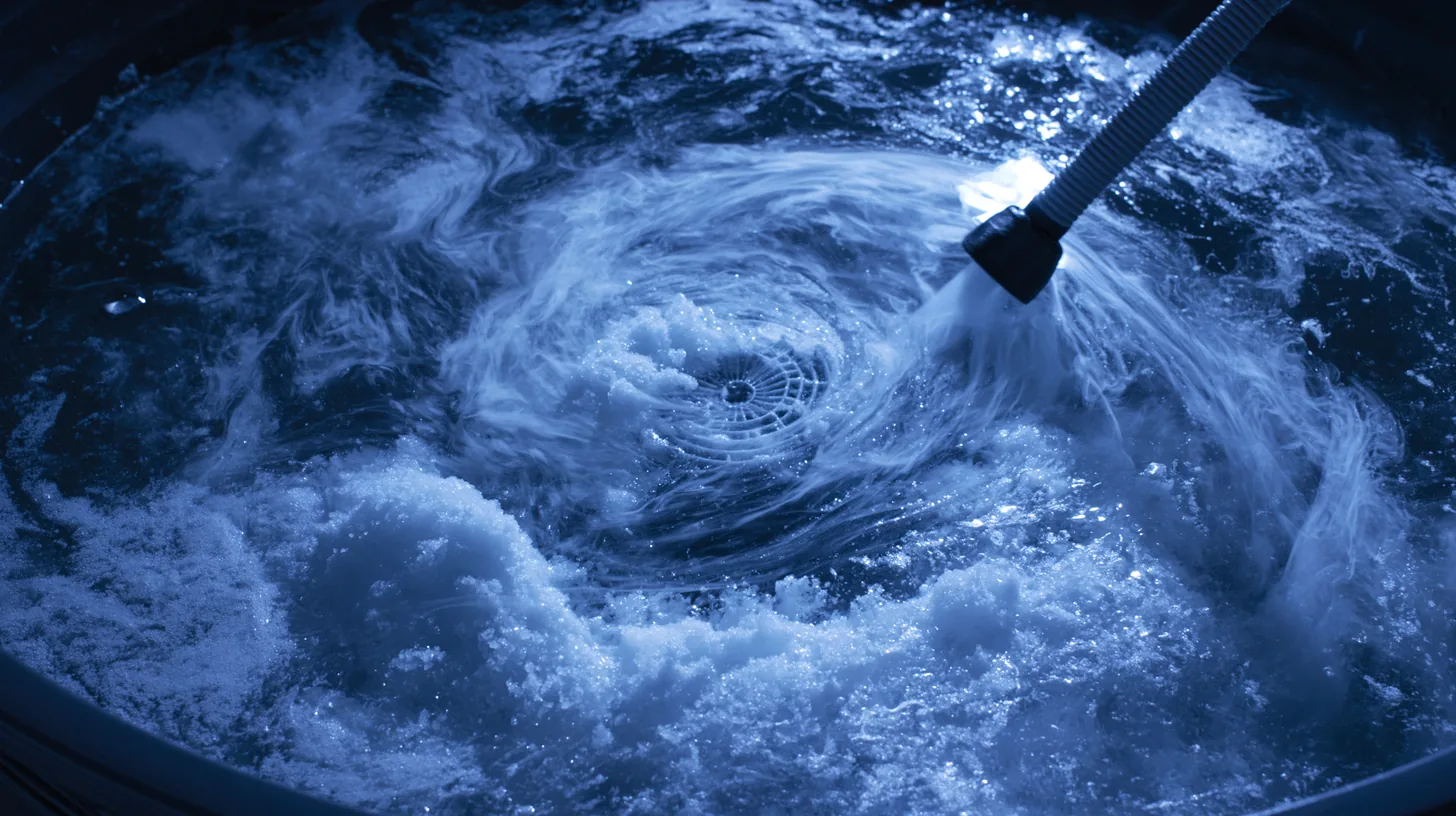
Water Changes in Practice — Rhythm, Volume, and Technique
Water changes are the most underrated tool in reef aquarium keeping. They don’t require precise biochemical understanding, they work consistently, and they fix multiple problems simultaneously. Yet hobbyists tend to reach for a more complex solution first — a new device, a new additive, a new protocol — before asking: when was the last time the water was changed?
This article covers the practical water change process in full: frequency, volumes, replacement saltwater preparation, technique, and automation.
1. Frequency and Volume — the Math Behind It
The most common question is: how often and how much? The answer depends on your tank’s bioload, coral population, and other export mechanisms in use — but the mathematical framework helps visualize the consequences of different choices.
In Holmes-Farley’s modeling, the same total volume divided across more frequent changes keeps substance concentrations more stable than infrequent large changes. For example, 15% monthly as a single change is less effective than 7.5% twice a month, even though the total volume is the same — concentration peaks and valleys are smaller with a more frequent schedule.
Riuttareef’s view on schedule options:
| Schedule | Volume per change | Best suited for |
|---|---|---|
| Weekly | 5–10% of total volume | Recommended baseline for most tanks |
| Every two weeks | 10–15% | Well-running tanks with low bioload |
| Monthly | 20–30% | Minimal — only if other export mechanisms are strong |
| Never | — | Only possible with comprehensive ICP monitoring and targeted trace element replacement; not recommended |
The practical rule of thumb: 10% weekly is a reliable starting point that works for most reef tanks. It’s sufficient to keep DOC, nitrate, and phosphate drift under control in most situations, and small enough not to significantly disturb the microbiome.
The more fish you have, the more you feed, and the fewer other export mechanisms you use — the more frequent and larger the change needed.
2. Preparing Replacement Saltwater
The quality of replacement saltwater is as important as the change itself. Poorly prepared saltwater can stress your animals and disrupt established water chemistry.
RO/DI water is the only acceptable source water. Tap water contains phosphate, chlorine compounds, and variable trace elements that disrupt reef tanks. RO/DI membranes remove most of these. The membrane condition must be checked regularly — a worn membrane won’t filter properly.
Choose a quality salt mix from a reputable manufacturer. Good reef salt contains trace elements in the correct ratios and dissolves without cloudiness or precipitation.
Mixing time should be at least 12–24 hours. Salt needs time to dissolve completely. Aeration is important — an air stone or pump in the mixing container ensures the water is properly oxygenated before use. Hastily mixed saltwater can have a low pH and be chemically uneven.
Three parameters must be matched before the change:
- Salinity — match your tank. Measure with a refractometer or electronic salinity meter.
- Temperature — as close to tank temperature as possible, practically ±0.5°C. Cold water causes thermal shock, especially for sensitive corals.
- pH — doesn’t need to be matched precisely, but a clearly low pH (below 8.0) in the mixing container indicates insufficient aeration.
3. Water Change Technique
Removal. Remove old water before adding new — not simultaneously. Use a hose or pump from the sump bottom or a convenient point at the tank bottom. If your tank has a sand bed, a water change is a good opportunity to vacuum part of the sand — not the entire bottom at once, but about a quarter each time in rotation. This minimizes bacterial community disruption.
Addition. Add new water slowly — don’t pour it directly onto corals. Adding through the sump is the safest approach — the water mixes before reaching the main tank’s inhabitants. If you don’t have a sump, add water at the tank’s edge or directed behind rockwork.
Measurement. Check salinity and temperature in the tank after the change for those doing it for the first time — an experienced hobbyist knows their own process well enough that this isn’t necessary every time.
4. What You Should Not Do with Water Changes
Do not maintain calcium and alkalinity through water changes. They deplete so quickly in a tank with stony corals that the required change volumes would be 30–50% per day. A separate dosing strategy is required.
Do not use water changes as emergency response during a parameter crisis — such as alkalinity crashing or nitrate spiking dramatically. A single large water change (over 30%) can cause microbiome disruption and rapid parameter changes that stress corals. In crisis situations, corrections are made in small steps.
Do not stop water changes when the tank “is doing well.” A well-running tank is often doing well precisely because water changes have been consistent.
5. Automated Water Change Systems
An AWC (Automatic Water Changer) is a device that continuously removes and adds water in small amounts. The principle is the same as manual changes, but distributed evenly across days or weeks.
The benefits are clear: parameter drift is minimal when change is continuous and small. Microbiome disruption is lower than with weekly larger changes. Labor is significantly reduced once the system is calibrated.
AWC requirements: a sufficiently large replacement saltwater reservoir (at least a week’s supply), reliable pumps, and regular salt mix preparation. Reservoir salinity must be checked weekly — evaporation rates vary.
AWC is particularly useful in large tanks where weekly manual changes are logistically demanding. In small tanks the benefit is more modest.
6. Water Changes in Relation to Other Methods
Water changes don’t compete with other export mechanisms — they complement them.
A protein skimmer removes proteins and certain DOC fractions, but doesn’t dilute accumulated ions or remove refractory DOC as effectively as fresh saltwater.
Activated carbon removes certain organic compounds but doesn’t affect nitrate, phosphate, or ion balance.
Carbon dosing lowers nitrate and phosphate, but adds DOC load. Water changes are carbon dosing’s natural partner: they remove what carbon dosing adds.
A refugium sequesters nutrients into macroalgae growth, but doesn’t remove accumulated metals or organic compounds.
A combination of all of these works best — and water changes are the element that benefits all others positively without side effects.
Practical Checklist
- Always prepare replacement saltwater 24 hours in advance
- Match temperature and salinity before the change
- Remove old water before adding new
- Add new water slowly through the sump
- Vacuum the sand partially (about a quarter) during each change
- Don’t vary the schedule dramatically — consistency matters more than the perfect percentage
- Don’t use water changes to replace a dosing strategy for calcium and alkalinity
Sources
1. Peer-Reviewed Research
- Kellogg, C.T.E., Goldsmith, D.B., & Carlson, C.A. (2018). Microbiome Dynamics in a Large Artificial Seawater Aquarium. mSystems, 3(2), e00017-18. DOI: 10.1128/mSystems.00017-18
- Van Bonn, W. et al. (2015). Aquarium microbiome response to ninety percent system water change. Zoo Biology, 34(1), 41–48. (A 90% water change caused increased microbiome diversity but reduced stability — the biological rationale for small regular changes)
2. Hobbyist Literature and Brand Documentation
- Holmes-Farley, R. (2005). Water Changes in Reef Aquaria. Reefkeeping Magazine, October 2005. reefkeeping.com (Mathematical modeling analysis of different schedules and volumes; demonstrates the advantage of more frequent smaller changes over infrequent large ones)
- Bulk Reef Supply (2021). Why Water Changes Matter — Beginner’s Guide Ep. 25. bulkreefsupply.com
- Bulk Reef Supply (2023). 17 Tips That Prove Water Changes Are Worth It. bulkreefsupply.com
- Aquaforest (2025). Water change in a reef aquarium — how to do it safely? aquaforest.eu
3. Books and Textbooks
- Borneman, E.H. (2001). Aquarium Corals: Selection, Husbandry, and Natural History. Microcosm / TFH Publications.
- Knop, D. & Fossa, S.A. (1998). Coral Reef Aquarium. Dähne Verlag.