Fish Selection and Compatibility
Fish Selection and Compatibility
A reef aquarium’s fish community usually fails before a single fish is even in the tank. A fish is bought because it is beautiful and available at that moment, not because it fits the tank’s size, the species already planned, and the wellbeing of the corals. The result is familiar: torn fins, a hiding fish that won’t eat, corals that won’t open, and eventually a dead animal.
This article reverses the order. The fish community is planned as a whole in advance — on paper — before any species is acquired. A good plan is not a list of beautiful fish but a list of species that fit the tank, tolerate one another, and leave the corals alone.
1. Why selection is done in advance
A reef aquarium is a closed, small volume in which animals cannot escape each other. In the wild a weaker fish would swim away from an aggressive individual’s territory; in an aquarium it cannot. Every fish added is therefore a permanent decision whose consequences play out over years.
When the community is planned as a whole, two questions are answered before purchase: will the species fit this tank as a full-grown adult, and is it compatible with the species already planned for the tank. A single fish in a store tank tells you neither — a small juvenile looks calm and appropriately sized even though it may grow large and territorial.
The starting point for planning is that the tank must be cycled and stable before the very first fish. A fish is added to a mature biological system, not to a fresh tank whose nitrogen cycle is not yet working.
2. Tank size and swimming room
Tank size is the first limiting factor, and it is more than just a number of litres. Two tanks of the same volume can be very differently usable for different fish: a long, low tank offers swimming length, a tall narrow tank does not.
A fish’s space requirement rests on two things. The first is swimming room — active swimmers such as tangs (Acanthuridae) need length, because in the wild they swim kilometres a day. In a cramped tank the muscles waste and the fish grows fat; a common cause of death in older aquarium fish is excess body fat from lack of exercise. The second is territory — many fish defend an area, and in too small a tank territories overlap, which leads to constant stress and aggression.
Species-specific minimum volumes are not marketing but experience-based lower limits. A small pair of clownfish (Amphiprion) gets by in about 75 litres, but a tang (Acanthuridae) typically requires 280–400 litres and many larger species clearly more. When a minimum recommendation seems large, it should be taken seriously — it reflects the species’ true space requirement as a full-grown adult, not as a juvenile.
3. Bioload — load, not headcount
A common rule of thumb that sizes the stock by the combined length of the fish per volume is misleading, because it counts length rather than load. A ten-centimetre, heavy-bodied fish produces many times more waste than a slender fish of the same length, and eats more.
The right concept is bioload — the animals’ combined metabolic load, which shows up as the amount of feeding and as the nitrogen and phosphate load. A large fish eats more, produces more waste and demands more capacity from the system to process nutrients. The size of a fish community is therefore not a headcount but the load the tank can handle without nutrients running away and stability suffering.
The practical guidance is to add fish a little at a time and watch how the system responds. A larger volume is always more forgiving: more water dilutes load spikes, evens out temperature and gives more room for error. A small tank punishes overloading quickly.
4. The three principles of compatibility
Aggression between fish is not random. It follows three predictable principles, and once you know them, most compatibility problems can be avoided already at the planning stage.
Conspecific aggression
The most intense aggression occurs between individuals of the same species or the same genus. Two tangs or two dwarf angelfish (Centropyge) compete for exactly the same hiding places, the same food and the same territory, so they direct the fiercest competition at one another. The rule is simple: keep only one individual of a species in the tank — or a deliberately formed pair or shoal, if the species lives that way.
Body shape and colour
Many fish — especially tangs and dwarf angelfish — attack most strongly a fish that resembles them in body shape or coloration. The fish reads a similar-looking individual as a competitor, even if it is a different species. In practice this means you should not choose several fish of the same size, shape or colour for the tank, especially if they are closely related.
Territory and temperament
Species fall roughly into peaceful and aggressive. Peaceful species, such as many gobies (Gobiidae) and cardinalfish (Apogonidae), keep to themselves. Aggressive species, such as many dottybacks (Pseudochromidae) and some damselfish (Pomacentridae), defend territory strongly. When species are combined in a tank, their temperaments must be matched — adding one highly aggressive species to a peaceful community can upend the whole tank’s dynamic.
5. Stocking order
Once the fish community is planned, the fish are added in order from the most peaceful to the most aggressive. This is one of the single most effective ways to manage aggression.
The reason lies in territorial behaviour. The fish that is in the tank first treats the whole tank as its territory. If an aggressive species is added first, it gets to establish its territory and treats every later arrival as an intruder. When peaceful species are added first and the most aggressive last, the last to arrive has to adapt to an existing order rather than dominate it.
It also helps to add new fish several at a time rather than singly, so aggression is dispersed rather than focused on a single victim. Time is left between additions — typically a couple of weeks — so the system can adapt to the increasing load and each new fish can be observed calmly.
6. “Reef safe” — and reef safe with caution
In a reef tank, a fish must leave corals and invertebrates alone. “Reef safe” means a fish that does not eat corals, snails, shrimp or clams. The term is not black and white, however, and many popular species fall into a grey area of “reef safe with caution”.
Clearly reef-safe are most clownfish, gobies, blennies (though some nip at algae and may touch corals), cardinalfish and many wrasses (Labridae). Clearly not safe are, for example, most triggerfish (Balistidae), which are predators and make short work of invertebrates, and many butterflyfish (Chaetodontidae), which in the wild eat mainly coral polyps.
The hardest group is the middle ground. Dwarf angelfish cannot be considered reliably reef-safe: they may nip at corals — especially fleshy and long-tentacled LPS corals — although some species (for example flame angel, Centropyge loricula, and coral beauty, Centropyge bispinosa) are on average safer. Individuals vary: the same species can behave differently in different tanks. Dottybacks may eat small shrimp. Large angelfish (Pomacanthus) nip at the mantle of clams. The practical rule is that the more valuable or sensitive the coral stock, the more cautiously you proceed with these middle-ground species — and a larger tank, where the fish has more natural food and space, reduces the risk of nipping.
7. Good beginner fish
The first fish should be hardy, easy to feed and peaceful. With this list a fish forgives a beginner’s mistakes and gets the keeper used to the rhythm of feeding and observation.
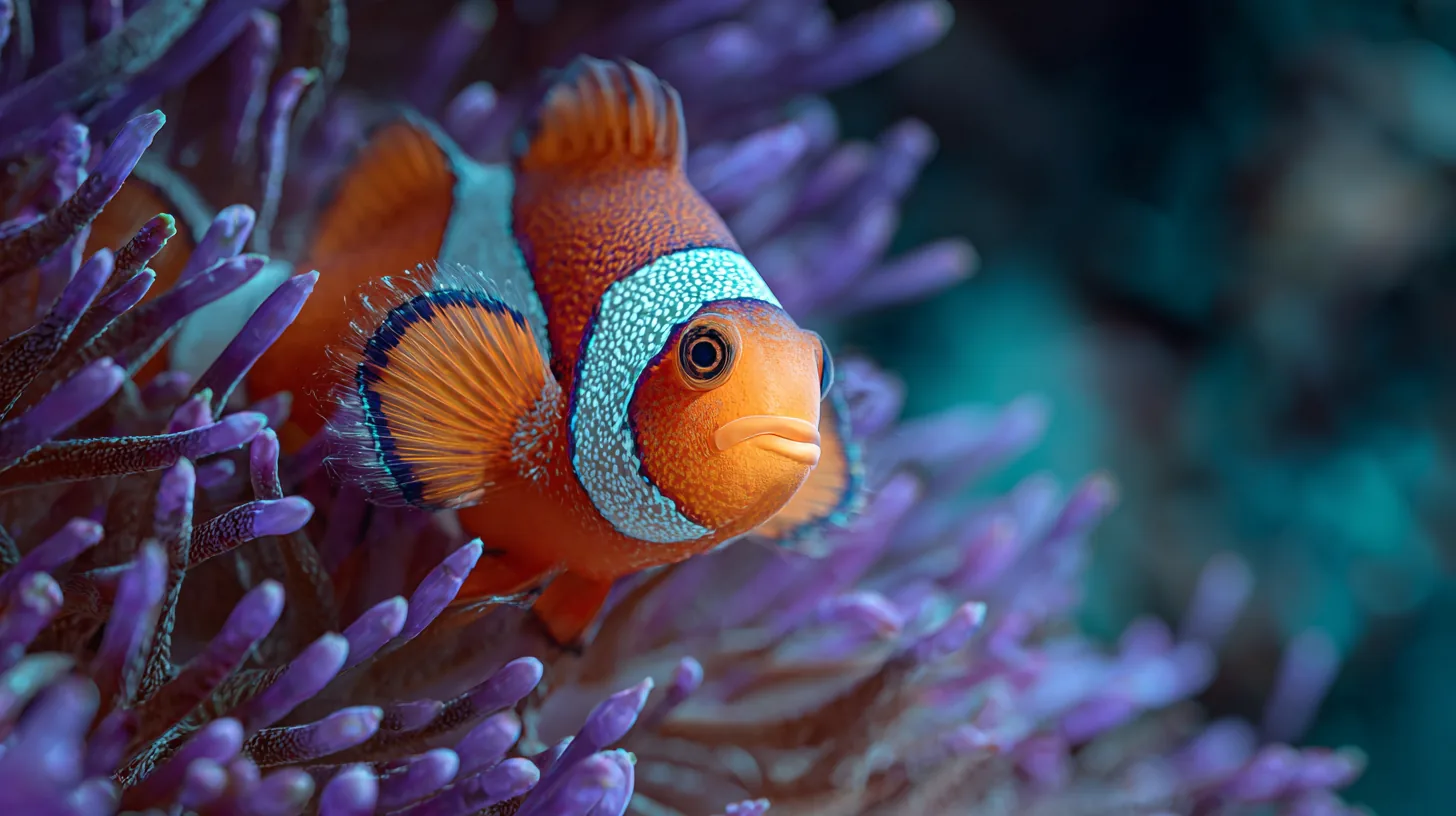
Clownfish (Amphiprion ocellaris) is widely held to be the best first fish: hardy, easy to feed and adapts well to the aquarium. Gobies (Gobiidae) are excellent — peaceful, reef-safe and keep to themselves. Royal gramma (Gramma loreto), cardinalfish (such as Banggai cardinalfish, Pterapogon kauderni, and pajama cardinalfish, Sphaeramia nematoptera) and many peaceful wrasses are likewise good early choices.
At the start it is wise to avoid species that demand special conditions or specialised feeding. Mandarin (Synchiropus splendidus) and leopard wrasses (Macropharyngodon) are beautiful but require a mature tank and abundant live food — they are covered in the next section. Tangs, large angelfish and all notoriously aggressive or shy species are also left for later, once experience has accumulated.
8. Mature tank, feeding and quarantine
Some fish thrive only in a mature tank, because they depend on the tank’s natural food. Mandarin and many wrasses graze constantly in the wild on micro-organisms — copepods and amphipods — and often do not learn to take prepared food right away. For them the tank must be allowed to mature long enough (typically half a year or more), so that live food is continuously available, preferably supported by a refugium. Producing the animals’ natural food belongs to the same picture as choosing the cleanup crew.
A varied diet is the foundation of a healthy fish community: frozen food, dry food and live food in rotation cover the species’ different needs. A fish’s ability to adapt to prepared food is worth checking before purchase — in the store you can ask to see the fish eat.
Quarantine deserves a mention already at the selection stage. New fish should be kept in a separate quarantine tank before being moved to the display tank, because marine diseases — especially ich and velvet — spread quickly and are hard to eradicate once they have reached a reef tank, where chemical treatments cannot be used. Quarantine is its own broad topic, but it is good to be aware of its principle already when planning the fish community.
9. Practical checklist
Planning a fish community comes down to a few decisions made before the first purchase:
- Plan the whole community in advance on paper — don’t buy fish one at a time on impulse.
- Check each species’ minimum volume and swimming-room requirement as a full-grown adult, not as a juvenile.
- Size the community by bioload, not by headcount; add a little at a time and watch the system.
- Keep only one individual per species/genus (or a deliberate pair/shoal); avoid same-shaped and same-coloured species together.
- Add fish from most peaceful to most aggressive, a couple of weeks between additions.
- Check each species’ reef safety; treat the middle-ground species (dwarf angelfish, dottybacks) with caution.
- Start with hardy species; leave the demanding and aggressive ones for later.
- Make sure the tank is mature and stable, and that new fish go through quarantine.
A well-planned fish community is calm, healthy and stays that way for years. Most of the work is done before a single fish is in the tank.
More on this: Cycling process · Cleanup crew · The principle of stability
Lähdeluettelo
Harrastajakirjallisuus ja -lähteet
- Marine Collectors (2024). Acanthurus Tangs — Keeping Powder Browns, Powder Blues, Achilles & Goldrims. Quarantine, diet and aggression-management protocol.
- Marshall, T., Manta Systems (2024). Fairy Wrasses (Cirrhilabrus) — Complete Care Guide. Species selection by collection depth and temperament.
- Marshall, T. Mandarin Fish Survival Guide — Feeding, Tank Setup, and Pro Tips for Success. Importance of a mature tank and copepod population.
- Fauna Marin. Biotope Aquariums: How to Get Started (video transcript). Mixed reef first, then targeted species selection.
- AlgaeBarn. 5 Tips for Increasing Aquarium Fish Compatibility. https://www.algaebarn.com/blog/other/5-tips-for-increasing-aquarium-fish-compatibility/
- Bulk Reef Supply. Species Compatibility Checker. https://www.bulkreefsupply.com/content/post/species-compatibility
- Bulk Reef Supply. CAUTION! 10 popular animals that may not be reef safe. https://www.bulkreefsupply.com/content/post/md-2014-09-reef-safe-or-not-reef-safe
- Top Shelf Aquatics. Dwarf Angelfish Reef Safety by Species. https://topshelfaquatics.com/blogs/news/dwarf-angelfish-reef-safety-by-species
- Expert Aquarist. Fish Compatibility, Selection, Acclimation And Stocking Guide For A Marine Reef Tank. https://expertaquarist.com/reef-tank-stocking-guide
Verkkosivut
- Reef safe. Wikipedia. https://en.wikipedia.org/wiki/Reef_safe
- AquariumStoreDepot. Saltwater Fish for Beginners: 10 Hardy Species (and 3 to Avoid). https://aquariumstoredepot.com/blogs/news/saltwater-fish-for-beginners
- RateMyFishTank.com. What Are Good Saltwater Fish For Beginners. https://www.ratemyfishtank.com/blog/what-are-good-saltwater-fish-for-beginners