Anemones and clownfish — symbiosis and care
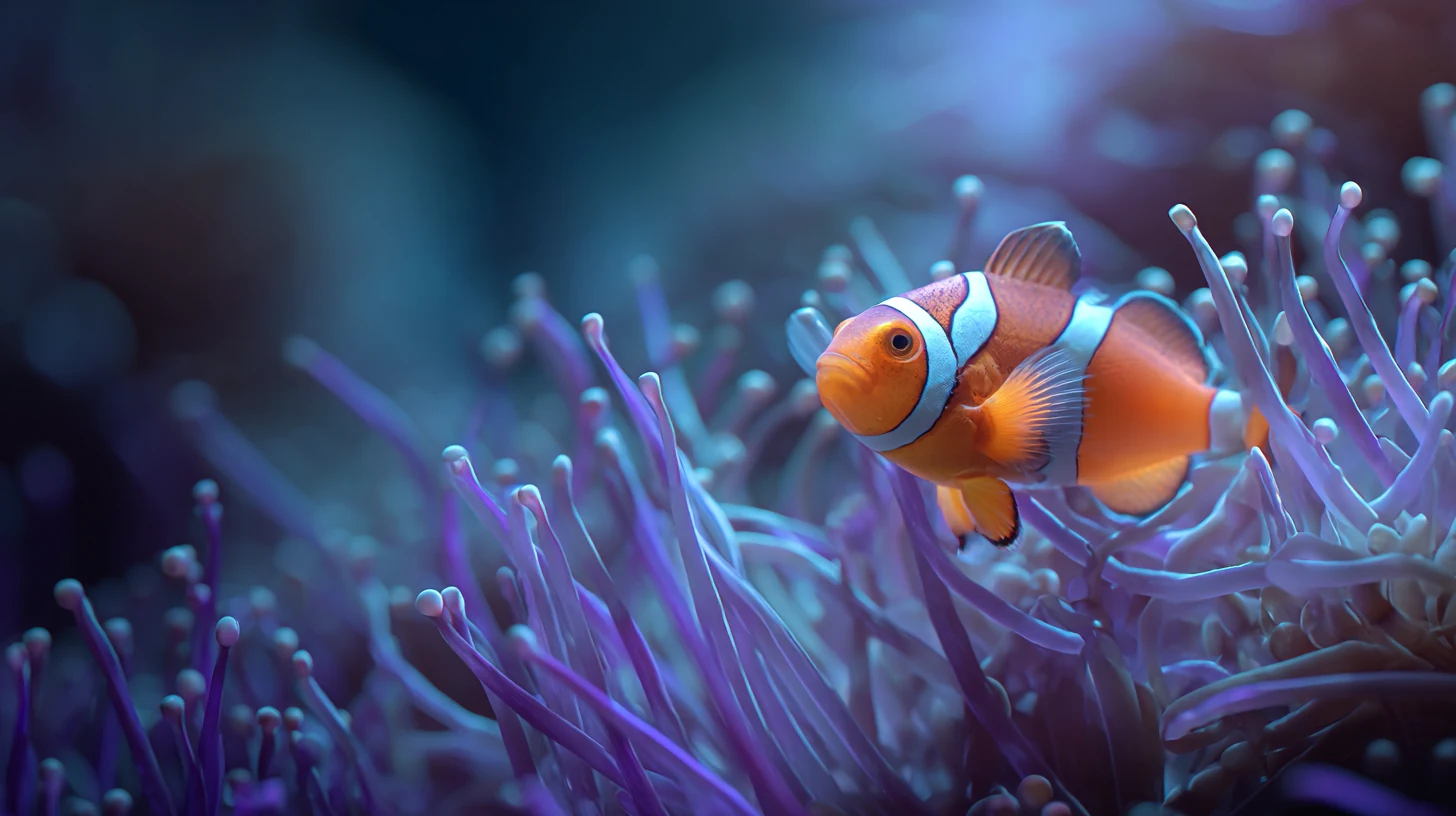
A clownfish nestled in an anemone is the image that got many of us into the hobby in the first place. That is exactly why it also leads to the classic beginner mistake: the anemone is bought too early, for a tank that isn’t stable yet.
Clownfish and anemones are the aquarium world’s most famous couple. The pairing is so iconic that many assume it must also be easy — buy the fish, buy the anemone, and nature handles the rest. The reality is more complicated. The clownfish is one of the hardiest and most beginner-friendly reef fish, but an anemone is a predatory invertebrate that demands a stable, mature tank, strong light and properly tuned flow. On top of that, the fish does not always agree to host the anemone the way it does in the photos.
This article explains why the symbiosis works, what each partner actually gets out of it, how the clownfish avoids the anemone’s stinging cells, and what keeping an anemone — in practice almost always a bubble tip — really requires.
The symbiosis is genuine mutual benefit
The relationship between clownfish and anemone is mutualism: both partners benefit. This is more than “the fish gets shelter,” which is the most common oversimplification. The relationship runs in both directions and is surprisingly elaborate.
The clownfish gets a home and protection from the anemone. The anemone’s tentacles are full of stinging cells that most predatory fish won’t go near. The clownfish lives among those tentacles as if in a fortress: it sleeps there, spawns nearby and retreats into the tentacles the instant a threat appears. The anemone also provides a stable territory, which matters for an animal that is a fairly clumsy swimmer and wouldn’t survive in open water.
But the benefit flows the other way too, and this is often forgotten. The anemone gains several concrete advantages from the clownfish. The fish chases off anemone-eating animals such as certain butterflyfish. It moves constantly among the tentacles, improving water exchange and oxygen supply at the tissue surface — effectively ventilating its host. It also drops food scraps to the anemone and, perhaps most importantly, its nitrogen-rich waste acts as fertiliser: research shows that a hosted anemone increases its tissue protein and the density of its symbiotic algae (zooxanthellae), meaning it gains more energy. An anemone with a clownfish can therefore grow faster and better than a solitary one.
Why doesn’t the clownfish get stung?
The question everyone asks first: why doesn’t the anemone sting the clownfish, when it stings almost everything else?
The anemone’s tentacles carry nematocysts — microscopic harpoon-like stinging cells that fire on contact and inject venom into prey or an attacker. Firing isn’t purely mechanical, it’s also chemical: the tentacles “recognise” the contact from the chemistry of the surface, including certain N-acetylated sugars that bind receptors on the stinging cells and trigger the strike.
The clownfish’s protection rests on its mucus coat. Clownfish skin, gills and gut carry mucus that is 3–4 times thicker than on other fish of similar size. The prevailing explanation is that this mucus acts as chemical camouflage: its composition resembles the anemone’s own mucus so closely that the anemone doesn’t recognise the fish as “foreign” and therefore doesn’t fire its stinging cells. The fish, in effect, dresses in its host’s uniform.
Crucially, the protection isn’t innate but learned. When a clownfish first gets to know a new anemone, it touches the tentacles gently and repeatedly, a little at a time, over many hours or days. This acclimation is bidirectional: the immunological profile of the fish’s mucus shifts to mimic the anemone, while the anemone reduces the firing of its stinging cells toward the fish. Both partners learn.
A note of honesty here: the mechanism still isn’t fully understood. Studies in 2024 showed that the old simple explanation — that clownfish mucus simply lacks the sugars that trigger the stinging cells — is too straightforward, and the real biochemistry is more complex. The foundation of the symbiosis is real, but its precise molecular basis remains a subject of research.
Natural host pairings — and why they don’t apply in the aquarium
The clownfish–anemone symbiosis is obligate: in the wild, a clownfish doesn’t live without a host anemone. About 28 clownfish species form a symbiosis with only ten anemone species, belonging to five genera (Entacmaea, Heteractis, Stichodactyla, Macrodactyla, Cryptodendrum). So not every clownfish hosts every anemone — in nature the pairings are fairly specific.
The natural hosts of the most common aquarium species, in broad strokes:
- Ocellaris clownfish (Amphiprion ocellaris) — in the wild Heteractis magnifica, Stichodactyla gigantea, S. mertensii.
- Percula clownfish (Amphiprion percula) — the same hosts as ocellaris.
- Clarkii clownfish (Amphiprion clarkii) — the widest range, hosting nearly all ten species, including the bubble tip.
- Tomato/Red clownfish (Amphiprion frenatus) — its natural host is specifically the bubble tip (Entacmaea quadricolor).
- Maroon clownfish (Premnas biaculeatus) — also the bubble tip.
An important caveat: this list describes nature, not the aquarium. In practice, almost every anemone kept in the hobby is a bubble tip, because it is the only species that can be recommended to a beginner. And although the bubble tip is not the natural host of ocellaris or percula, they very often accept it in the aquarium — sometimes even more eagerly than their “real” wild host. The symbiosis is therefore more flexible under captive conditions than the strict species list would suggest.
The bubble tip — the only sensible beginner anemone
In practice, “keeping an anemone” means keeping a bubble tip anemone (Entacmaea quadricolor, BTA for short). The other host anemones sold in the hobby — especially Heteractis magnifica and the various carpet anemones (Stichodactyla) — are clearly more demanding, more sensitive to shipping and less adaptable to a home tank. The bubble tip is the exception: it is the hardiest, most adaptable host species and the one best suited even to a smaller tank.
The bubble tip takes its name from the bubble-like swelling at the tips of its tentacles. The bubbling isn’t constant and isn’t fully understood: the same individual can be bubble-tipped at times and smooth-tentacled at others. Light, flow, feeding and whether a clownfish is hosting all play a part — no single cause is known. So the loss of the bubbles does not automatically mean the anemone is doing badly.
Colour morphs range from brown and green all the way to bright red. The red morph, the rose bubble tip (RBTA), is the hobby’s most popular and most expensive. The colour comes from tissue pigments and symbiotic algae; under strong light the colour usually deepens.
In the aquarium, bubble tips typically reproduce by fission: an individual tears in two and forms two genetically identical anemones. This is a healthy, normal event, and in a healthy tank a single anemone can produce a small group over the years. Fission is covered in more detail below.
The aquarium reality: the clownfish doesn’t always host
One of the most common disappointments: the clownfish is bought, the anemone is bought, and the fish won’t go anywhere near it. This is entirely normal, and the reason is usually simple.
Almost all clownfish sold today are tank-bred, not wild. A captive-bred individual has never seen an anemone, and hosting isn’t an automatic, innate reflex in the sense that it would instantly recognise the right anemone. Many tank-bred clownfish learn to host only over time — or never learn at all.
In addition, a tank-bred clownfish may “host” anything resembling an anemone: a torch coral, a bubble coral, even a flow pump or a heater. This is harmless to the fish, but can be dangerous if the target is a stinging LPS coral or a mechanical pump.
What can you do about it? Less than many hope. You can’t force it. The approach that works best is patience: a healthy, thriving bubble tip in a fixed spot, stable conditions and time. Sometimes it helps to place the anemone in a lit, flowing spot where the fish already spends time. The “force it to host” tricks circulating online (showing it a picture, confining the fish near the anemone) are mostly ineffective and stress the animals for nothing. If the fish doesn’t host, the tank can still be perfectly healthy — hosting is a bonus, not a measure of health.
Anemone care: light, flow and a mature tank
The three pillars of keeping an anemone are tank maturity, light and flow. If any one of them is off, the anemone wanders, shrinks or dies.
A mature tank above all. A bubble tip does not belong in a new tank. The recommendation is that the tank has been running for at least 6 months with stable parameters before an anemone is added. A fresh tank swings too much chemically: nutrient levels, pH and alkalinity fluctuate, and biological filtration isn’t yet mature. An anemone is a predatory invertebrate that reacts to instability more sensitively than many corals. Most “the anemone wandered into a pump and died” stories begin with adding it too early. Stability is the foundation of everything here — more on this: Stability and The cycling process.
Light. A bubble tip gets most of its energy from symbiotic algae, which need strong light. A typical recommended PAR range is around 150–250, with more demanding sources citing 220–350. The single most important mistake is too much light too fast: a new anemone must be acclimated to light gradually over two to three weeks, starting at a lower intensity and increasing little by little. Too sudden a jump to strong light causes bleaching — the anemone expels its algae, pales and loses its energy source. More on this: Lighting.
Flow. An anemone needs moderate, indirect flow. The tentacles should sway gently, not whip violently. Too much direct flow tears the tissue; too little hampers the exchange of food scraps and waste. Don’t place an anemone directly in front of a flow pump. More on this: Water flow.
Temperature and water chemistry. Aim for a steady temperature of about 24–26 °C and normal reef-tank parameters: salinity 35 ppt, pH 8–8.4 and alkalinity 7.5–8.5 dKH. An anemone doesn’t require special chemistry, but it does require stability.
Feeding
Although a bubble tip gets most of its energy from light and algae, it benefits from direct feeding — a fed anemone grows faster, colours up better and splits more often. Offer meaty food such as frozen mysis or small pieces of silverside, shrimp or mussel, roughly 1–4 times a week.
Keep the piece size moderate — about the size of the anemone’s mouth or smaller. Too large a piece may come back out undigested and burden the tank for nothing. Avoid overfeeding: an anemone doesn’t need a daily meal, and excess feeding raises nutrient levels. If a hosting clownfish is present, it often “feeds” the anemone by bringing it pieces — this is part of the symbiosis, but doesn’t replace controlled feeding.
Common problems and how to avoid them
Wandering and pumps. Of all the host anemones, the bubble tip moves the most. It searches out a spot it likes in terms of light and flow, and if the conditions don’t please it, it sets off. The single biggest danger is that a wandering anemone drifts into a flow pump or return pump and is shredded — this kills the anemone and can poison the whole tank. Protect all pump intakes with foam guards or screens before adding the anemone. Wandering decreases once light, flow and tank maturity are in order.
Fission (splitting). When an anemone grows, or experiences mild stress — a water change, a cleaning, a parameter swing — it may split in two. A sign of an impending split is the mouth stretching into an elongated shape. Splitting is usually a healthy event and requires no action; both halves normally recover within a few days. Repeated splitting, however, can indicate ongoing stress — if that happens, check the conditions.
Stinging neighbours. An anemone stings any coral it touches. Because it can move, leave plenty of space around it and don’t place valuable corals in its immediate vicinity. The stinging cells can also harm fish that end up in the tentacles — a healthy clownfish knows to avoid this, a sick or weak fish doesn’t always.
Paling and bleaching. If an anemone begins to pale, turn translucent or shrink, you’re usually looking at bleaching or the start of a collapse. The most common causes are too sudden light, unstable chemistry or too fresh a tank. With a paling anemone, return to basics: lower the light temporarily, ensure stable parameters and continue moderate feeding. A badly shrunken anemone with a gaping mouth that is losing tissue is in an emergency — it’s worth isolating, so that a possible death doesn’t poison the tank.
For whom, and when
The realistic beginner’s path is clear. The clownfish is an excellent first fish: hardy, adaptable and, when tank-bred, easy to find. It can be added as soon as the cycling process is complete, typically around the 6–8 week mark. The anemone, by contrast, belongs in the tank only later — once the tank is at least 6 months old, its parameters are stable, light and flow are under control and the pumps are protected.
A clownfish doesn’t need an anemone to be healthy and happy; it lives perfectly well in the aquarium without one. The anemone is therefore an addition, not a necessity. Acquired at the right time and in the right conditions, the reward is the hobby’s most classic sight — a clownfish venturing home into the shelter of the tentacles.
More on this: Fish selection and compatibility.
Sources
Peer-reviewed research
- Roux, N. et al. (2024). N-acetylated sugars in clownfish and damselfish skin mucus as messengers involved in chemical recognition by anemone host. Scientific Reports, 14. https://www.nature.com/articles/s41598-024-84495-w
- Emanuel, E. et al. (2024). Eluding anemone nematocysts: are clownfish deprived of N-acetylated sugars in their skin mucus? bioRxiv (preprint). https://www.biorxiv.org/content/10.1101/2024.05.11.591997
- Pratte, Z.A. et al. (2021). Microbiomes of clownfish and their symbiotic host anemone converge before their first physical contact. Microbiome, 9, 109. https://doi.org/10.1186/s40168-021-01058-1
- Fautin, D.G. & Allen, G.R. (1992). Anemonefishes and Their Host Sea Anemones. Western Australian Museum.
Hobby sources
- Top Shelf Aquatics: Bubble Tip Anemone Care Guide — Feeding, Lighting, and More. https://topshelfaquatics.com/blogs/news/bubble-tip-anemone-care-guide
- AquariumStoreDepot: Bubble Tip Anemone Care Guide — How to Have Real Success With BTAs. https://aquariumstoredepot.com/blogs/news/bubble-tip-anemone-care
- Melev’s Reef: Photo-documentary of a Bubble Tip Anemone splitting. https://melevsreef.com/articles/photo-documentary-bubble-tip-anemone-splitting
- Tropical Fish Hobbyist: Host Anemones and Clownfishes — Three Symbiotic Pairs. https://www.tfhmagazine.com/articles/saltwater/host-anemones-and-clownfishes-three-symbiotic-pairs