Lighting in practice — LED fixture selection, placement and photoperiod
Lighting in practice — LED fixture selection, placement and photoperiod
A PAR measurement tells you what the coral receives. This article is about how to get that number right — and keep it there. Fixture selection, placement, optics, acclimation and photoperiod are all variables that can be adjusted. The biological depth — how corals use light at the cellular level — is covered in the research article. The fundamentals of PAR measurement are covered in the PAR article.
1. The two fundamental problems with LED lighting
Modern LED is the most common lighting technology in the hobby — and for good reason. It is dimmable, energy-efficient, long-lasting, and can be connected to a controller. But LED brings with it two problems that older technologies did not have to the same degree.
Point-source light and coverage problems
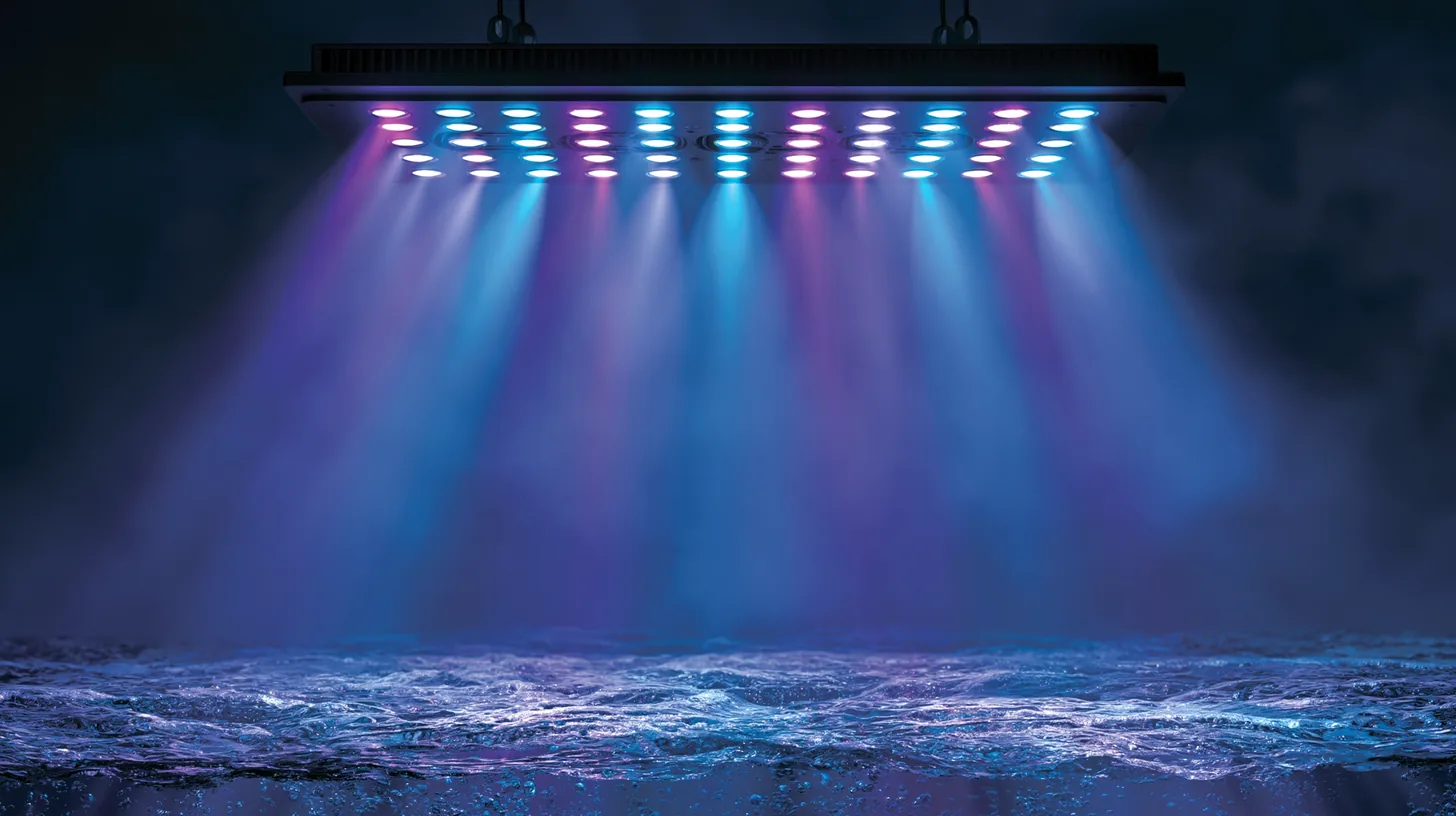
An LED fixture is a point source of light. Unlike T5 tubes or a metal halide lamp with a reflector, an LED fixture creates an intense beam whose PAR value drops off sharply as you move toward the edges. A single fixture rarely covers the entire tank footprint evenly — lighting undersized relative to tank dimensions creates hot spots in the centre and light deficiency at the edges.
SPS Academy XII (Aslett 2024) states directly: PAR hot spots are typically observed at 15 cm depth beneath modern LED pendants, and while diffusers and wide-angle lenses smooth the gradient, they do not eliminate it. This is a structural characteristic of LED technology, not a defect.
Spectral skew
The second problem is spectrum. LED manufacturers build their fixtures to be blue-dominant, because blue light looks dramatic on social media and has become the visual signature of the marine aquarium. This is a marketing decision, not a biological one. Tulio (Reef Brite) and Luca (Quanta/Atlas LED) — both lighting technology experts — stated unanimously on the Real Reef Talk panel (2025): “I don’t know any serious SPS grower who runs pure blue.” Pure 450 nm blue overloads the chlorophyll absorption peak. Full spectrum — violet, cyan, green, white, some red — serves coral biology better.
2. Optics — what a lens does to light
The optics of an LED fixture determine how radiation is distributed across the tank. Not all lens solutions are equal.
Collimating optics — the problem
Early LED fixtures used collimating secondary lenses that concentrated radiation into a narrow beam to achieve maximum PAR at a point. This caused corals to bleach directly beneath the light while leaving edges in shadow. The problem was not the LED itself but the optics — point-loading at 450 nm wavelength overloaded chlorophyll (Luca, Real Reef Talk 2025).
Reflectors and radial lenses — the current solution
Better fixture manufacturers have moved to reflector-based or radial lens solutions that spread light more evenly over a wider area. Tulio (Reef Brite) noted that reflectors in LEDs were contrary to industry consensus just two decades ago — and proved to be the right approach.
A practical rule of thumb: a good LED fixture should not need to be raised two feet higher to prevent burning. If the manufacturer’s instructions advise mounting the fixture very far away to avoid stress, the optics are likely wrong — not that the fixture is too powerful.
Beam angle and coverage
The fixture’s beam angle determines how widely PAR is distributed at a given height. Typical coverage circle diameter at a given height:
| Angle | Height above water | Coverage circle (Ø) |
|---|---|---|
| 55° | 30 cm | ~30 cm |
| 55° | 40 cm | ~40 cm |
| 90° | 30 cm | ~60 cm |
| 120° | 30 cm | ~100 cm |
A narrow angle (55°) means deeper penetration and a higher PAR peak directly below, but weaker edge coverage. A wide angle (120°) gives a more even distribution but a lower PAR value at any given point. In most tanks, narrow-optic fixtures are used in greater numbers and placed closer together.
3. How many fixtures — sizing principles
A common mistake is buying a single powerful fixture for a large tank. Two or more fixtures placed closer together give a more even PAR distribution than one fixture far away.
Leonard’s Reef practice (Acropora Deep Dive): over a tank approximately 80 cm wide, two EcoTech Radion XR15 fixtures provide better coverage than one XR30, at the same cost. A good rule of thumb is one fixture per 30–40 cm of tank width, so that the coverage circles span the entire tank floor evenly.
Practical approach:
- Measure the tank floor footprint
- Determine target PAR for your coral selection (see PAR reference values in the PAR article)
- Set the number of fixtures so coverage circles overlap by approximately 20–30%
- Verify with an ITC PARwice — first at the surface level, then at mid-depth and at the bottom
A deep tank requires more fixtures or stronger optics than a shallow one. 45 cm water depth is a different challenge from 25 cm.
4. DLI — photoperiod and intensity in one number
PAR measures instantaneous intensity. DLI (Daily Light Integral) measures the total daily dose — how many moles of photons per square metre per day. It is the only way to compare different photoperiods with each other.
Formula:
DLI (mol m⁻² day⁻¹) = PAR (µmol m⁻² s⁻¹) × photoperiod (h) × 3600 / 1,000,000Example: 200 µmol m⁻² s⁻¹ × 9 h × 3600 / 1,000,000 = 6.5 mol m⁻² day⁻¹
The same DLI can be achieved in multiple ways:
| PAR (µmol m⁻² s⁻¹) | Photoperiod | DLI (mol m⁻² day⁻¹) |
|---|---|---|
| 100 | 12 h | 4.3 |
| 150 | 10 h | 5.4 |
| 200 | 9 h | 6.5 |
| 300 | 8 h | 8.6 |
| 400 | 8 h | 11.5 |
On natural reefs in shallow zones, DLI is 30–42 mol m⁻² day⁻¹ (Aslett 2024, Tonk et al. 2014). In an aquarium we do not aim for natural values — the adaptation of corals to a closed system makes this unnecessary and often harmful. Practical DLI targets:
| Coral type | DLI target (mol m⁻² day⁻¹) |
|---|---|
| Softies / shade LPS | 3–6 |
| Mixed reef LPS | 5–9 |
| SPS (Montipora, Stylophora) | 8–14 |
| Demanding SPS (Acropora) | 12–20 |
The ITC PARwice measures DLI directly — it calculates the daily dose automatically from photoperiod and intensity.
5. Photoperiod — high PAR requires a shorter day
High instantaneous PAR combined with a long photoperiod is the most common lighting mistake. A coral cannot use an unlimited amount of light — excess leads to photoinhibition and ultimately bleaching.
Rules of thumb:
- High PAR (> 250 µmol m⁻² s⁻¹): keep photoperiod 8–9 hours
- Moderate PAR (150–250 µmol m⁻² s⁻¹): 9–10 hours
- Low PAR (< 150 µmol m⁻² s⁻¹): 10–12 hours
A practical schedule structure for an LED controller:
Sunrise  (60–90 min): intensity rises 0% → 30–40%
Midday peak (8–9 h): full intensity on all channels
Sunset   (60–90 min): intensity falls 30–40% → 0%
Moonlight (optional): 1–3% green or white at night
The length of the morning ramp is not critical for corals — 15 minutes is biologically sufficient (Leonard’s Reef, 2024). A longer ramp is an aesthetic choice. More important is that the peak photoperiod remains shorter than one might expect.
6. Spectrum — why blue alone is not enough
In natural seawater at 15 metres depth, light is still broad-spectrum — red, green and all wavelengths are present, even though shorter wavelengths dominate. Mote Marine’s underwater spectral measurements demonstrate this directly (Tulio, Real Reef Talk 2025).
LED controller sliders say nothing about absolute PAR value or spectral balance. Percentages are the manufacturer’s internal numbers. The only way to know what the fixture actually produces is to measure.
Practical starting point for all LED channels:
Leonard’s Reef recommendation: run all channels at the same percentage (e.g. all at 60% or all at 40%) during the full-intensity phase. This gives a balanced broad spectrum. Blue can be slightly higher during sunrise and sunset as an aesthetic choice — but full spectrum during peak photoperiod.
Colour changes and spectrum:
Corals use pigments — fluorescent proteins — partly to protect themselves from excessive radiation. Colours develop under full spectrum and are most visible when exposed to blue light in the evening. This often leads to a false conclusion: “blue creates colour” — in reality, full spectrum during the day builds the pigments; blue light in the evening merely reveals them.
UV and violet:
True UV (below 380 nm) is not required for coral growth or health in an aquarium. Violet LEDs (385–420 nm) are useful for pigmentation in shallow-water corals but require measurement — without a meter there is no way to know whether the dose is appropriate or excessive. Use the ITC PARwice to check spectral analysis before using the UV/violet channel aggressively.
7. Acclimating a new coral to light
The need for acclimation is one of the most underestimated risks in the hobby. Two days under light that is too intense is enough to damage a coral that has been kept at a lower PAR level.
Why acclimation is necessary:
A coral regulates its zooxanthellae density and pigment according to light — this takes days to weeks depending on the species. Acropora millepora adapts slowly (more than 20 days), Pachyseris speciosa more quickly (3–5 days) (DiPerna et al. 2018). Too rapid a transition to a high PAR level leads to photoinhibition before the coral has time to adjust its defences.
Practical acclimation protocol for a new coral:
- Place the new coral in the lowest, least-illuminated spot in the tank — typically at the edge or on the bottom
- Leave it there for at least 1–2 weeks, monitoring polyp extension daily
- Move the coral gradually upward or closer to the light source every 2–4 weeks
- Bleaching or tissue recession = too much light, too fast — move it back down
- Polyps closing for a week alone does not mean death — give it time
Signs of successful acclimation:
- Active polyp extension during the day
- Colour holds or begins to brighten
- Growth at the base (SPS) or tentacle extension (LPS)
8. Installing a new fixture — PAR matching
Changing a fixture is one of the riskiest operations in an established tank. Even if the new fixture has “the same wattage”, its spectrum and PAR distribution can differ significantly from the old one.
Protocol:
- Measure the old fixture’s PAR at three points: surface centre, mid-depth, and bottom
- Install the new fixture and adjust intensity to match the old readings — do not trust percentage figures
- Run the new fixture at the old PAR values for 2–4 weeks
- If the corals’ response is positive, increase intensity by 5–10% at a time every two weeks toward the target PAR
- Use acclimation mode (ramp mode) in the controller if available
Important note: LEDs degrade over time — even with quality fixtures, light output drops significantly over the years. The same % setting produces lower PAR after three years than when new. Measure at least once a year and compensate by increasing intensity.
9. ITC PARwice — a practical tool
A PAR meter is an essential tool in this hobby — not an optional accessory. The eye cannot distinguish between 100 µmol and 400 µmol, nor can it see spectral skew.
The ITC PARwice (ITC Reefculture, UK) is currently the most practical choice for hobbyists, because it measures both PAR (PPFD µmol m⁻² s⁻¹) and spectrum, DLI, Kelvin, and peak wavelength with a single device. Spectral analysis reveals directly whether the fixture is skewed blue-dominant or producing a balanced broad distribution.
Important practical limitation: The ITC PARwice does not work with iOS devices (iPhone, iPad) — Apple does not allow USB OTG connections. The device requires an Android phone, a Windows PC, or a Mac. This is worth checking before purchasing.
The device is available from several European aquarium retailers. In Finland it is stocked by, among others, Korallifarmi and Akvaariokeidas.
Summary — three decisions before buying
Choosing a lighting solution comes down to three questions:
What corals are you keeping? Shallow-water SPS species need high PAR and a broad spectrum. For deeper-collected LPS species a lower intensity is sufficient. This determines the number of fixtures and the optics.
How large and how deep is the tank? A deep tank (> 40 cm water depth) needs more fixtures or stronger optics than a shallow one. More than one fixture is needed for a large tank.
Is the spectrum balanced? Buy an ITC PARwice before the corals, or immediately after. Measure. Adjust. Do not trust your eyes.
References
Peer-reviewed studies
- DiPerna, S., Hoogenboom, M., Noonan, S. & Fabricius, K. (2018). Effects of variability in daily light integrals on the photophysiology of the corals Pachyseris speciosa and Acropora millepora. PLOS ONE, 13(9): e0203882.
- Tonk, L., Sampayo, E. M., Weeks, S., Magno-Canto, M. & Hoegh-Guldberg, O. (2013). Host-specific interactions with environmental factors shape the distribution of Symbiodinium across the Great Barrier Reef. PLoS ONE, 8(8): e68533.
- MacKellar, M., McGowan, H. & Phinn, S. (2011). Spatial heterogeneity of air-sea energy fluxes over a coral reef — Heron Reef, Australia. Journal of Applied Meteorology and Climatology, 51(7), 1353–1370.
Hobby literature and brand documentation
- Aslett, C. G. (2024). Teach a Person to Fish… SPS Academy Part XII. reefranch.co.uk.
- Real Reef Talk (2025). Lighting panel: Halides, LEDs, UV & Full Spectrum. Tulio (Reef Brite) × Luca (Quanta). 24-hour stream transcript.
- Leonard’s Reef (2024). Acropora Care Deep Dive. Podcast/interview transcript.
- ITC Reefculture (2024). PARwise — product documentation. par-wise.com.
Books and textbooks
- Delbeek, J. C. & Sprung, J. (2005). The Reef Aquarium: Science, Art, and Technology. Two Little Fishes, Miami Gardens.
- Riddle, D. (2004). Too Much Light! Advanced Aquarist, July 2004.
- Joshi, S. (2005). Feature Article: Underwater Light Field and its Comparison to Metal Halide Lighting. Advanced Aquarist, August 2005.