
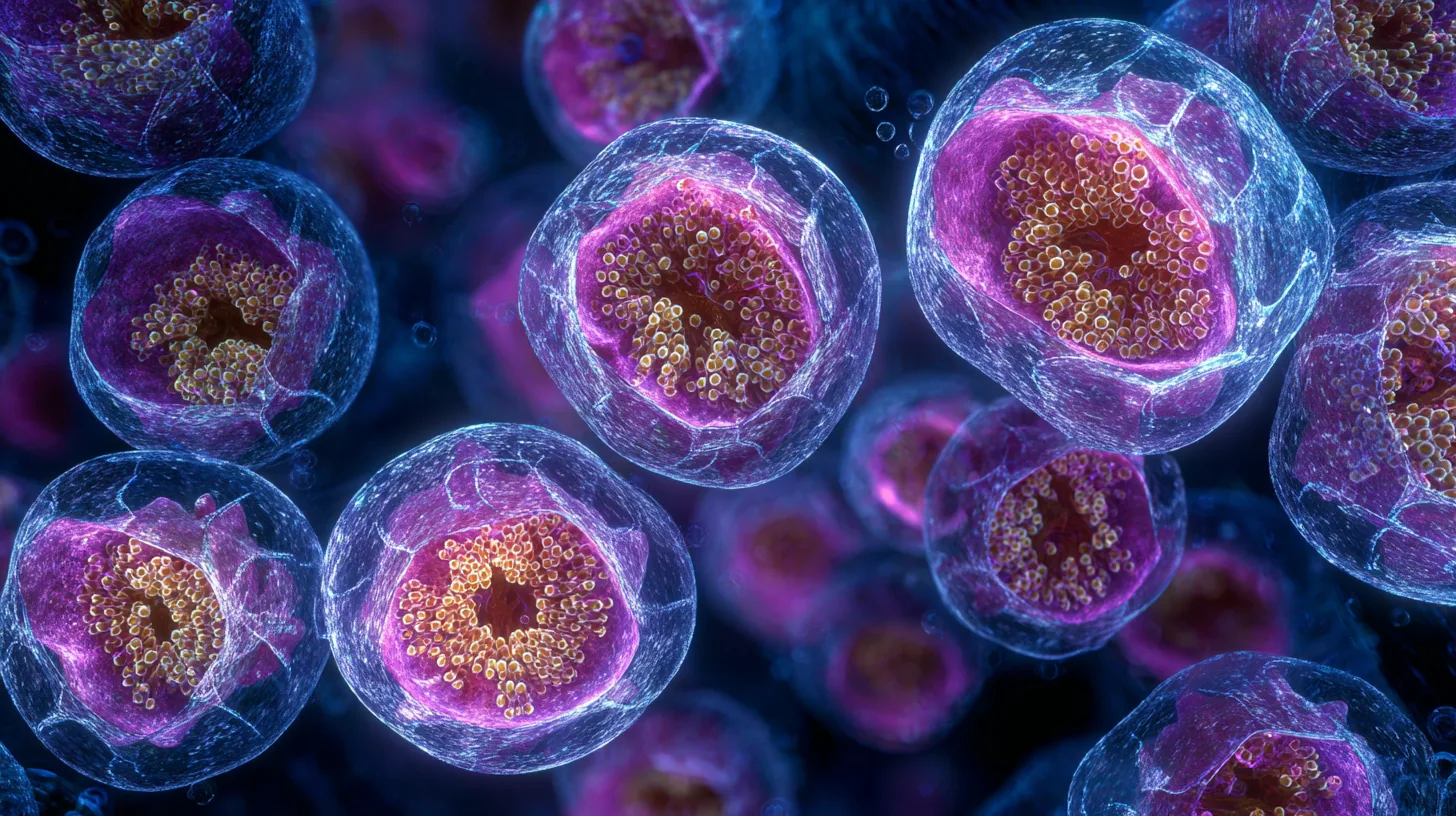
Zooxanthellae and the coral symbiosis
The corals in a reef aquarium are not merely animals. Each stony coral is, strictly speaking, a holobiont — a whole made up of the host animal, the photosynthetic algae living in its cells, and bacteria, archaea, fungi and viruses, all functioning as a single superorganism. The energetic foundation of this whole is the symbiosis between the host and its algae — the zooxanthellae. Once you understand what happens inside a coral’s cells, you also understand why light, stability and nutrients decide everything in the aquarium.
This article dives deep: what zooxanthellae are, how they are classified, how the symbiosis produces energy and builds a calcium skeleton, why corals bleach — and how this biology translates into practical husbandry. The topic is broad and at times technical, but every part comes back to the same question: how do I keep the symbiosis healthy?
The holobiont — symbiosis as the foundation of life
Stony corals (order Scleractinia) appeared about 250 million years ago, around the time of the first terrestrial dinosaurs, but they evolved into their present form only once their dinoflagellate symbionts became established roughly 160 million years ago. This is no coincidence. The symbiosis enabled corals to thrive precisely in those clear, nutrient-poor tropical waters — the “blue desert” — where free food is scarce. The algae produce energy from light, which the host uses to build its calcium shell and grow.
It is important, though, to see the bigger picture. The algae are only one — albeit the most visible — part of the coral’s microbial community. Within the same holobiont live an enormous number of bacteria, archaea, fungi, endolithic algae and viruses, all of which take part in nutrient cycling and defence. The microbes of the coral’s mucus layer act as its first line of defence, much like the gut microbiome of an animal. Researchers have even defined coral bleaching as a holobiont dysbiosis — a disturbance of the entire microbial community’s balance, not merely a loss of algae (Boilard et al. 2020). This broader view explains why diversity and stability are vital to a coral: a rich community withstands disturbance, an impoverished one falls ill.
In the aquarium this means you are effectively keeping several organisms at once: an animal with its own needs, the plant-like alga inside it with quite different needs, and a microbial community that binds the two together. A thriving coral requires that the conditions for all of them are met simultaneously.
More on this topic: The aquarium microbiome and Dinoflagellates — deep dive.
What zooxanthellae are
“Zooxanthellae” is a general term for many brown, photosynthetic dinoflagellates that live within animal cells. The symbionts of corals belong to the family Symbiodiniaceae. They measure 6–12 micrometres and live in the cells of the host’s endoderm, in so-called symbiocytes, inside a membrane structure called the symbiosome. The host’s tissue is divided into two layers, the outer ectoderm and the inner endoderm, separated by a gelatinous intermediate layer, the mesoglea. It is in the endoderm that the algae reside, close to the mitochondria-rich calicoblast cells responsible for calcification.
The cell biology of the alga is peculiar. They are so-called mesokaryotes, whose chromosomes remain permanently condensed in the nucleus. Within the symbiosome the alga appears as a round, immobile coccoid form, but the free-swimming cell has two flagella with which it seeks a host. The photosynthetic machinery is diverse: the light-harvesting pigments include chlorophylls a and c2, β-carotene, and a range of xanthophylls such as peridinin, diatoxanthin and dinoxanthin — peridinin gives many dinoflagellates their brown colour.
From this follows the most important starting point in any discussion of colour: all zooxanthellae are fundamentally brown. A coral’s brilliant colours do not come from the algae but from the host’s own pigments and fluorescent proteins. The algae also have their own UV protection, the mycosporine-like amino acids (MAAs) known as “sunscreens”, which protect especially against UVB radiation (wavelengths of about 310 nm and shorter). Some hosts produce these compounds themselves as well. Colour and pigments are revisited in their own section.
Acquisition of symbionts and the new classification
A coral acquires its symbionts in two ways. Some species pass the algae directly to their offspring via the parent colony, in the egg or larva (vertical transmission), while others acquire them from the environment in the larval or first-polyp stage through the mouth (horizontal acquisition). A strain acquired from the environment can adapt better to local conditions — this is of great significance for a coral’s adaptability.
For a long time all of these algae were considered members of a single genus, Symbiodinium, and were divided into “clades” marked with letters (A, B, C, D…). In 2018 LaJeunesse and colleagues thoroughly revised the systematics on the basis of molecular-genetic data: the former clades were raised to the genus level. The word Symbiodinium means “living together”, and it was now restricted to the former clade A only. Several genera are now recognised:
Symbiodinium (former clade A) contains members ranging from free-living to opportunistic parasites and endosymbionts, which tolerate variable light and secrete MAA protectants. Breviolum (“the small ones”, clade B) is common especially in the Caribbean as a symbiont of shallow coastal corals. Cladocopium (“plentiful”, clade C) is the most common in the whole family, distributed almost everywhere and highly faithful to its hosts; it tolerates varying light and temperature but is relatively heat-sensitive among the genera. Durusdinium (“tough”, clade D) contains the true extremophiles, such as Durusdinium trenchii, which withstands extremes of temperature, strong light and shade and renders its host bleaching-resistant. In addition, genera such as Effrenium (free-swimming, bloom-forming), Fugacium (“ephemeral”) and the ancient Gerakladium have been named. The family is enormously diverse — there may be several hundred species, though only a fraction has been formally named, and further reclassification is to be expected.
The most common partners of corals are Breviolum-, Cladocopium-, Durusdinium- and Symbiodinium-type algae; Fugacium and Gerakladium are rare. The differences between the genera are not mere taxonomy — they have a direct effect on a coral’s heat tolerance, growth rate and colour, as the following sections show.
More on this topic: LPS, SPS and soft corals in practice.
Nutrient exchange — the core of the symbiosis
The core of the symbiosis is reciprocal nutrient exchange. Put simply, the host supplies the alga with what photosynthesis needs — nitrogen (N), phosphorus (P) and carbon dioxide (CO₂), largely as the waste of its own metabolism. In return, the alga supplies the host with the products of photosynthesis: oxygen (O₂), glycerol, glucose, amino acids and lipids. This transfer of the alga’s products into host tissue is called translocation, and its foundational research traces back to Leonard Muscatine’s classic work: it is precisely the translocated carbon that makes corals’ success possible in nutrient-poor waters.
The scale of this exchange is astonishing. In good conditions zooxanthellae can cover more than 90 percent of the host’s energy requirements. In practice, then, the coral “eats light” by way of its symbionts. This does not eliminate the importance of heterotrophy, however: many corals supplement their diet by capturing plankton and taking up dissolved organic matter, which is especially important during stress, when photosynthesis is not enough. The symbiosis is thus the foundation of energy production, not its sole source.
The exchange is also a delicate balance. Recent research has shown that Symbiodiniaceae are the first site in a reef coral where inorganic nitrogen is assimilated — the symbionts are therefore not mere energy producers but a central part of the whole holobiont’s nitrogen metabolism (Rädecker et al.). The stability of the symbiosis depends precisely on the ratio and absolute availability of nutrients (Morris et al. 2019). When the nutrient balance is upset — for example, when there is too much nitrogen relative to phosphorus — the symbiont community can change in a way that weakens the coral. Excess nitrate can cause a harmful over-density of symbionts in SPS corals, and a coral’s thermal-stress response even depends on its nitrogen status (Béraud et al. 2013).
More on this topic: Phosphate — deep dive, Nitrate and Trace elements and nutrients.
Light-enhanced calcification
One of the most significant consequences of the symbiosis — and one of the most practical from the aquarist’s point of view — is so-called light-enhanced calcification. As early as the 1970s, Goreau and others showed that corals build their calcium skeleton far faster in light than in darkness — often at several times the rate. The phenomenon is driven precisely by the photosynthesis of the symbionts.
The mechanism is multifaceted. Photosynthesis produces oxygen and energy-rich carbon compounds, which translocate to the calcifying tissue and serve both as an energy source and as building material for the skeleton’s organic matrix. In addition, photosynthesis alters the chemical environment of the calcifying zone to favour the precipitation of aragonite. It has been shown experimentally that merely adding oxygen can raise dark calcification to the level measured in light — oxygen is thus a key factor. It has also been observed that even a coral’s nearly algae-free, bright tips grow rapidly, because they are fed by photosynthesis lower down the branch: the products move to the growing parts.
This explains why, in the aquarium, light is not merely an aesthetic factor or something “given to the algae”, but directly the engine of coral growth. Adequate, properly acclimatised lighting means faster skeletal formation — provided that the chemistry of calcification (alkalinity, calcium, magnesium) is also in order. The symbiosis and water chemistry thus work hand in hand.
More on this topic: Lighting — zooxanthellae, the Stokes shift and photoacclimation.
Light, photoacclimation and symbiont density
Because the symbiosis runs on photosynthesis, light is its most important regulator. A coral typically has on the order of a million symbiont cells per square centimetre, but this density is not fixed — the coral constantly adjusts it according to the light conditions. This is called photoacclimation.
In dim light a coral increases symbiont density and the pigment content of each cell to extract all it can from the scarce light. The result is visible to the eye: the coral browns, as the number of brown algae grows and masks the host’s own colours. In bright light, by contrast, the coral reduces the number of its symbionts and their pigment density and lets its own pigment and fluorescent proteins shine — and from this come the colours the aquarist seeks. A colourful coral is therefore not “empty” of algae, but an overly lush, brown coral often signals either too little light or too high a nutrient load.
Photoacclimation is, however, a slow process. The adjustment of symbiont density and pigments takes days or weeks, and a coral cannot keep up with sudden changes. For this very reason a change in light is always a change in how the symbiosis works, and raising light too quickly forces the symbionts into a situation they are not prepared for. From there it is a short step to bleaching.
More on this topic: Coral colour and pigments — deep dive.
Bleaching as a mechanism
Bleaching means the loss of symbionts or their pigments, whereby the coral’s translucent tissue reveals the white calcium skeleton beneath. It is not a disease as such but the breakdown of the symbiosis — and its mechanism is worth understanding precisely, for it is at the same time an example of how science sharpens with new knowledge.
The chain typically begins with photoinhibition. When the temperature rises too high, the alga’s photosynthetic machinery becomes overloaded: more light arrives than can be used safely. In Cladocopium-type symbionts the excess excitation energy passes from photosystem II to photosystem I and turns into heat, as photosynthetic electron transport and product exchange come to a halt (Slavov et al. 2016). The symbiont cells of a heat-stressed coral lose their attachment to the tissue, detach and degrade. The coral can also actively eliminate damaged symbionts: by digesting them within the cell, by expelling them from the cell or through the polyp’s mouth, or by triggering a programmed cell-death cascade (apoptosis or necrosis).
The classic explanation has been the oxidative theory of bleaching: photosynthesis stressed by heat and light produces reactive oxygen species (ROS), which accumulate in the tissue and damage the cellular machinery, triggering the expulsion of the symbionts. This theory is still widely taught, and the rise of ROS levels in stressed corals is well documented. More recent research has, however, challenged the simplicity of the theory: single-cell measurements (Nielsen et al. 2018) suggest that ROS do not necessarily accumulate in the symbionts in harmful quantities or leak from them into the host as expected. This does not negate ROS’s role as a marker of stress, but it shows that bleaching is a more complex event of several parallel pathways than a single tidy “oxidative cascade”. Such a debate is instructive for a deep dive: in biology a prevailing explanation can sharpen or change, and a critical reading is needed even in hobby literature.
The coral also has defence mechanisms that delay the collapse: the xanthophyll cycle, small heat-shock proteins (sHsp), changes in membrane lipid composition, and stress-stable enzyme complexes. Antioxidant enzymes such as superoxide dismutase (SOD) and catalase convert reactive oxygen species into more harmless forms. These mechanisms work up to a point — prolonged extremes of heat and light overwhelm all but the most resilient symbionts.
Changing symbionts and the cost of heat tolerance
Bleaching is not merely a catastrophe. According to the adaptive bleaching hypothesis, a coral constantly regulates the types and numbers of its symbionts to winnow the community to suit the prevailing conditions. The research literature distinguishes two mechanisms: shuffling means altering the proportions of the existing symbiont complement — increasing the share of the most suitable type — whereas switching means acquiring an entirely new symbiont type from the environment.
A practical example is Durusdinium. Many a bleached coral recovers dominated by Durusdinium trenchii, which raises the bleaching threshold by about 1–2 °C and makes the host more resilient to future heat spikes. This comes at a cost, however: a more heat-tolerant symbiosis can mean slower growth, because energy production and translocation are not as efficient as in a Cladocopium partnership. It is thus a trade-off between performance and stress tolerance — the same compromise seen on natural reefs as the climate warms. In the aquarium this is worth remembering: a coral that has recovered from bleaching may look healthy but grow more slowly or take on different colours than before, if its symbiont community has changed.
What this means in the aquarium
The biology of the symbiosis translates directly into practical husbandry principles.
Always acclimatise light gradually. Because symbiont density and pigments adjust slowly, you must proceed in steps with a new coral or a new light — for example, raising the intensity or photoperiod incrementally over weeks. Raising light too quickly drives the symbionts into photoinhibition and can trigger bleaching even if the temperature is fine. This is one of the most common reasons an otherwise healthy coral bleaches in the aquarium.
Stability protects the symbiosis. The symbiosis tolerates sudden changes poorly — in temperature, light or chemistry. Temperature spikes are especially dangerous, because they strike directly at the core mechanism of photosynthesis. A stable tank is the safest tank for the symbiosis.
Keep nutrients in balance, not at zero. The symbionts need nitrogen and phosphorus. Too-scarce nutrients can starve the symbiosis and bleach the coral by “starvation”, while an excessive and unbalanced nutrient load fertilises the algae, browns the coral and, in the case of SPS corals, can be directly harmful. The aim is a controlled, low but non-zero level — neither zero nor overload.
Support the chemistry of calcification. Because light enhances calcification, water chemistry easily becomes the bottleneck for growth. Adequate and stable alkalinity, calcium and magnesium ensure that the growth rate granted by photosynthesis is not held back by a lack of building material for the skeleton.
Read the coral’s colour correctly. Browning often signals either too little light or too high a nutrient level — not “health”. Rapid bleaching, on the other hand, is an emergency signal of the symbiosis breaking down, in which case you should immediately check temperature, light and stability. A change in colour is a window into what is happening inside the coral’s cells.
More on this topic: Cycling process in practice and Lighting in practice.
Summary
A coral is a holobiont whose life is built on the photosynthesis of zooxanthellae — but also on a broader microbial community. The algae of the family Symbiodiniaceae, now divided into several genera, live in the host’s cells, exchange nutrients and in good times cover more than 90 percent of the coral’s energy needs. The same photosynthesis enhances calcification and drives skeletal growth. Light regulates symbiont density and thereby the coral’s colour, and the breakdown of the symbiosis — bleaching — begins with photoinhibition; its precise mechanism is still being refined scientifically. Corals can even change their symbiont strain to withstand heat, but often at the cost of growth. In aquarium husbandry this means above all four things: acclimatise light gradually, keep conditions stable, manage nutrients in balance and support the chemistry of calcification. When the symbionts are well, so is the coral.
Lähdeluettelo
Vertaisarvioidut tutkimukset
- LaJeunesse, T. C. et al. (2018). Systematic Revision of Symbiodiniaceae Highlights the Antiquity and Diversity of Coral Endosymbionts. Current Biology, 28(16), 2570–2580. https://www.sciencedirect.com/science/article/pii/S0960982218309072
- Morris, L. A. et al. (2019). Nutrient Availability and Metabolism Affect the Stability of Coral–Symbiodiniaceae Symbioses. Trends in Microbiology, 27(8), 678–689. https://www.cell.com/trends/microbiology/fulltext/S0966-842X(19)30068-X
- Rädecker, N. et al. (2023). Symbiodiniaceae Are the First Site of Heterotrophic Nitrogen Assimilation in Reef-Building Corals. mBio. https://www.ncbi.nlm.nih.gov/pmc/articles/PMC9600528/
- Sproles, A. E. et al. (2020). Nutrient dynamics in coral symbiosis depend on both the relative and absolute abundance of Symbiodiniaceae species. Microbiome. https://www.ncbi.nlm.nih.gov/pmc/articles/PMC9639324/
- Fujise, L. et al. (2014). Moderate Thermal Stress Causes Active and Immediate Expulsion of Photosynthetically Damaged Zooxanthellae (Symbiodinium) from Corals. PLOS ONE, 9(12), e114321. https://www.ncbi.nlm.nih.gov/pmc/articles/PMC4262390/
- Boilard, A. et al. (2020). Defining Coral Bleaching as a Microbial Dysbiosis within the Coral Holobiont. Microorganisms, 8(11), 1682. https://www.mdpi.com/2076-2607/8/11/1682
- Cunning, R., Silverstein, R. N. & Baker, A. C. (2015). Investigating the causes and consequences of symbiont shuffling in a multi-partner reef coral symbiosis under environmental change. Proceedings of the Royal Society B, 282. https://www.ncbi.nlm.nih.gov/pmc/articles/PMC4590431/
- Jones, A. M. & Berkelmans, R. (2010). Potential Costs of Acclimatization to a Warmer Climate: Growth of a Reef Coral with Heat-Tolerant vs. Sensitive Symbiont Types. PLOS ONE, 5(5), e10437. https://www.ncbi.nlm.nih.gov/pmc/articles/PMC2862701/
- Goreau, T. F. & Goreau, N. I. (1971). Role of Symbiotic Algae (Zooxanthellae) in Coral Calcification. The Biological Bulletin, 141(2), 383–393. https://www.journals.uchicago.edu/doi/abs/10.2307/1540123
- Muscatine, L. & Cernichiari, E. (1969). Assimilation of Photosynthetic Products of Zooxanthellae by a Reef Coral. The Biological Bulletin, 137, 506–523. https://pubmed.ncbi.nlm.nih.gov/28368714/
- Light Enhanced Calcification in Hermatypic Corals: New Insights from Light Spectral Responses (2015). Frontiers in Marine Science. https://www.frontiersin.org/journals/marine-science/articles/10.3389/fmars.2015.00122/full
Katsaukset ja yleiskatsaukset
- What is the role of zooxanthellae during coral bleaching? Review of zooxanthellae and their response to environmental stress (2021). South African Journal of Science. https://scielo.org.za/scielo.php?script=sci_arttext&pid=S0038-23532021000400013
- Durusdinium — an overview of heat-tolerant symbionts. Wikipedia. https://en.wikipedia.org/wiki/Durusdinium
Harrastajakirjallisuus ja -lähteet
- Aslett, C. G. (2024). The Zooxanthellae of the Hermatypic Coral Holobiont (Holosystemics series). Reef Ranch. https://www.reefranch.co.uk/
- Aslett, C. G. (2023). Coral Nubbins: Reactive Oxygen Species (ROS) and the Refuted Oxidative Theory of Bleaching. Reef Ranch. https://www.reefranch.co.uk/