
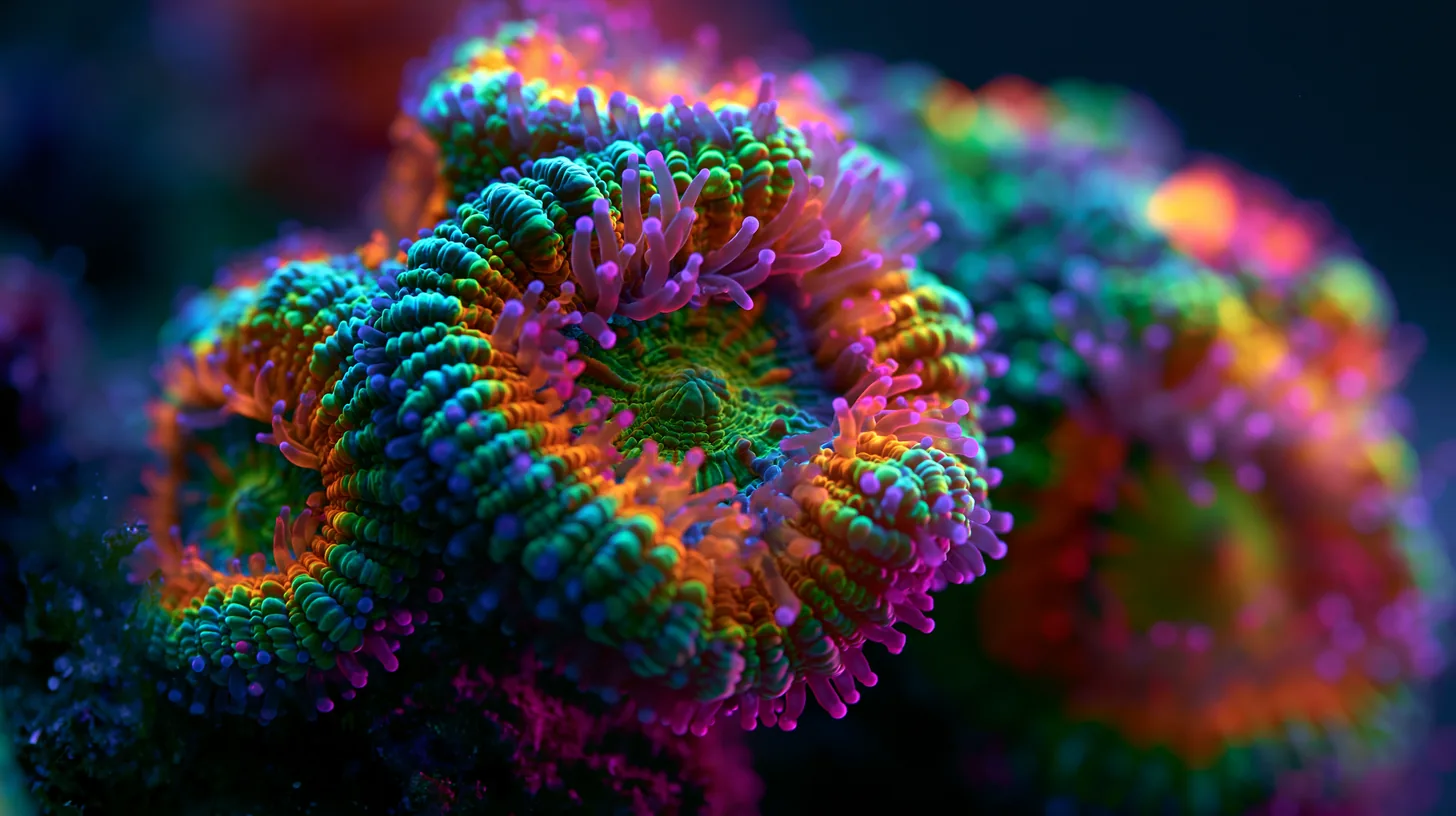
Coral Color and Pigments — from GFP proteins to zooxanthellae density
Coral colours are one of the visual highlights of reef keeping — but they are also a window into coral physiology. Colour is not a random aesthetic property: it is a biological signal that reflects light conditions, nutritional status, and stress levels. Understanding how colour is generated and why it changes provides a diagnostic tool that no test kit can replace.
Two sources of colour
A coral contains two independent colour systems that operate via different mechanisms and respond to different conditions.
Zooxanthellae — the endosymbiotic dinoflagellates (Symbiodiniaceae) living within coral tissue — are naturally golden-yellow to brown. They contain chlorophyll, carotenoids, and peridinin-chlorophyll-a-protein (PCP) light-harvesting complexes that absorb light for photosynthesis. When zooxanthellae density is high, their brown colour masks all other pigments. The more zooxanthellae a coral contains, the browner it appears — regardless of what other pigments are present in its tissue.
The coral’s own pigments form a second system. These are proteins of the GFP superfamily (green fluorescent protein) — produced by the coral host itself, not the symbionts. This family includes both fluorescent proteins (FPs) and non-fluorescent chromoproteins (CPs). They can produce blue, cyan, green, yellow, orange, red, or violet colours — entirely independently of zooxanthellae density.
These two systems operate in parallel. A coral can be full of zooxanthellae and still be bright blue if it produces abundant blue chromoproteins. It can appear green because it has few zooxanthellae and abundant green GFP — or because its zooxanthellae density is moderate but GFP expression outweighs the browning effect. Visual inspection alone cannot determine which system is responsible for a given colour at any given moment.
The GFP superfamily — protein structure and diversity
Green fluorescent protein was first discovered in the jellyfish Aequorea victoria in 1962. Cnidarians — the phylum that includes corals — have since evolved a broad array of GFP homologues, whose optical diversity far exceeds the original discovery.
All GFP superfamily members share the same structural foundation: a β-barrel enclosing a tripeptide chromophore that absorbs and (in fluorescent cases) emits light. While the structure is conserved, the chemical environment of the chromophore varies greatly — and this variation accounts for the full spectrum from blue to near-infrared.
Fluorescent proteins (FPs)
Fluorescent proteins absorb light and re-emit it at a longer wavelength — this is fluorescence. The main FP groups in corals are:
Cyan (CFP, ~480 nm emission) occur in many shallow-water species and contribute to light scattering within tissue.
Green (GFP, ~510 nm emission) are the most common group. They absorb blue light (~488 nm) and emit in the green. GFP expression is light-dependent: blue light induces production in shallow-water corals. Bollati et al. (2022, eLife) demonstrated that GFP-like proteins fine-tune the internal light microclimate of corals by modulating radiation transfer through tissue.
Red (RFP, ~580–620 nm emission) produce corals’ red, orange, and pink hues. A particularly significant subgroup, photoconvertible red fluorescent proteins (pcRFPs), are biologically remarkable: they are initially synthesised as green-emitting proteins, but UV light (~390 nm) irreversibly converts the chromophore into a red-emitting species. Converted pcRFPs absorb blue-green light and re-emit in the orange-red range — a wavelength conversion with critical importance in deeper reef environments.
Chromoproteins (CPs)
Chromoproteins are GFP homologues that absorb light but do not emit it significantly — they effectively “absorb” photons without fluorescence. This makes them efficient light attenuators. CPs produce coral’s violet, dark red, brown, and black hues. Most CPs absorb most strongly in the orange-yellow range (562–586 nm).
Biological functions: what do pigments do?
GFP superfamily proteins are not passive pigments. They are functional molecules with active biological roles. Research has identified three primary mechanisms that are not mutually exclusive.
1. Photoprotection on shallow reefs
On shallow reefs, corals are exposed to light excess — PAR values can exceed 3,900 µmol m⁻² s⁻¹ due to the wave-lensing effect (Wangpraseurt et al. 2014). Overloading damages zooxanthellae: superoxide and other reactive oxygen species (ROS) accumulate, and photoinhibition of chlorophyll begins.
CPs function here as a biological sunscreen. Located in the ectoderm — above the endodermal layer containing zooxanthellae — they can reduce chlorophyll excitation by up to 50% at their absorption maximum (562–586 nm) (Bollati et al. 2022). This is especially critical during bleaching: as zooxanthellae density falls, skeletal reflectance and tissue scattering amplify the internal light field — CPs upregulate to dampen this light amplification.
GFPs also scavenge reactive oxygen species directly — this antioxidant function is separate from the photoprotective role.
2. Wavelength conversion in deep environments
Mesophotic reefs (50–150 m depth) present a completely different light situation. UV and long wavelengths attenuate rapidly, leaving light that is almost entirely blue-green. Red light — which chlorophyll uses efficiently in deeper tissue layers — is effectively absent.
This is where pcRFPs provide a solution. Bollati et al. (2022) showed, using direct optical microsensor measurements, that converted pcRFPs can double the amount of red radiation (560–650 nm) available at 50–80 m depth — and beyond 80 m, pcRFP fluorescence is the dominant source of orange-red light in the tissue surrounding zooxanthellae. Orange-red light penetrates deeper tissue layers more effectively than blue-green, because symbiont pigments absorb it less strongly. The result: pcRFP-containing corals survive better in deep light environments than non-pigmented conspecifics.
3. Active support of growth zones and recovery
GFP-like proteins accumulate strongly in areas where zooxanthellae density is low: growing tips, branch terminations, areas recovering from mechanical damage. Bollati et al. (2020) proposed that this is a deliberate optical feedback loop: low symbiont concentration → increased light penetration through tissue → light induces GFP/CP production → pigments buffer the light climate → new symbiont populations can establish without photodamage risk.
How light drives colour intensity
GFP protein expression is a light-sensitive process triggered by blue light. D’Angelo et al. (2008) demonstrated that GFP-like proteins have light-induced transcriptional regulation: blue light activates protein production, darkness suppresses it.
The practical consequence: a coral moved into a higher-PAR environment will increase its GFP/CP levels over several weeks. This is a clearly observable phenomenon — the coral’s colour intensifies after the move, not because the coral is “recovering” but because it is producing more protective pigments in response to increased light pressure.
Conversely, a coral under low light produces fewer light-induced GFPs. A theoretically bright-blue species kept under dim light may appear darker — not as a sign of disease, but as an adapted response.
An important exception: deep-water pcRFPs are constitutively expressed — they do not respond to light levels in the same way. They are effectively “programmed” to remain high regardless of intensity, because in deep environments there is no overexposure risk that would justify downregulation.
How nutrients drive colour: zooxanthellae density as a dimmer
Nutrients control colour through an entirely different mechanism than light — they do not directly regulate GFP production, but instead modulate zooxanthellae density, which in turn masks or reveals the underlying pigments.
High nitrate and phosphate fertilise zooxanthellae. As symbiont numbers increase, their brown colour masks FPs and CPs. Corals brown out. This is not a sign of health — it signals that the symbiotic relationship has become skewed: the symbiont benefits from excess nutrients, while the coral gains no additional energy advantage from the expanded population.
Excessively low nutrients, conversely, lead to declining zooxanthellae populations. The coral first pales — less brown coverage over the underlying pigments. True bleaching follows, as symbionts are actively expelled. In extreme bleaching, a coral may appear white or bright pale-green (if GFP is abundant but no zooxanthellae brown remains).
In practice, vivid colours do not indicate nutrient deficiency — they may indicate that zooxanthellae density is optimal with no excess symbiont brown to obscure the pigments. Recommended nutrient levels where coral colour is often at its best: nitrate 2–10 ppm, phosphate 0.03–0.08 ppm.
Colour during bleaching — an optical feedback loop
During bleaching, colour dynamics shift dramatically. When zooxanthellae are expelled under heat stress, light overexposure, or other stressors, two things happen simultaneously:
- The brown symbiont layer disappears — underlying FPs and CPs are exposed.
- Without zooxanthellae, the tissue light environment brightens: skeletal reflectance and tissue scattering amplify light intensity within the tissue.
Bollati et al. (2022) showed that this increased internal light activates CP production via the blue-light induction pathway: the brightened tissue induces more chromoproteins. A bleaching coral may therefore paradoxically turn a brighter pink or violet during the stress response — this is the well-known “pink coral” phenomenon, not a recovery sign but a photoprotective feedback loop activated in crisis.
A bleached coral that is pale blue or pale green (not white) has typically retained its GFPs even as zooxanthellae were lost. A purely white coral has lost both. A coral maintaining colour from pigments alone can potentially recover — its regulatory system is still active. A fully white coral is dead or very close to it.
Practical applications for the aquarist
Colour as a diagnostic signal. Sudden browning points either to a nutrient spike-driven zooxanthellae expansion or a drop in light level. Colour intensification after a lighting upgrade is a normal photo-adaptation response. Bleaching is an emergency signal — check temperature, light, and nutrients before making corrective moves.
Blue light reveals, full spectrum builds. Fluorescent proteins are optimally activated at specific wavelengths — often blue or UV — and their fluorescence is most dramatic under blue light. This leads to a common misconception: “blue light makes the colours.” In reality, full spectrum during the main photoperiod builds the pigments (induces GFP), while blue light in the evening only reveals them as fluorescence. Run full spectrum during the peak photoperiod.
Vivid colour is not a sign of stress. Strong fluorescence — especially blue, green, or cyan — may indicate that the coral has produced abundant light-induced pigments in response to higher light levels. This is a normal biological adaptation, not disease. Maintain nutrient balance and lighting stability — colour does not need to be “enhanced” with special additives.
References
1. Peer-reviewed research
- Bollati, E. et al. (2022). Green fluorescent protein-like pigments optimise the internal light environment in symbiotic reef-building corals. eLife, 11, e73521. https://doi.org/10.7554/eLife.73521
- Bollati, E. et al. (2020). Functional colour: GFP-like proteins in the coral Acropora millepora during bleaching. Proceedings of the Royal Society B, 287, 20200626.
- D’Angelo, C. et al. (2008). Blue light regulation of host pigment in reef-building corals. Marine Ecology Progress Series, 364, 97–106.
- Salih, A. et al. (2000). Fluorescent pigments in corals are photoprotective. Nature, 408, 850–853. https://doi.org/10.1038/35048564
- Smith, E.G. et al. (2013). Screening by coral green fluorescent protein (GFP)-like chromoproteins supports a role in photoprotection of zooxanthellae. Coral Reefs, 32, 463–474. https://doi.org/10.1007/s00338-012-0994-9
- Smith, E.G. et al. (2017). Acclimatization of symbiotic corals to mesophotic light environments through wavelength transformation by fluorescent protein pigments. Proceedings of the Royal Society B, 284, 20170320. https://doi.org/10.1098/rspb.2017.0320
- Alieva, N.O. et al. (2008). Diversity and Evolution of Coral Fluorescent Proteins. PLOS ONE, 3(7), e2680. https://doi.org/10.1371/journal.pone.0002680
- Wangpraseurt, D. et al. (2014). In vivo microscale measurements of light and photosynthesis during coral bleaching. Journal of Experimental Biology, 217, 489–498.
- DiPerna, S. et al. (2018). Effects of variability in daily light integrals on the photophysiology of the corals Pachyseris speciosa and Acropora millepora. PLOS ONE, 13(9), e0203882.
2. Hobby literature
- Aslett, C.G. (2024). The Complete Reef Aquarist. Reef Ranch Publishing Ltd.
- Riddle, D. (2007). Coral Coloration: Proteins and Chromoproteins. Reefs.com.