Zooplankton and phytoplankton in the reef aquarium — biological basis and ecological significance
Introduction: the invisible foundation
There is a paradox in the natural reef that has puzzled researchers for decades. The water is clear — nitrate and phosphate concentrations are often close to zero. Yet the reef is one of the planet’s most productive ecosystems. How? The answer lies in the small: plankton, microbial communities and organic matter cycling through pathways invisible to the naked eye.
This article goes deeper than practical dosing. It covers what zooplankton and phytoplankton biologically are, how corals use them for nutrition, which fatty acids transfer through the food web, and why live plankton is more than just food — it is an ecosystem process that shapes the entire tank’s microbiome and chemistry.
Part 1: The natural reef’s plankton economy
The reef is an open system dependent on flow
On the natural reef, plankton is not primarily generated on-site — it is imported. Hamner and colleagues measured at one location on the Great Barrier Reef that every linear metre of reef crest receives approximately 400 grams of plankton biomass via current over 12 hours. This means over 400 kilograms per kilometre per day. Plankton is the foundation of the reef’s nitrogen and protein metabolism. Without this import there is no usable nitrogen, without nitrogen no protein synthesis, without protein synthesis no reef.
During the day, planktivorous fish eat nearly all available zooplankton before it can reach corals. But fish digest their food quickly — faeces begin to form within minutes of eating, and they are nutrient-rich. This faeces is eaten by other fish, and the process repeats two to three times. Finally nutrients reach the benthos — including corals — by an indirect route.
At night the situation changes dramatically. Planktivorous fish shelter. Demersal zooplankton — those that hide in reef crevices and cavities during the day — rise into the water column. Studies have measured up to a tenfold zooplankton density spike above the reef after sunset. This is the moment when corals extend their polyps and feed actively.
The closed aquarium circuit problem
In the aquarium, this current-delivered plankton biomass does not exist. Nothing comes from outside. What is in the system stays there — and is consumed. This creates a structural problem, for which the practice-level article provides the solution (regular seeding and daily phytoplankton dosing), but which only this article explains biologically.
Part 2: Phytoplankton — the invisible foundation
What phytoplankton is
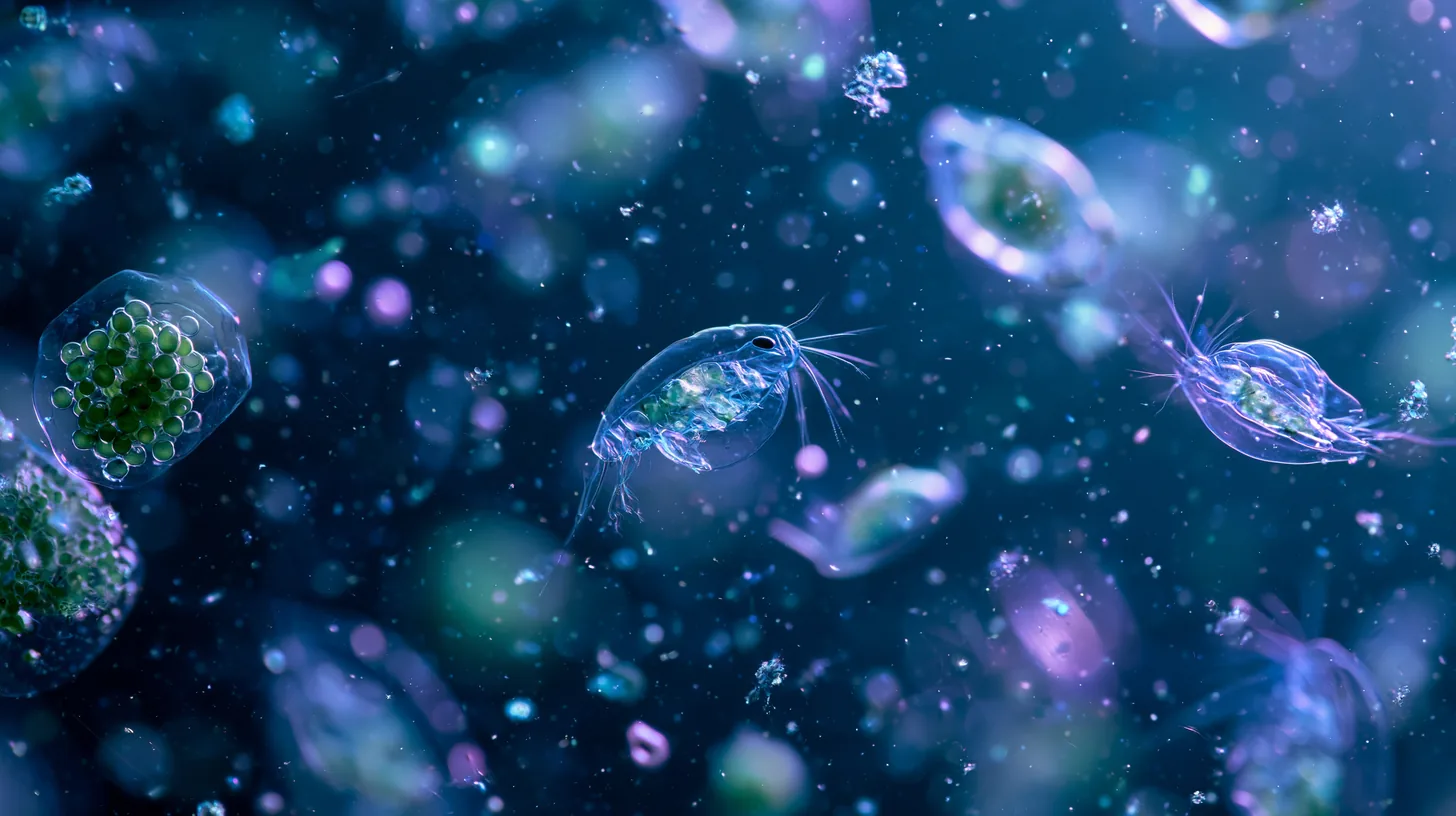
Phytoplankton are photosynthesising single-celled organisms that form the foundation of the food chain. They range from picoplankton (under 2 µm) to microplankton (20–200 µm) in size. Phytoplankton density in the tank’s water volume is typically low — oligotrophic conditions limit growth — but its importance is not directly proportional to density. Phytoplankton is an irreplaceable source of certain vitamins, particularly vitamin C, for organisms that cannot synthesise it themselves.
Four species relevant for aquarium use
Nannochloropsis sp. is 2–5 µm, spherical, non-motile. It is extremely resilient to culture and preservation, and it is rich in EPA fatty acid (eicosapentaenoic acid, 20:5 n-3). Nannochloropsis is well suited for general use and for feeding rotifer cultures. Drawback: its small size and spherical form make it less palatable to some copepod species compared to motile species.
Isochrysis sp. (T-Iso, technical isolate) is 5–6 µm, yellowish-brown, two flagella. It is particularly valuable as a DHA fatty acid source (docosahexaenoic acid, 22:6 n-3) — the most important omega-3 fatty acid in the marine environment, transferring efficiently up the food chain. Isochrysis is invaluable for copepod population reproduction because DHA is essential for nauplius larval development. It is also the key food source for filter-feeding corals such as Tridacna clams.
Tetraselmis sp. is larger, 10–14 µm, green, four flagella. It swims actively, which makes it palatable: movement stimulates feeding behaviour in copepods and other filter feeders. Tetraselmis is a good choice for activating and feeding copepod populations, though its fatty acid profile is less DHA-focused than Isochrysis.
Rhodomonas sp. is approximately 8–12 µm, reddish-brown, one flagellum. It contains a unique combination of phycoerythrin pigments and is extremely nutritious. It is favoured by many delicate filter feeders such as gorgonians and NPS corals that have specialised in small, pigment-rich particles.
Phytoplankton and the microbial community
Phytoplankton is not merely food — it is an ecosystem factor. Living phytoplankton cells excrete dissolved organic carbon (DOC) as a by-product of growth. This DOC feeds heterotrophic bacteria, which are the basis of the reef’s microbial loop. This creates the chain: phytoplankton → DOC → heterotrophic bacteria → protozoans → copepod nauplii → adult copepods → corals and fish.
In other words: when live phytoplankton is dosed, it is not just the visible animals being fed. It is the microbial loop being maintained — the one that sustains broader biological diversity and produces organic matter in forms biologically accessible to the entire food web.
Results from a Taiwanese longitudinal study across several coral species showed that all tested coral species fed on bacterioplankton — selectively. The most preferred bacterial genera were Pelagibacter (SAR11 clade), Prochlorococcus and Synechococcus — precisely those species most abundant in the natural reef’s clear, oligotrophic water.
Part 3: Copepod biology in depth
Taxonomic groups and their ecological roles
The subclass Copepoda contains an estimated 7,000–20,000 species. Three orders dominate both in natural reef biomass and in aquarium usefulness: Calanoida, Harpacticoida and Cyclopoida.
Calanoida are planktonic for their entire life cycle. They are primarily herbivores or omnivores. Calanoids are the most abundant copepod group by biomass in the natural ocean. They swim in a jerky, irregular motion, making them visually attractive prey for planktivores. They are difficult to cultivate in large aquarium populations, but are the most valuable food source for fish and corals that have specialised in planktonic prey in open water.
Harpacticoida are benthic as adults — living on rock surfaces, substrate and biofilm. In the larval stage (nauplius) they are planktonic. They are detritivores and microalgae eaters, extremely prolific, and establish in the aquarium more readily than calanoids or cyclopoids. Tisbe biminiensis is most common in aquarium use; it can reach densities of 28,000 nauplius and copepodite-stage individuals per litre per day under optimal conditions. Tigriopus californicus is larger (250–1,700 µm), making it more visible and more easily caught, but also more nutritious per unit weight.
Cyclopoida are omnivores feeding on bacteria, fine particulate organic matter, phytoplankton and even other microscopic animals. Apocyclops panamensis is common in aquarium use; it tolerates condition variability better than many other species. Oithona sp. is particularly small (60–220 µm) and is therefore best suited to the most delicate filter feeders.
Life cycle and its significance for seeding
All copepod species go through multiple developmental stages: the nauplius stage (typically 6 stages) and copepodite stage (typically 5 stages) before adulthood. Nauplii are smaller, slower and less visible than adults. This is important for practical seeding: a nauplius-dominant seeding is more effective than an adult-dominant one, because nauplii are better able to hide before being detected by fish or corals.
Copepod fatty acid profile and its transfer through the food web
Copepods’ nutritional value is based primarily on their fatty acid profile. The lipid fraction of marine copepods is dominated by PUFAs — polyunsaturated fatty acids.
EPA (20:5 n-3, eicosapentaenoic acid) — produced primarily in Symbiodiniaceae zooxanthellae. It is essential for coral tissue integrity and the immune system.
DHA (22:6 n-3, docosahexaenoic acid) — the highest-profile fatty acid in marine zooplankton. Essential for nerve cell membrane formation and fish reproduction. Isochrysis sp. is its primary phytoplankton source. DHA transfers efficiently through the food chain: Isochrysis → copepod → fish or coral.
ALA (18:3 n-3, alpha-linolenic acid) — plant-derived omega-3 that animals cannot synthesise themselves. Zooxanthellae produce it, and it is one of the few fatty acids found in abundance in Acropora corals (Dana Riddle / Advanced Aquarist).
There is an important mechanism in fatty acid transfer: a copepod does not simply pass phytoplankton fatty acids directly forward. It metabolises and modifies them in its own metabolism — particularly elongating shorter fatty acids into longer PUFAs via enzymes. This makes a well-fed copepod more nutritious than phytoplankton alone.
Part 4: Heterotrophy — the coral’s second energy source
Autotrophy vs. heterotrophy — not a binary choice
Hobbyist literature often treats the coral as primarily a photosynthetic organism. This is partly correct but leads astray. Zooxanthellae produce organic compounds through photosynthesis and transfer them to their hosts, but this autotrophic production covers only part of a coral’s energy needs — and varies significantly with species, depth, light level and temperature.
Heterotrophic nutrient intake is essential for most corals. The meta-analysis by Houlbrèque and Ferrier-Pagès (2009) showed that fed corals grow up to twice as fast as starved ones. This is biological fact, not hobbyist myth.
What corals actually eat — species specificity
The Taiwanese study tested several coral species under controlled conditions with different plankton fractions. The results were clear:
- Phytoplankton: some species fed selectively, some did not respond at all
- Zooplankton (copepods and rotifers): primarily species with larger mouths
- Bacterioplankton: all tested species, selectively
The selectivity for bacteria was interesting — corals clearly preferred Pelagibacter (SAR11), Prochlorococcus and Synechococcus genera. Corals have evolutionarily adapted to eat precisely the bacteria that have been available throughout their millions of years of evolution.
This observation is practically significant: it explains in part why a well-maintained aquarium — with a healthy microbial community and sufficient biological diversity — produces corals that grow and look better than an aquarium where the water is “clean” but biologically impoverished.
Night-time feeding and aquarium practices
In the natural reef, corals are primarily nocturnal feeders. Polyps expand at dusk and stay open all night. The rise of plankton at night (diel vertical migration, DVM) means food is most available precisely then. In the aquarium this rhythm has been preserved — coral polyp expansion in the evening is a direct biological signal.
Practical implication: phytoplankton dosing in the evening, copepod seeding at night with pumps off, and coral feeding after the evening lights go out — all based on this biological rhythm.
Part 5: The microbial loop and DOC cycling
Organic carbon in motion
Reef organic carbon cycling is not a linear process — it is a loop. Corals excrete mucus containing dissolved organic carbon. Heterotrophic bacteria consume this DOC. Viruses infect bacteria and disrupt them, releasing more DOC. Protozoans eat bacteria. Copepod nauplii eat protozoans. Adult copepods eat phytoplankton and protozoans. Corals eat copepods. The cycle begins again.
Estimates suggest up to 60 % of marine ecosystem energy flows through this microbial loop. This is the answer to the reef paradox: in nutrient-poor water lives an extremely productive ecosystem, because organic carbon is recycled efficiently rather than leaving the system.
In the aquarium this loop is smaller in scale but the same in principle. When live phytoplankton that excretes DOC during growth is dosed, the entire cycle is being supported — not just the visible animals.
The Carbon Continuum principle
Wingerter (AlgaeBarn, Carbon Continuum) describes this elegantly: DOC → heterotrophic bacteria → protozoans → copepod nauplii → adult copepods → coral and fish nutrition. Each level adds nutritional value and transforms carbon into a form more accessible to the next level. In the aquarium this chain cannot be purchased ready-made from a single bottle — it only builds by keeping live microfauna continuously present.
Part 6: The refugium’s role from a plankton perspective
A refugium is not just a nitrate removal device
A common misconception is that a refugium is primarily a macroalgae cultivation box for nitrate and phosphate removal. This is only one of its functions, and in many systems not even the most important one.
Biologically, a refugium is a protected breeding area for zooplankton, particularly copepods. Copepods cannot be maintained as a permanent population in the main tank where planktivorous fish are present — predation pressure is too great. In the refugium, through which water flows but from which fish are absent, the copepod population can reproduce and sustain itself. Individuals naturally transfer to the main tank with water flow, continuously supplementing the food supply.
Macroalgae growth (such as Chaetomorpha or Caulerpa sp.) in the refugium serves a specific purpose in this context: it provides mechanical protection for copepod eggs and nauplii. The filaments are not as easily penetrated as open water volume. This significantly raises the population’s carrying capacity.
Part 7: Phytoplankton and nutrient management — balancing act
When phytoplankton can be a problem
Phytoplankton is not always beneficial in all situations. Overdosing can lead to a bacterial bloom (cloudy water), cyanobacteria growth or rising nitrate and phosphate (dying phytoplankton decomposes through bacterial metabolism).
A living phytoplankton cell is active in photosynthesis — it assimilates inorganic nitrogen and phosphorus for growth, slightly reducing the water column’s inorganic nutrients. A dead or dying phytoplankton cell is the opposite: it is an organic matter source that when decomposing raises nutrient concentrations. This is why dead or old phytoplankton is actively harmful and its quality must be checked before every dosing.
The optimal situation is a steady, low daily dose of live phytoplankton in a multi-species mix — not large single doses infrequently.
UV steriliser and phytoplankton — an antagonistic relationship
A UV steriliser kills living cells through irradiation as soon as they pass through the unit. If UV is continuously on, practically all dosed phytoplankton cells die before reaching the food web. The result is an addition of dead organic matter — the opposite of what was intended.
Solutions: switch off UV for 4–6 hours after dosing, or dose through a UV bypass pipe if the system allows it.
Part 8: Zooplankton diversity and planktivorous fish
Beyond copepods, the natural reef’s zooplankton includes a considerable number of other organism groups that corals and planktivorous fish use for nutrition. This diversity is ecologically important — it means multi-species zooplankton has better ecological interactions than a single-species monoculture.
Planktivorous fish such as Pseudanthias sp. (dispar anthias, evansi anthias) have specialised in feeding on zooplankton from open water. In the aquarium this means planktivorous fish create continuous predation pressure on the zooplankton population. Top-up seeding is not optional — it is mandatory for population maintenance. At the same time these fish act as a biological bridge: they transfer zooplankton’s fatty acids and proteins to a larger size class, from which they are released again as faeces — back into the food web.
Summary: why all this matters
Zooplankton and phytoplankton are not an accessory for the reef aquarium. They are an ingredient of the ecological process. Without continuous plankton:
- The copepod population dwindles → planktivorous fish quietly starve
- The microbial loop is impoverished → DOC cycling slows → coral nutrient intake narrows
- Fatty acid flows break → coral tissue integrity weakens long-term
- Biological diversity falls → the system becomes more susceptible to dysbiosis and disease
This does not appear immediately. The tank does not collapse in a week without plankton. But over months and years the difference is visible: corals that have never been fed biologically grow more slowly, lose colour and are more susceptible to stress. A tank with live and diverse microfauna is more resilient — not because it looks better, but because it functions biologically more like the natural reef.
Sources
1. Peer-reviewed studies
- Houlbrèque, F. & Ferrier-Pagès, C. (2009). Heterotrophy in tropical scleractinian corals. Biological Reviews, 84(1), 1–17. doi:10.1017/S1464793108004665
- Leal, M.C. et al. (2014). Coral aquaculture: past, present, and future challenges and perspectives. Reviews in Aquaculture, 6(1), 1–18.
- Turner, J.T. (2004). The importance of small planktonic copepods and their roles in pelagic marine food webs. Zoological Studies, 43(2), 255–266.
- Hays, G.C. (2004). A review of the adaptive significance and ecosystem consequences of zooplankton diel vertical migrations. Hydrobiologia, 503, 163–170.
- Treignier, C. et al. (2008). Effect of light and feeding on the fatty acid and sterol composition of zooxanthellae and host tissue. Limnology and Oceanography, 53(6), 2702–2710.
- Falkowski, P.G. et al. (1993). Population control in symbiotic corals. BioScience, 43(9), 606–611.
2. Hobbyist literature and brand documentation
- Riddle, D. (2015). Coral Nutrition, Part Five: Fatty Acids. Advanced Aquarist Online.
- Shimek, R.L. (2003). Zooplankton in the Reef Aquarium, Part 1. CORAL Magazine / Advanced Aquarist.
- Wingerter, K. (2021). Mesozooplankton and Multivorous Food Webs. AlgaeBarn blog. algaebarn.com.
- Wingerter, K. (2021). The Major Copepod Groups. AlgaeBarn blog. algaebarn.com.
- Wingerter, K. (2021). The Carbon Continuum — Heterotrophic Bacterioplankton and Reef Food Webs. AlgaeBarn.
- Aslett, C.G. (2024). Teach a Person to Fish… SPS Academy Part IV. reefranch.co.uk.
- Hamner, W.M. et al. (1988). Zooplankton, planktivorous fish, and water currents on a windward reef face. Bulletin of Marine Science, 42(3), 459–479.
3. Books and textbooks
- Ruppert, E.E., Fox, R.S. & Barnes, R.D. (2004). Invertebrate Zoology: A Functional Evolutionary Approach (7th ed.). Brooks/Cole.
- Lalli, C.M. & Parsons, T.R. (1997). Biological Oceanography: An Introduction (2nd ed.). Butterworth-Heinemann.
- Borneman, E.H. (2001). Aquarium Corals: Selection, Husbandry, and Natural History. TFH Publications / Microcosm.
- Falkowski, P.G. & Raven, J.A. (2007). Aquatic Photosynthesis (2nd ed.). Princeton University Press.